Anatomy & Physiology
My Course
Learn
Exam Prep
AI Tutor
Study Guides
Textbook Solutions
Flashcards
Explore
My Course
Learn
Exam Prep
AI Tutor
Study Guides
Textbook Solutions
Flashcards
Explore
Back
Passive vs. Active Transport definitions
You can tap to flip the card.
Passive Transport
You can tap to
flip the card.
👆
Passive Transport
Movement of molecules from high to low concentration without energy use.
Track progress
Control buttons has been changed to "navigation" mode.
1/10
Related flashcards
Related practice
Recommended videos
Guided course
05:05
Passive vs. Active Transport
Bruce Bryan
16772
views
228
rank
Guided course
03:41
Classes of Membrane Transport Proteins
Bruce Bryan
13635
views
175
rank
Terms in this set (10)
Hide definitions
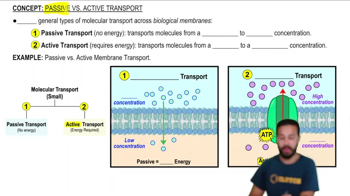
Passive Transport
Movement of molecules from high to low concentration without energy use.
Active Transport
Movement of molecules from low to high concentration requiring energy.
ATP
High-energy molecule used by cells to power active transport.
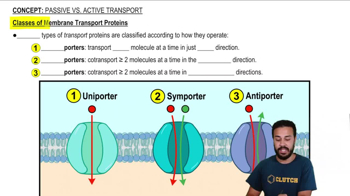
Uniporter
Transport protein moving a single molecule in one direction across a membrane.
Symporter
Transport protein moving two or more molecules in the same direction across a membrane.
Antiporter
Transport protein moving two or more molecules in opposite directions across a membrane.
Biological Membrane
Barrier that separates the interior of cells from the external environment.
Concentration Gradient
Difference in the concentration of a substance across a space.
Molecule
Smallest unit of a chemical compound that can take part in a chemical reaction.
Transport Protein
Protein that assists in moving substances across a cell membrane.