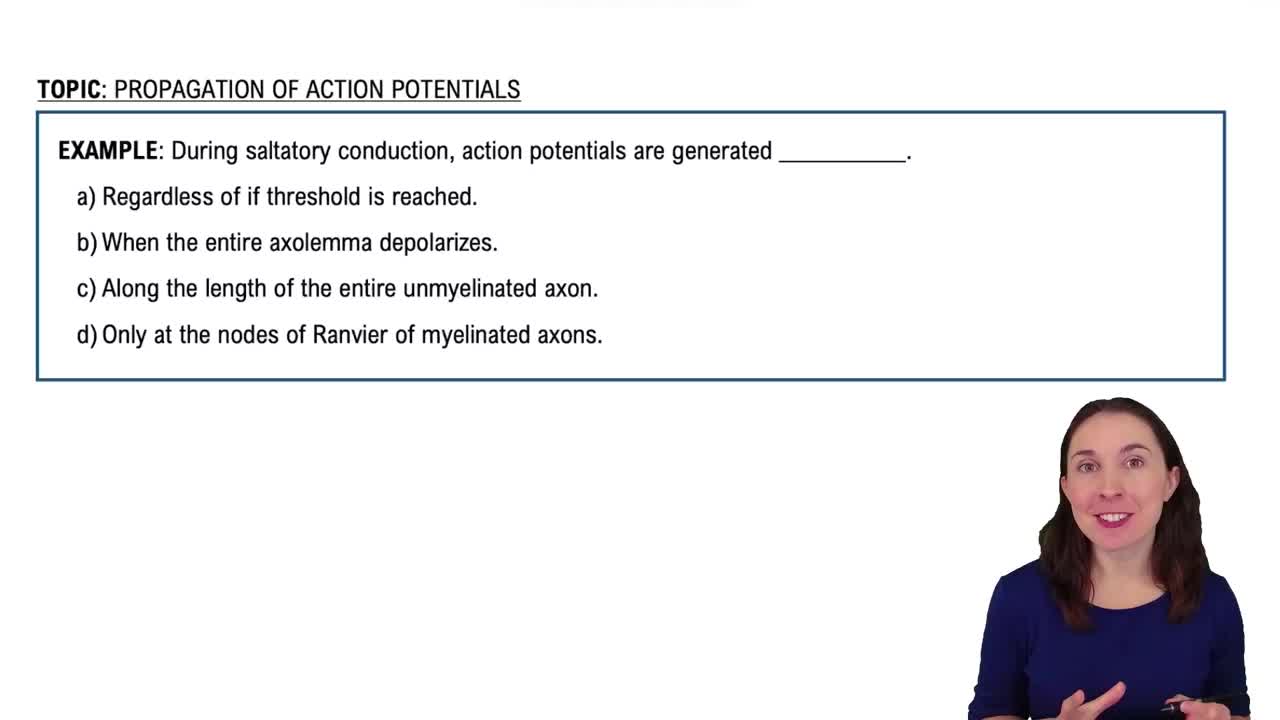
Which type of neuron conducts impulses faster: myelinated or unmyelinated axons?
Myelinated axons conduct impulses faster due to saltatory conduction, where the action potential leaps from node to node, while unmyelinated axons use slower continuous conduction.
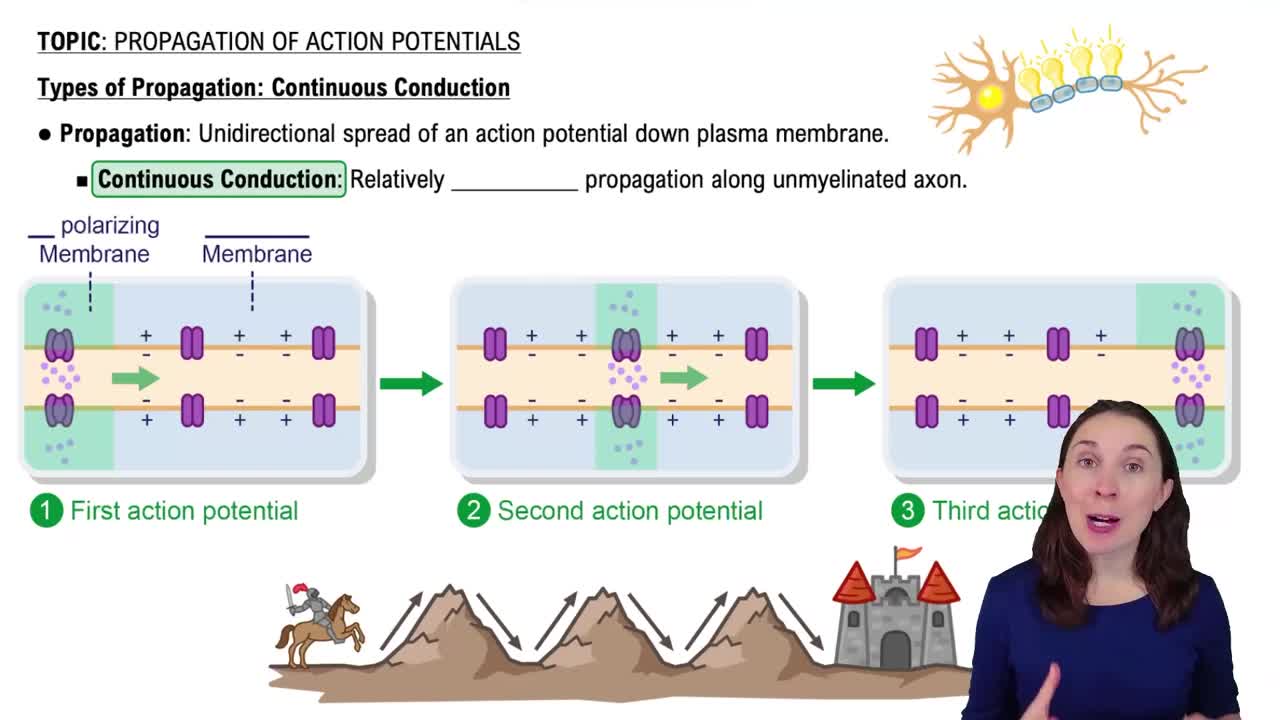
What prevents the action potential from traveling backward along the axon during propagation?
The area behind the action potential enters a refractory period, which prevents the current from moving backward. This ensures the unidirectional spread of the action potential.
In continuous conduction, what attracts sodium ions to the next segment of the axon?
Sodium ions are attracted to the next segment because the adjacent membrane is still at its negative resting potential. This attraction helps depolarize the next segment and propagate the action potential.
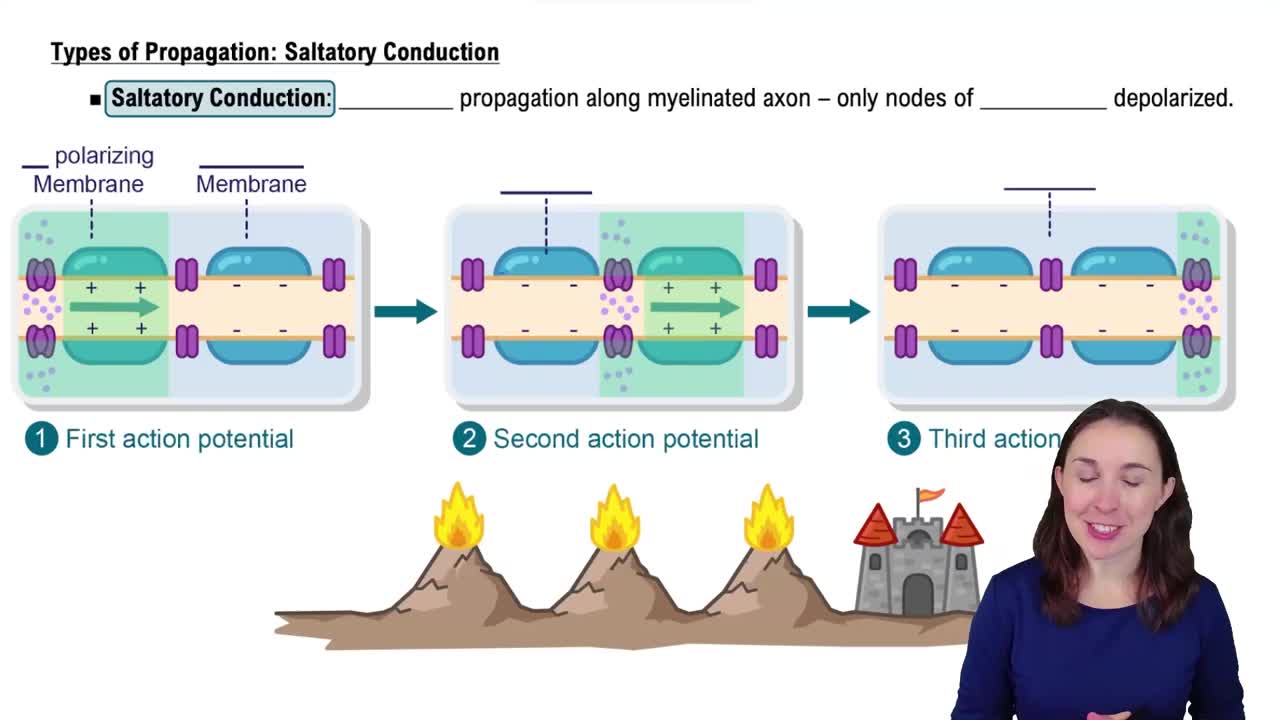
Where are voltage-gated sodium channels concentrated in myelinated axons?
Voltage-gated sodium channels are concentrated at the nodes of Ranvier in myelinated axons. These nodes are the only places where depolarization occurs during saltatory conduction.
How does myelin affect the movement of current along the axon?
Myelin insulates the axon and prevents current from leaking out. This allows the current to travel rapidly down the myelinated segments to the next node.
Why is the term 'saltatory' used to describe this type of conduction?
The term 'saltatory' comes from the Latin word 'saltare,' meaning to leap. It describes how the action potential appears to jump from node to node along the axon.
What is the main difference in depolarization between continuous and saltatory conduction?
In continuous conduction, every segment of the axon membrane is depolarized sequentially. In saltatory conduction, only the nodes of Ranvier are depolarized.
How does the analogy of lighting fires on mountaintops relate to saltatory conduction?
The analogy illustrates how the action potential quickly leaps from one node (mountaintop) to the next, rather than traveling continuously along the entire axon. This makes neural communication much faster and more efficient.
What role do leak channels play in the speed of action potential propagation?
Leak channels allow current to escape from the axon, which slows down propagation. Myelin prevents this leakage, speeding up the action potential in myelinated axons.
How is the propagation of an action potential similar to a series of light bulbs turning on in sequence?
Just as each light bulb turns on one after another to create the illusion of a moving light, each segment of the axon depolarizes in sequence to propagate the action potential. This sequence of events gives the appearance of a single action potential traveling down the axon.