Anatomy & Physiology
My Course
Learn
Exam Prep
AI Tutor
Study Guides
Textbook Solutions
Flashcards
Explore
My Course
Learn
Exam Prep
AI Tutor
Study Guides
Textbook Solutions
Flashcards
Explore
Back
Renal Physiology Step 1: Glomerular Filtration definitions
You can tap to flip the card.
Filtration Membrane
You can tap to
flip the card.
👆
Filtration Membrane
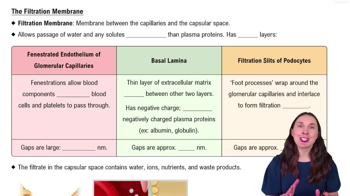
A three-layered structure in kidneys that filters blood, allowing water and small solutes to pass while retaining blood cells and most proteins.
Track progress
Control buttons has been changed to "navigation" mode.
1/15
Related flashcards
Related practice
Recommended videos
Guided course
4:30
The Filtration Membane
Bruce Bryan
3270
views
57
rank
Guided course
0:42
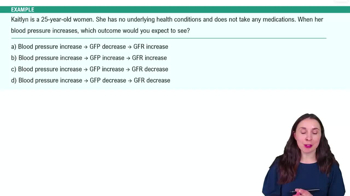
Renal Physiology Step 1: Glomerular Filtration Example 1
Bruce Bryan
2434
views
37
rank
Guided course
2:58
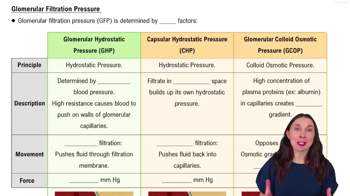
Overview of Filtration Pressures
Bruce Bryan
2813
views
64
rank
Terms in this set (15)
Hide definitions
Filtration Membrane
A three-layered structure in kidneys that filters blood, allowing water and small solutes to pass while retaining blood cells and most proteins.
Fenestrated Endothelium
The first layer of the filtration membrane with large pores that allow passage of blood components except cells and platelets.
Basal Lamina
A thin extracellular matrix gel layer in the filtration membrane that repels negatively charged plasma proteins.
Podocytes
Cells with foot processes that form filtration slits, the finest layer of the filtration membrane.
Hydrostatic Pressure
The force exerted by a fluid against the wall of its container, influencing fluid movement in capillaries.
Colloid Osmotic Pressure
Pressure created by plasma proteins that pulls water back into capillaries, opposing filtration.
Glomerular Filtration Pressure
Pressure determined by hydrostatic and colloid osmotic pressures, crucial for kidney filtration.
Net Filtration Pressure
The overall pressure driving fluid movement through the filtration membrane, typically around 10 mmHg.
Glomerular Filtration Rate (GFR)
The volume of filtrate formed by both kidneys per minute, averaging about 125 mL/min.
Systemic Blood Pressure
A key factor influencing glomerular filtration rate, with increases leading to higher GFR.
Electrolyte Imbalances
Disruptions in the balance of ions in the body, potentially caused by changes in GFR.
Dehydration
A condition resulting from excessive fluid loss, potentially due to increased GFR.
Hypertension
High blood pressure, which can result from decreased GFR and fluid retention.
Edema
Swelling caused by fluid retention, often associated with decreased GFR.
Waste Products
Substances like urea and uric acid filtered by kidneys, retained if GFR is low.