Skip to main content
Anatomy & Physiology
My Course
Learn
Exam Prep
AI Tutor
Study Guides
Textbook Solutions
Flashcards
Explore
Try the app
My Course
Learn
Exam Prep
AI Tutor
Study Guides
Textbook Solutions
Flashcards
Explore
Try the app
Back
Respiration definitions
You can tap to flip the card.
Respiration
You can tap to flip the card.
👆
Respiration
The exchange of oxygen and carbon dioxide between the air, blood, and tissues, driven by pressure gradients.
Track progress
Control buttons has been changed to "navigation" mode.
1/15
Related flashcards
Recommended videos
Respiration quiz #1
Respiration
12 Terms
Guided course
5:18
Respiration Example 1
2592
views
33
rank
2
comments
Guided course
8:19
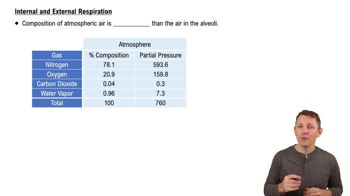
Internal and External Respiration
3255
views
40
rank
Guided course
5:20
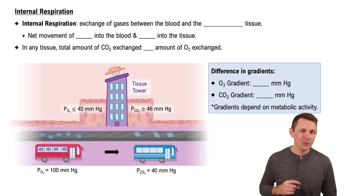
Internal Respiration
2467
views
29
rank
Terms in this set (15)
Hide definitions
Respiration
The exchange of oxygen and carbon dioxide between the air, blood, and tissues, driven by pressure gradients.
External Respiration
Gas exchange between alveolar air and blood, with oxygen moving into blood and carbon dioxide into air.
Internal Respiration
Gas exchange between blood and body tissues, with oxygen moving into tissues and carbon dioxide into blood.
Alveoli
Tiny air sacs in the lungs where external respiration occurs, facilitating gas exchange with blood.
Partial Pressure
The pressure exerted by a single type of gas in a mixture, crucial for understanding gas movement in respiration.
Henry's Law
Describes the solubility of gases in liquids, explaining why carbon dioxide is more soluble than oxygen.
Hemoglobin
A protein in red blood cells that primarily carries oxygen, binding to it for transport in the bloodstream.
Pressure Gradient
The difference in partial pressures that drives the movement of gases during respiration.
Blood Plasma
The liquid component of blood where gases like carbon dioxide dissolve and are transported.
Tidal Volume
The amount of air inhaled or exhaled during normal breathing, typically around 500 milliliters.
Residual Capacity
The volume of air remaining in the lungs after a normal exhalation, preventing lung collapse.
Intrapulmonary Pressure
The pressure within the alveoli, which equalizes with atmospheric pressure during ventilation.
Cellular Respiration
The metabolic process in tissues using oxygen and producing carbon dioxide as a waste product.
Solubility
The ability of a gas to dissolve in a liquid, affecting how gases are transported in the blood.
Metabolic Activity
The level of biochemical processes in tissues, influencing the gradients of oxygen and carbon dioxide.
 BackBack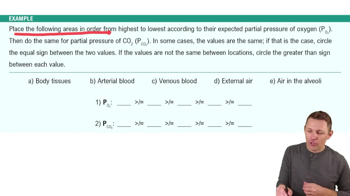
 5:18
5:18