Skip to main content
Anatomy & Physiology
My Course
Learn
Exam Prep
AI Tutor
Study Guides
Textbook Solutions
Flashcards
Explore
Try the app
My Course
Learn
Exam Prep
AI Tutor
Study Guides
Textbook Solutions
Flashcards
Explore
Try the app
Back
Review of Adaptive Immunity quiz
You can tap to flip the card.
Where do T cells and B cells mature before migrating to secondary lymphoid organs?
You can tap to flip the card.
👆
Where do T cells and B cells mature before migrating to secondary lymphoid organs?
T cells mature in the thymus and B cells mature in the bone marrow, which are the primary lymphoid organs.
Track progress
Control buttons has been changed to "navigation" mode.
1/15
Related flashcards
Recommended videos
Review of Adaptive Immunity definitions
Review of Adaptive Immunity
15 Terms
9:20
Review of Adaptive Immunity
1104
views
11
rank
Terms in this set (15)
Hide definitions
Where do T cells and B cells mature before migrating to secondary lymphoid organs?
T cells mature in the thymus and B cells mature in the bone marrow, which are the primary lymphoid organs.
What does the term 'naive' refer to in T cells and B cells?
Naive refers to the inactive forms of T cells and B cells that have not yet encountered their specific antigen.
How are naive T cells activated?
Naive T cells are activated when their T cell receptors recognize antigens presented on MHCs by antigen-presenting cells like dendritic cells.
What is the role of dendritic cells in adaptive immunity?
Dendritic cells present antigens on MHCs to naive T cells and produce co-stimulatory molecules essential for T cell activation.
Which MHC class do dendritic cells use to present antigens to cytotoxic T cells?
Dendritic cells use MHC class I to present antigens to cytotoxic T cells.
Which MHC class do dendritic cells use to present antigens to helper T cells?
Dendritic cells use MHC class II to present antigens to helper T cells.
What happens to T cells after activation?
Activated T cells proliferate and differentiate into effector and memory cells.
What is the function of effector cytotoxic T cells?
Effector cytotoxic T cells induce apoptosis in infected cells, helping to limit the spread of pathogens.
How do effector helper T cells contribute to the immune response?
Effector helper T cells activate other immune cells, such as macrophages and B cells, often by releasing cytokines.
What is the role of memory T cells in adaptive immunity?
Memory T cells remain in secondary lymphoid organs and enable a stronger response to future exposures to the same antigen.
How are B cells activated?
B cells are activated when they bind, internalize, and present their specific antigen on MHC class II, and are then activated by helper T cells.
Into what cell types can activated B cells differentiate?
Activated B cells can differentiate into plasma cells or memory B cells.
What is the function of plasma cells?
Plasma cells secrete antibodies that tag pathogens for removal and contribute to various immune responses.
Why are memory cells important in adaptive immunity?
Memory cells enhance the speed and efficacy of the immune response during future infections with the same antigen.
How does the adaptive immune system ensure specificity?
Each T cell and B cell responds to a unique antigen, providing a diverse response capability to different antigens.
 BackBack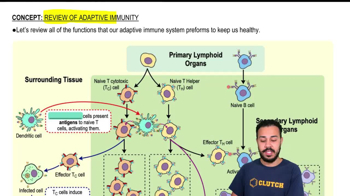
 9:20
9:20