Skip to main content
Anatomy & Physiology
My Course
Learn
Exam Prep
AI Tutor
Study Guides
Textbook Solutions
Flashcards
Explore
Try the app
My Course
Learn
Exam Prep
AI Tutor
Study Guides
Textbook Solutions
Flashcards
Explore
Try the app
Back
Rods, Cones, and Light definitions
You can tap to flip the card.
Opsin
You can tap to flip the card.
👆
Opsin
A protein pigment in the eye that absorbs light, enabling the perception of different wavelengths.
Track progress
Control buttons has been changed to "navigation" mode.
1/15
Related flashcards
Related practice
Recommended videos
Rods, Cones, and Light quiz
Rods, Cones, and Light
38 Terms
Rods, Cones, and Light
15. The Special Senses
7 problems
Topic
Jason
The Lens and Focusing Light on the Retina
15. The Special Senses
2 problems
Topic
15. The Special Senses
8 topics
13 problems
Chapter
Bruce
Guided course
5:04
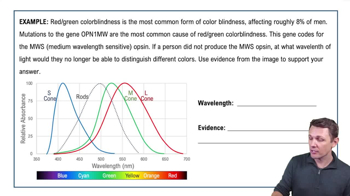
Rods, Cones, and Light Example 2
1964
views
22
rank
Guided course
4:22
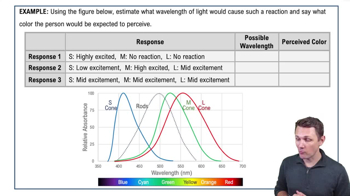
Rods, Cones, and Light Example 1
2176
views
28
rank
Guided course
9:08
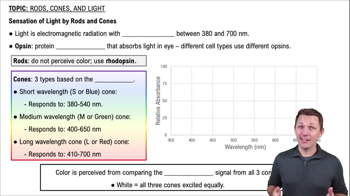
Sensation of Light by Rods and Cones
3056
views
36
rank
Terms in this set (15)
Hide definitions
Opsin
A protein pigment in the eye that absorbs light, enabling the perception of different wavelengths.
Rhodopsin
The opsin used by rods, absorbing light best at 500 nanometers, crucial for grayscale vision.
Rods
Photoreceptor cells in the eye that perceive light in grayscale using rhodopsin.
Cones
Photoreceptor cells in the eye that perceive color using three types of opsins.
Short Wavelength Cone
Also known as the S or blue cone, it absorbs light best at 420 nanometers.
Medium Wavelength Cone
Also known as the M or green cone, it absorbs light best around 535 nanometers.
Long Wavelength Cone
Also known as the L or red cone, it absorbs light best at 565 nanometers.
Color Perception
Arises from comparing the relative signals received from all three types of cones.
Electromagnetic Radiation
Light is a form of this, with wavelengths between 387 and 700 nanometers.
Wavelength
The distance between successive peaks of a wave, crucial for determining light color.
Relative Absorbance
A measure of how much light a photoreceptor absorbs at a given wavelength.
Color Blindness
A condition where certain colors cannot be distinguished, often due to cone deficiencies.
Graph Interpretation
Understanding graphs of wavelength versus absorbance is key to grasping color vision.
Signal Pattern
The unique combination of signals from cones that the brain interprets as a specific color.
White Perception
Occurs when all three cones are equally excited by a bright mix of wavelengths.
 BackBack

 5:04
5:04