Approximately how many nephrons are found in each kidney?
Each kidney contains about 1 to 2 million nephrons.
What structures make up the renal corpuscle, and what is its primary function?
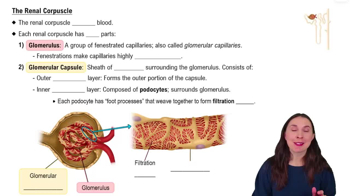
The renal corpuscle consists of the glomerulus and the glomerular (Bowman's) capsule, and its primary function is to filter blood.
What is the role of podocytes in the glomerular capsule?
Podocytes are specialized epithelial cells in the visceral layer of the glomerular capsule that wrap around capillaries and form filtration slits, aiding in selective filtration.
List the three main regions of the renal tubule and their general locations.
The three main regions of the renal tubule are the proximal tubule (in the cortex), the nephron loop (extends into the medulla), and the distal tubule (in the cortex).
Differentiate between the descending and ascending limbs of the nephron loop.
The descending limb travels toward the renal medulla, while the ascending limb returns toward the renal cortex; each limb has distinct roles in filtrate processing.
What is the collecting duct, and what is its role in urine formation?
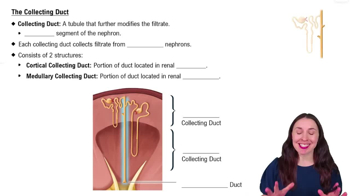
The collecting duct is a tubule that receives filtrate from multiple nephrons, further modifies it, and transports it toward the papillary duct where it becomes urine.
At what point is filtrate officially considered urine in the nephron pathway?
Filtrate is officially considered urine when it reaches the end of the papillary duct.
Where are cortical nephrons primarily located, and what is a distinguishing feature of their nephron loop?
Cortical nephrons are mainly in the renal cortex and have short nephron loops that barely dip into the medulla.
Which blood vessels supply cortical and juxtamedullary nephrons?
Cortical nephrons are supplied by peritubular capillaries, while juxtamedullary nephrons are supplied by both peritubular capillaries and the vasa recta.
What is the primary function of the renal corpuscle, and what two main structures does it consist of?
The renal corpuscle's primary function is to filter blood, and it consists of the glomerulus and the glomerular (Bowman's) capsule.
What is the functional unit of the kidney?
The nephron is the functional unit of the kidney.
What are the two main components of a nephron?
The two main components of a nephron are the renal corpuscle and the renal tubule.
What structures make up the renal corpuscle?
The renal corpuscle is made up of the glomerulus and the glomerular (Bowman's) capsule.
What is the glomerulus?
The glomerulus is a group of fenestrated (leaky) capillaries within the renal corpuscle that filter blood.
What is the glomerular capsule also known as?
The glomerular capsule is also known as Bowman's capsule.
What is the function of podocytes in the nephron?
Podocytes are specialized cells in the visceral layer of the glomerular capsule that form filtration slits for filtering blood.
Where is the renal corpuscle located?
The renal corpuscle is located in the renal cortex.
What is filtrate?
Filtrate is a plasma-derived fluid containing water, electrolytes, and nutrients that is collected in the capsular space of the renal corpuscle.
What are the three main regions of the renal tubule?
The three main regions of the renal tubule are the proximal tubule, the nephron loop, and the distal tubule.
What is the function of the proximal tubule?
The proximal tubule modifies filtrate and contains microvilli to increase surface area for reabsorption.
What are the two limbs of the nephron loop?
The nephron loop has a descending limb and an ascending limb.
Where is the distal tubule located?
The distal tubule is located in the renal cortex.
What is the function of macula densa cells?
Macula densa cells monitor sodium chloride content in the filtrate and help regulate filtration rate and blood pressure.
What is the collecting duct?
The collecting duct is a tubule that collects filtrate from multiple nephrons and further modifies it before it becomes urine.
What are the two sections of the collecting duct?
The collecting duct consists of the cortical collecting duct and the medullary collecting duct.
What is the papillary duct?
The papillary duct is formed by the fusion of collecting ducts at the tip of the renal pyramid, where filtrate becomes urine.
How many nephrons are in each kidney?
Each kidney contains about 1 to 2 million nephrons.
What are the two types of nephrons?
The two types of nephrons are cortical nephrons and juxtamedullary nephrons.
Where are cortical nephrons primarily located?
Cortical nephrons are primarily located in the renal cortex.
What percentage of nephrons are cortical nephrons?
Cortical nephrons make up about 80% of all nephrons.
Where are juxtamedullary nephrons located?
Juxtamedullary nephrons are located at the boundary of the renal cortex and renal medulla.
What is a distinguishing feature of juxtamedullary nephrons?
Juxtamedullary nephrons have long nephron loops that extend deep into the renal medulla.
What is the main function of juxtamedullary nephrons?
Juxtamedullary nephrons specialize in creating concentrated urine.
What is the main function of the nephron?
The nephron filters blood and produces urine.
What is the basic working unit of the kidney?
The nephron is the basic working unit of the kidney.
What is the filtration unit of the kidney?
The nephron is the filtration unit of the kidney.
What is the structural and functional unit of the kidney?
The nephron is the structural and functional unit of the kidney.
What is the cuplike part of the renal corpuscle?
The cuplike part of the renal corpuscle is the glomerular (Bowman's) capsule.
What is the capsular space?
The capsular space is the hollow region between the parietal and visceral layers of the glomerular capsule where filtrate collects.
What is the function of the renal tubule?
The renal tubule modifies filtrate by conserving or eliminating substances.
 Back
Back

 3:50
3:50