Which bone lies directly in front of the heart within the thoracic cage?
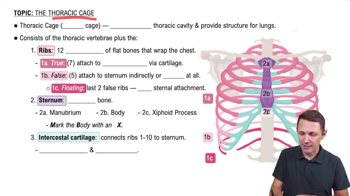
The sternum lies directly in front of the heart within the thoracic cage.
What is the primary function of the thoracic cage in relation to the lungs?
The thoracic cage provides essential structure for the lungs, allowing them to function properly. Without the ribs, the lungs would not work as they should.
How many pairs of ribs are typically found in the human thoracic cage?
There are usually 12 pairs of ribs in both males and females. Rarely, some individuals may have an extra pair.
What distinguishes true ribs from false ribs in terms of their attachment to the sternum?
True ribs attach directly to the sternum via their own piece of costal cartilage. False ribs attach to the sternum either indirectly or not at all.
Which ribs are classified as floating ribs, and why are they called that?
Ribs 11 and 12 are called floating ribs because they do not attach to the sternum at all. They only articulate with the vertebrae posteriorly.
What are the three fused bones that make up the sternum?
The sternum is composed of the manubrium at the top, the body in the middle, and the xiphoid process at the tip. These three bones fuse together to form the sternum.
What is the function of intercostal cartilage in the thoracic cage?
Intercostal cartilage connects ribs 1 through 10 to the sternum, providing both flexibility and strength. This allows the rib cage to flex slightly while protecting the thoracic organs.
How do the attachments of the first three false ribs differ from those of the true ribs?
The first three false ribs attach to the sternum indirectly through cartilage that connects to other rib cartilage. In contrast, true ribs attach directly to the sternum via their own cartilage.
What is a common misconception about the number of ribs in males versus females?
A common misconception is that females have one less pair of ribs than males, but both sexes typically have the same number. This misconception is not supported by anatomical evidence.
Why is the xiphoid process significant in the structure of the sternum?
The xiphoid process is the small tip at the bottom of the sternum and serves as an attachment point for various structures. It can be felt as a small projection and is sensitive to pressure.
 Back
Back

 5:03
5:03