Skip to main content
Anatomy & Physiology
My Course
Learn
Exam Prep
AI Tutor
Study Guides
Textbook Solutions
Flashcards
Explore
Try the app
My Course
Learn
Exam Prep
AI Tutor
Study Guides
Textbook Solutions
Flashcards
Explore
Try the app
Back
Types of Muscle Tissue definitions
1 student found this helpful
You can tap to flip the card.
Skeletal Muscle Tissue
You can tap to flip the card.
👆
Skeletal Muscle Tissue
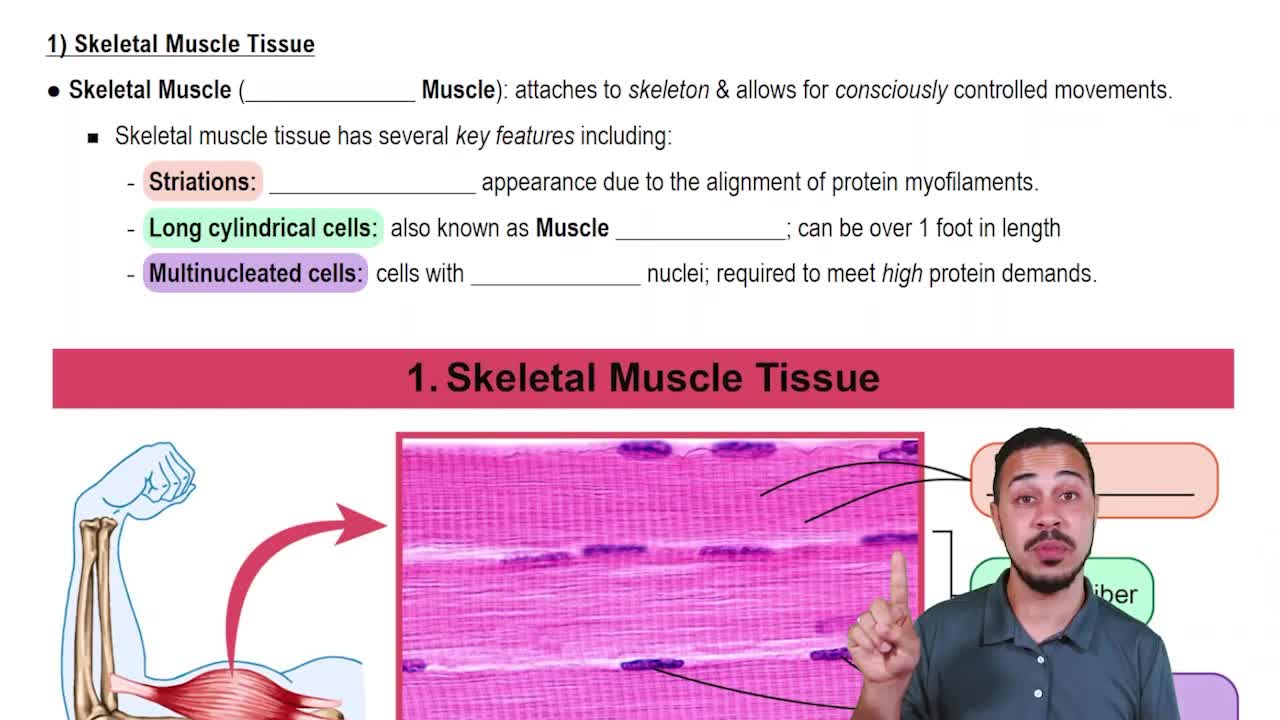
Voluntary muscle attached to the skeleton, featuring striations and multinucleated, long cylindrical cells.
Track progress
Control buttons has been changed to "navigation" mode.
1/15
Related flashcards
Related practice
Recommended videos
Types of Muscle Tissue quiz #1
Types of Muscle Tissue
38 Terms
Types of Muscle Tissue quiz #2
Types of Muscle Tissue
38 Terms
Types of Muscle Tissue quiz #3
Types of Muscle Tissue
40 Terms
Types of Muscle Tissue
4. Tissues & Histology
4 problems
Topic
Bruce
Introduction to Nervous Tissue
4. Tissues & Histology
2 problems
Topic
4. Tissues & Histology - Part 1 of 2
9 topics
14 problems
Chapter
Bruce
4. Tissues & Histology - Part 2 of 2
12 topics
14 problems
Chapter
Bruce
Guided course
00:36
3 Types of Muscle Tissue
4867
views
55
rank
Guided course
06:56
Skeletal Muscle Tissue
5047
views
92
rank
Guided course
07:35
Review of Types of Muscle Tissue
3460
views
48
rank
Terms in this set (15)
Hide definitions
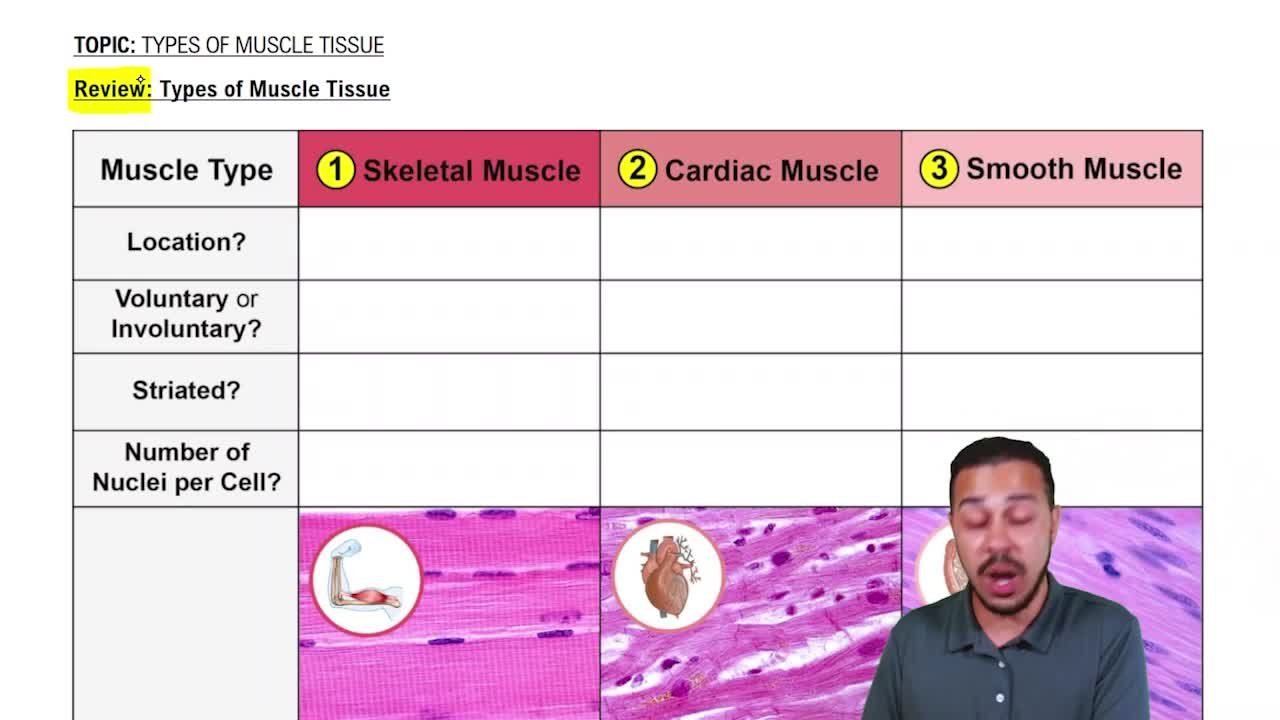
Skeletal Muscle Tissue
Voluntary muscle attached to the skeleton, featuring striations and multinucleated, long cylindrical cells.
Cardiac Muscle Tissue
Involuntary muscle found in the heart, with striated, branching, uninucleate cells connected by intercalated discs.
Smooth Muscle Tissue
Involuntary muscle in walls of hollow organs, lacking striations, with short, spindle-shaped, uninucleate cells.
Striations
Banded appearance in muscle tissue due to alignment of protein myofilaments, present in skeletal and cardiac muscles.
Voluntary Muscle
Muscle type under conscious control, allowing for deliberate movements, exemplified by skeletal muscle.
Involuntary Muscle
Muscle type not under conscious control, including cardiac and smooth muscles.
Multinucleated
Cells containing multiple nuclei, characteristic of skeletal muscle fibers to meet high protein demands.
Uninucleate
Cells with a single nucleus, typical of cardiac and smooth muscle cells.
Cardiomyocytes
Heart muscle cells that are striated, branching, and usually uninucleate, forming cardiac muscle tissue.
Intercalated Discs
Structures connecting cardiomyocytes, enabling coordinated contractions in cardiac muscle tissue.
Spindle-shaped Cells
Cells that are narrow at the ends and thicker in the middle, characteristic of smooth muscle tissue.
Protein Myofilaments
Protein structures in muscle cells responsible for contraction, aligned to form striations in some muscle types.
Tendons
Connective tissues that attach skeletal muscles to bones, facilitating movement.
Biceps
Example of skeletal muscle that can be voluntarily controlled, located in the upper arm.
Digestive System
System containing smooth muscle tissue in the intestines, aiding in propulsion of food.
 BackBack
 00:36
00:36