 Back
BackAnatomy & Physiology: Basic Chemistry and Biochemistry
 02:13
02:13
Terms in this set (30)
Matter is anything that has mass and occupies space. It can be seen, smelled, or felt.
Solid (definite shape and volume), Liquid (changeable shape, definite volume), Gas (changeable shape and volume).
Energy is the capacity to do work or put matter into motion; it has no mass or volume.
Kinetic energy (energy in action) and Potential energy (stored energy).
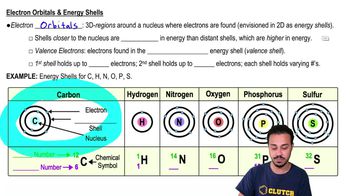
Carbon, Oxygen, Hydrogen, and Nitrogen.
Protons (positive charge), Neutrons (no charge), and Electrons (negative charge).
Planetary model shows electrons in fixed orbits; orbital model shows probable electron clouds.
Atoms of the same element with the same number of protons but different numbers of neutrons.
A molecule is two or more atoms bonded together; a compound is a molecule with two or more different kinds of atoms.
Solutions (homogeneous), Colloids (heterogeneous, particles do not settle), Suspensions (heterogeneous, particles settle out).
Mixtures do not involve chemical bonding and can be separated physically; compounds involve chemical bonds and are homogeneous.
Atoms tend to gain, lose, or share electrons to have 8 electrons in their valence shell for stability.
Formed by transfer of electrons from one atom to another, creating charged ions attracted to each other.
Formed by sharing of valence electrons between atoms; can be single, double, or triple bonds.
Polar bonds share electrons unequally, creating partial charges; nonpolar bonds share electrons equally.
Weak attractions between electropositive hydrogen of one molecule and electronegative atom of another, important in water properties.
Synthesis: smaller molecules form larger ones; Decomposition: molecules break down; Exchange: bonds made and broken.
Enzymes are biological catalysts that lower activation energy and speed up reactions without being consumed.
Water, salts, acids, and bases.
Water has high heat capacity, is a polar solvent, participates in reactions, and cushions organs.
Acids donate H+ ions; bases accept H+ ions in solution.
pH measures hydrogen ion concentration; scale ranges from 0 (acidic) to 14 (basic), with 7 neutral.
Contain carbon; major classes include carbohydrates, lipids, proteins, and nucleic acids.
Contain C, H, O; classes are monosaccharides, disaccharides, and polysaccharides.
Three fatty acids bonded to glycerol; functions include energy storage, insulation, and protection.
Saturated have single bonds and are solid at room temperature; unsaturated have double bonds and are liquid.
Polymers of amino acids linked by peptide bonds; structures include primary, secondary, tertiary, and quaternary.
Loss of protein's 3D shape due to pH or temperature changes, often reversible but sometimes permanent.
Polymers of nucleotides; major types are DNA (genetic blueprint) and RNA (protein synthesis).
Adenosine triphosphate stores and provides immediate energy for cellular work by transferring phosphate groups.