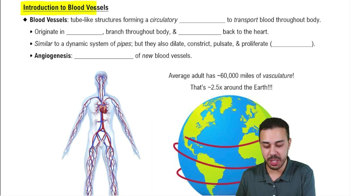
What causes constriction and dilation in blood vessels?
Constriction is caused by contraction of vascular smooth muscle, narrowing vessel diameter. Dilation is caused by relaxation, increasing vessel diameter.
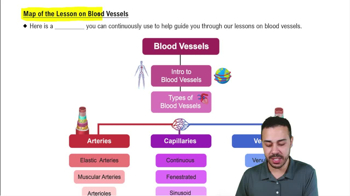
Physical characteristics of arteries
Thick, elastic walls to sustain high pressure; carry blood away from the heart.
Physical characteristics of arterioles
Smaller branches of arteries with muscular walls; major site of resistance controlling blood flow.
Physical characteristics of capillaries
Microscopic vessels with thin walls for exchange of gases, nutrients, and wastes between blood and tissues.
Physical characteristics of venules
Small vessels that collect blood from capillaries and deliver it to veins.
Physical characteristics of veins
Thin-walled, less muscular vessels with valves; return blood to the heart under low pressure.
How do metarterioles differ from arterioles and their function?
Metarterioles are short vessels linking arterioles to capillaries; they regulate capillary blood flow via precapillary sphincters.
What property of artery walls helps sustain driving pressure from the heart?
The elasticity of artery walls allows them to stretch and recoil, maintaining pressure during the cardiac cycle.
Define systolic and diastolic pressure
Systolic pressure is the peak arterial pressure during heart contraction; diastolic pressure is the minimum pressure during relaxation.
What is pulse pressure and how is it calculated?
Pulse pressure = systolic pressure − diastolic pressure; it reflects the force generated by each heartbeat.
Explain mean arterial pressure (MAP) and its formula
MAP is the average arterial pressure during one cardiac cycle; calculated as MAP = diastolic pressure + 1/3 pulse pressure.
Relationship between MAP, cardiac output, and resistance
MAP = cardiac output × total peripheral resistance; increases in either raise MAP.
Effect on MAP if blood flow into arteries increases but outflow is unchanged
MAP will increase due to accumulation of blood volume in arteries.
Effect on MAP if peripheral resistance increases
MAP will increase because resistance opposes blood flow, raising pressure.
Effect on blood pressure if circulating blood volume decreases
Blood pressure decreases due to reduced blood volume.
Which two body systems regulate blood pressure homeostasis?
The nervous system (via baroreceptor reflex) and the endocrine system (via hormones like RAAS).
Two cardiovascular compensations for decreased blood volume
Increase heart rate and vasoconstriction to maintain blood pressure.
Baroreceptor reflex response to increased blood pressure
Increased baroreceptor firing leads to decreased sympathetic and increased parasympathetic activity, lowering heart rate and dilating vessels.
Effect of decreased blood pressure on autonomic activity
Sympathetic activity increases, parasympathetic activity decreases to raise blood pressure.
Effects of increased sympathetic activity on heart and vessels
Increases heart rate, force of contraction, and causes arteriolar vasoconstriction.
Effects of increased parasympathetic activity on heart and vessels
Decreases heart rate and force of contraction; minimal effect on arteriolar diameter.
What is orthostatic hypotension and why does blood pressure initially fall?
A drop in blood pressure upon standing due to blood pooling in lower extremities and delayed autonomic response.
Relationship between total cross-sectional area and velocity of blood flow
Velocity decreases as total cross-sectional area increases, e.g., slow flow in capillaries for exchange.
Types of exchange at capillaries between plasma and interstitial fluid
Diffusion, filtration, absorption, and bulk flow.
Difference between filtration and absorption in capillaries
Filtration moves fluid out of capillaries; absorption moves fluid into capillaries.
Direction of hydrostatic pressure effect on water in capillaries
Hydrostatic pressure pushes water out of capillaries; it decreases along the capillary length due to energy loss.
What creates the osmotic pressure gradient between plasma and interstitial fluid?
Plasma proteins create colloid osmotic pressure (π), pulling water into capillaries.
Direction of bulk flow into lymph capillaries
Bulk flow moves fluid, proteins, and bacteria into lymph capillaries.
List six functions of the kidneys
Regulate blood volume, blood pressure, osmolarity, ion balance, acid-base balance, and excrete wastes.
Difference between cortical and juxtamedullary nephrons
Cortical nephrons have short loops of Henle; juxtamedullary nephrons have long loops extending deep into the medulla.
 Back
Back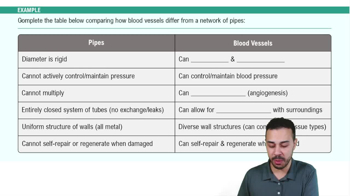
 3:38
3:38