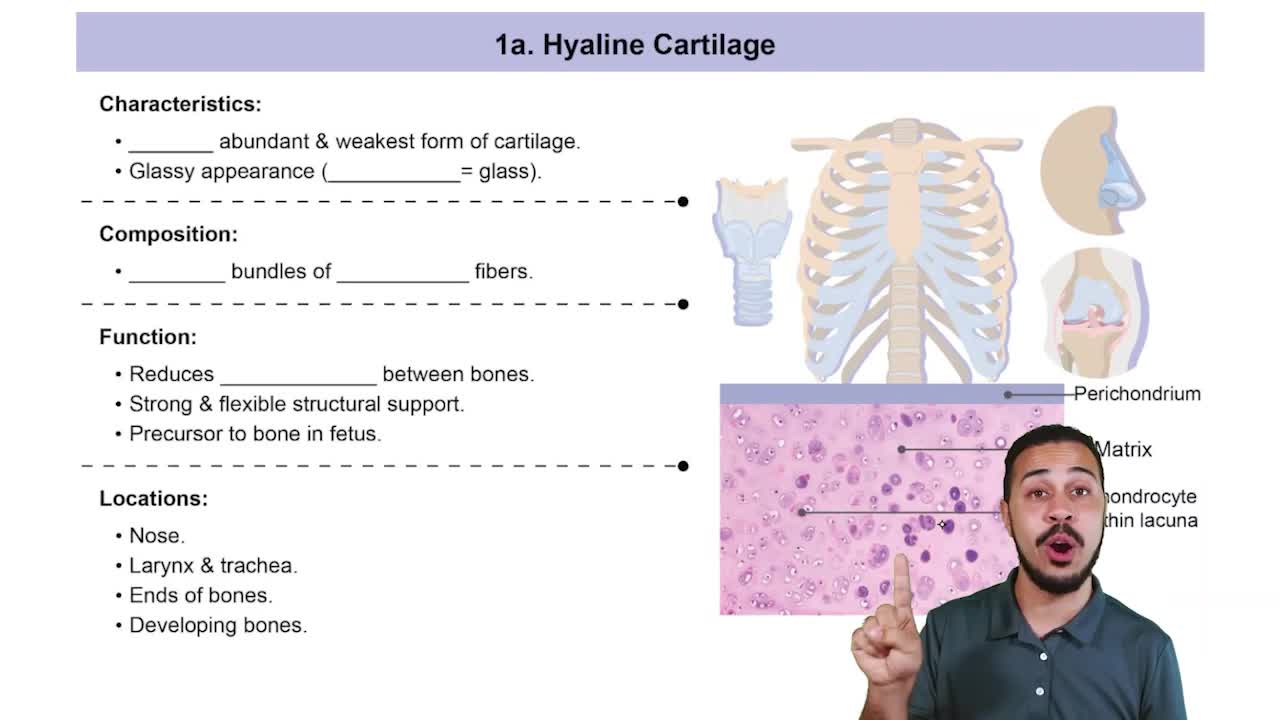
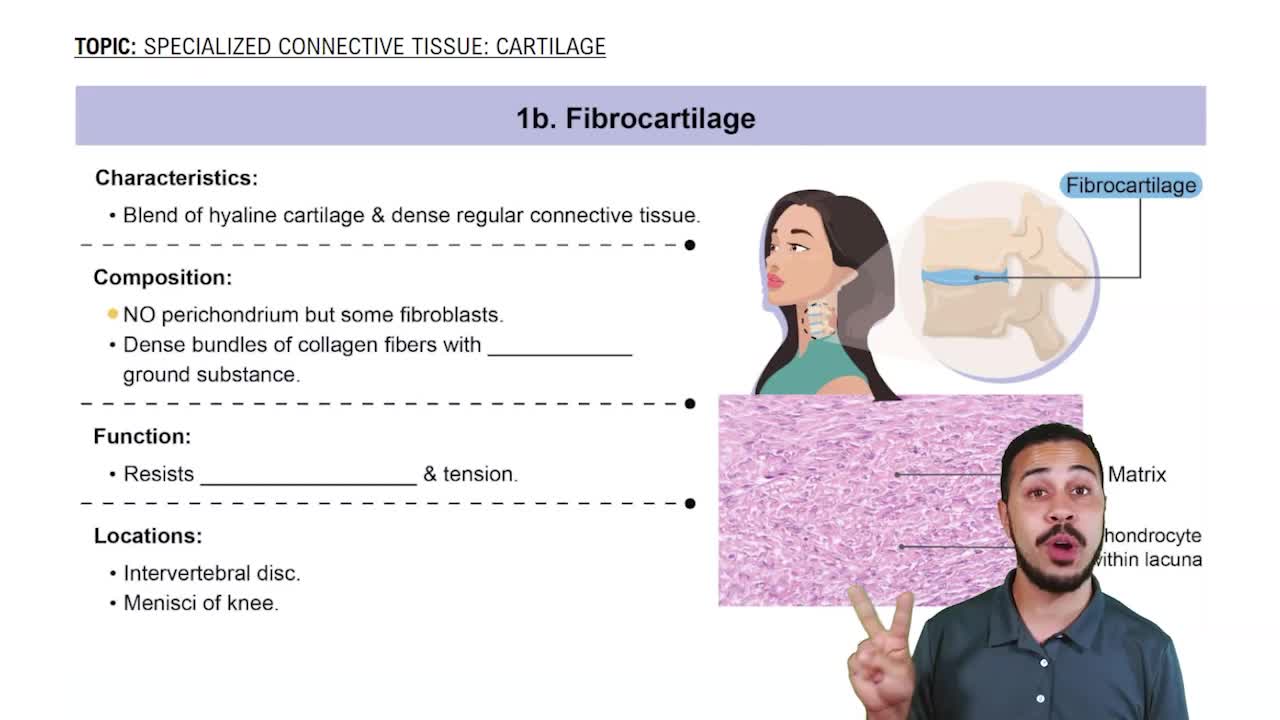
Hyaline cartilage provides support with flexibility; elastic cartilage contains elastic fibers for flexibility; fibrocartilage is highly compressible with tensile strength.
Functions of bones
Support, protection, movement, mineral storage, blood cell formation (hematopoiesis), fat storage, and hormone production (osteocalcin).
Classification of bones by location
Axial skeleton includes skull, vertebral column, rib cage; appendicular skeleton includes limbs and girdles.
Classification of bones by shape
Long bones (longer than wide), short bones (cube-shaped), flat bones (thin and curved), irregular bones (complex shapes).
Gross structure of bones
Compact bone forms dense outer layer; spongy bone (trabeculae) inside; marrow fills spaces; covered by periosteum and lined by endosteum.
Bone development processes
Intramembranous ossification forms flat bones from fibrous membranes; endochondral ossification replaces hyaline cartilage to form most other bones.
Cartilage growth types
Appositional growth: new matrix added at surface by chondroblasts; interstitial growth: chondrocytes divide and expand matrix from within.
Bone remodeling
Continuous process of bone deposition by osteoblasts and resorption by osteoclasts to maintain bone strength and calcium homeostasis.
The osteon is the structural unit of compact bone, consisting of concentric lamellae around a central canal containing blood vessels and nerves.
Function of canaliculi
Tiny canals connecting osteocytes, allowing nutrient and waste exchange despite the hard bone matrix.
Chemical composition of bone
Organic components (cells and osteoid with collagen) provide tensile strength; inorganic components (hydroxyapatite crystals) provide hardness and resistance to compression.
Endochondral ossification steps
Bone collar formation, cartilage calcification, periosteal bud invasion, diaphysis elongation, secondary ossification centers in epiphyses.
Zones of longitudinal bone growth
Resting zone, proliferation zone (cell division), hypertrophic zone (cell enlargement), calcification zone, ossification zone.
Hormonal regulation of bone growth
Growth hormone stimulates epiphyseal plate activity; thyroid hormones modulate growth; sex hormones (estrogen/testosterone) promote growth and epiphyseal closure.
Parathyroid hormone (PTH) role in bone
Increases blood calcium by stimulating osteoclasts to resorb bone, releasing calcium into the bloodstream.
Calcitonin function
Produced by thyroid parafollicular cells; lowers blood calcium by inhibiting osteoclast activity, but has minimal effect at normal levels.
Wolff’s law
Bone grows or remodels in response to mechanical stress, strengthening areas subjected to greater load.
Stages of bone fracture repair
Hematoma formation, fibrocartilaginous callus formation, bony callus formation, bone remodeling.
Osteoporosis characteristics
Decreased bone mass and density due to excessive resorption; bones become porous, fragile, and prone to fractures.
Causes and prevention of osteoporosis
Caused by decreased sex hormones, poor diet, lack of exercise, smoking, genetics; prevented by calcium/vitamin D intake and weight-bearing exercise.
Osteomalacia and rickets
Softening of bones due to defective mineralization from vitamin D or calcium deficiency; rickets is the childhood form causing bone deformities.
Paget’s disease
Excessive, disorganized bone remodeling causing enlarged but weak bones; often affects spine, pelvis, femur, and skull.
 Back
Back
 01:27
01:27