Back

Anatomy & Physiology: Bone Structure and Function

Control buttons has been changed to "navigation" mode.
1/27
  • Main components of the skeletal system


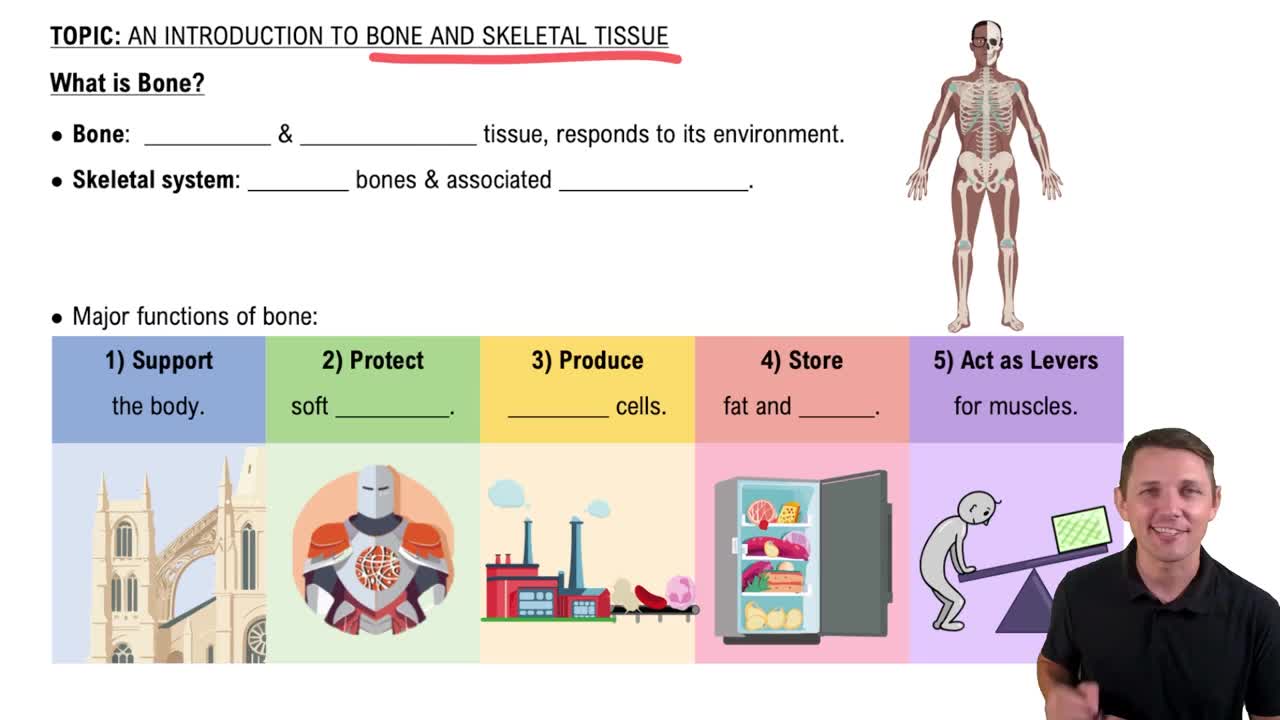
    The bones are the main components of the skeletal system, which also includes joints and other supporting structures.

  • Functions of the skeletal system

    Protection, mineral storage, acid-base homeostasis, blood cell formation, fat storage, movement, and support.
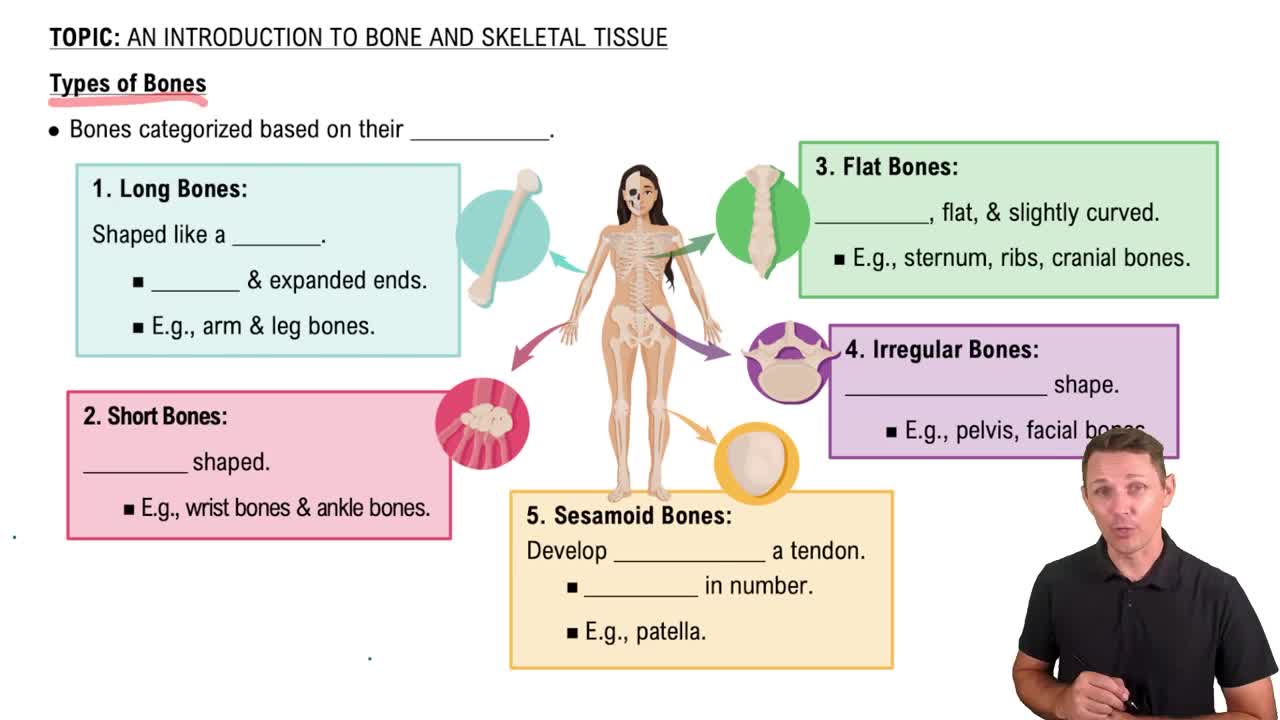
  • Five shapes of bones

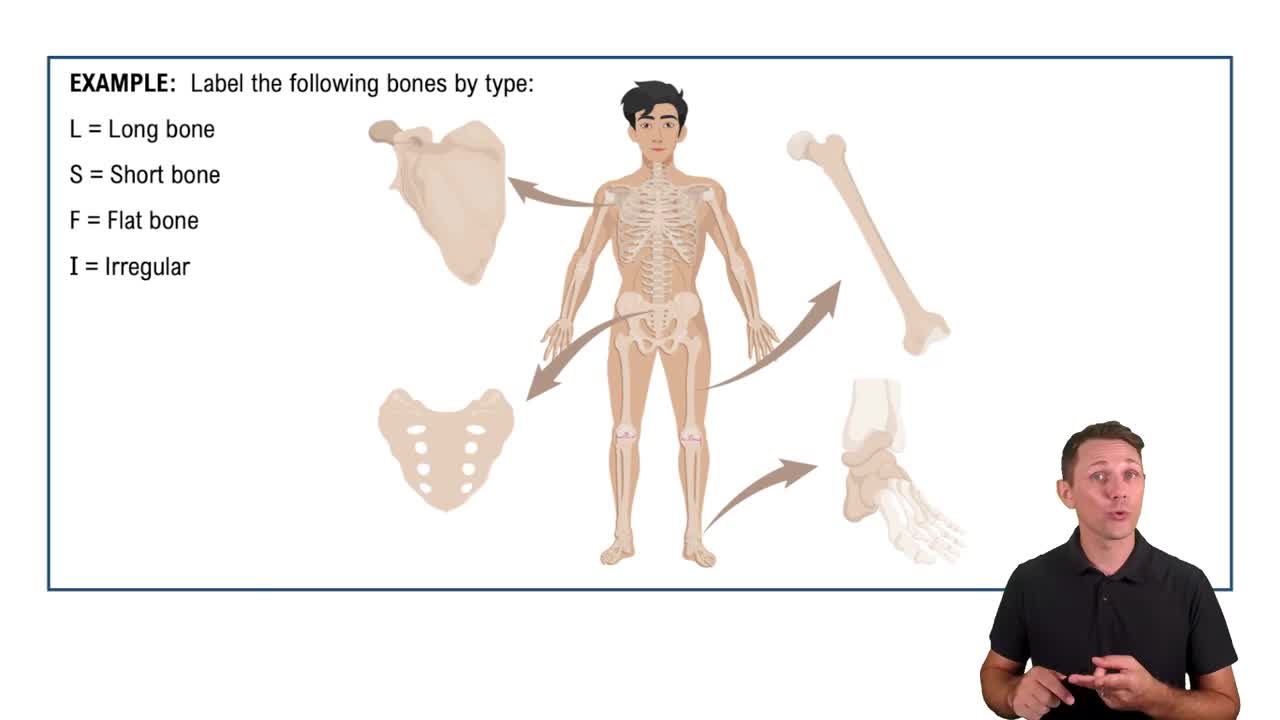
    Long bones, short bones, flat bones, irregular bones, and sesamoid bones.
  • Bone covering and layers

    Bones are covered by the periosteum, which lies over compact bone. Inside is spongy bone with a honeycomb structure.
  • Parts of a long bone

    A long bone has a diaphysis (shaft) and two epiphyses (ends).
  • Structure of short, flat, irregular, and sesamoid bones

    They consist of two thin layers of compact bone with spongy bone in the middle.
  • Red vs. yellow bone marrow

    Red bone marrow contains hematopoietic tissue; yellow bone marrow contains blood vessels and adipocytes.
  • Inorganic matrix of bone ECM

    Primarily calcium and phosphorus salts as hydroxyapatite crystals.
  • Organic matrix of bone ECM

    Called osteoid, it consists of collagen fibers and other extracellular matrix components.
  • Three main bone cell types

    Osteoblasts build bone, osteocytes are mature osteoblasts embedded in matrix, and osteoclasts resorb bone.
  • Structure of compact bone

    Made of osteons, which are rings of bone ECM called lamellae.
  • Structure of spongy bone

    Composed of branching trabeculae that form a framework for bone marrow; not made of osteons.
  • Definition of ossification

    The process of bone formation, also called osteogenesis.
  • Primary vs. secondary bone

    Primary bone forms first and is replaced by stronger secondary bone.
  • Intramembranous ossification

    Bone forms within a membrane of embryonic mesenchyme; spongy bone forms first, then periosteum and compact bone.
  • Endochondral ossification

    Bone forms within a hyaline cartilage model, starting with a bone collar of compact bone, then inner spongy bone.
  • Longitudinal bone growth location

    Occurs at the epiphyseal plate in long bones, which has five zones of cells.
  • Effect of epiphyseal plate ossification

    When the epiphyseal plate fully ossifies, longitudinal growth stops.
  • Bone growth in width

    Occurs by appositional growth, where osteoblasts in the periosteum add new circumferential lamellae.
  • Hormones affecting bone growth

    Growth hormone, testosterone, and estrogen significantly influence bone growth.
  • Bone remodeling process

    Continuous cycle of bone deposition by osteoblasts and resorption by osteoclasts.
  • Mechanical influence on bone remodeling

    Tension stimulates osteoblasts and deposition; pressure stimulates osteoclasts and resorption.
  • Hormonal influence on bone remodeling

    Vitamin D, testosterone, and estrogen promote net bone deposition; parathyroid hormone increases blood calcium by stimulating osteoclasts.
  • Dietary factors for bone remodeling

    Adequate calcium, vitamins D, C, K, and protein intake support bone remodeling.
  • Parathyroid hormone effects

    Stimulates osteoclasts, increases intestinal calcium absorption, and reduces calcium excretion by kidneys, raising blood calcium.
  • Types of bone fractures

    Simple (closed) fractures do not break the skin; compound (open) fractures break the skin.
  • Stages of bone fracture healing

    Chondroblasts form a soft callus of cartilage, then osteoblasts replace it with a bone callus of primary bone.