Back

Anatomy & Physiology: Bones and Bone Structure

Control buttons has been changed to "navigation" mode.
1/32
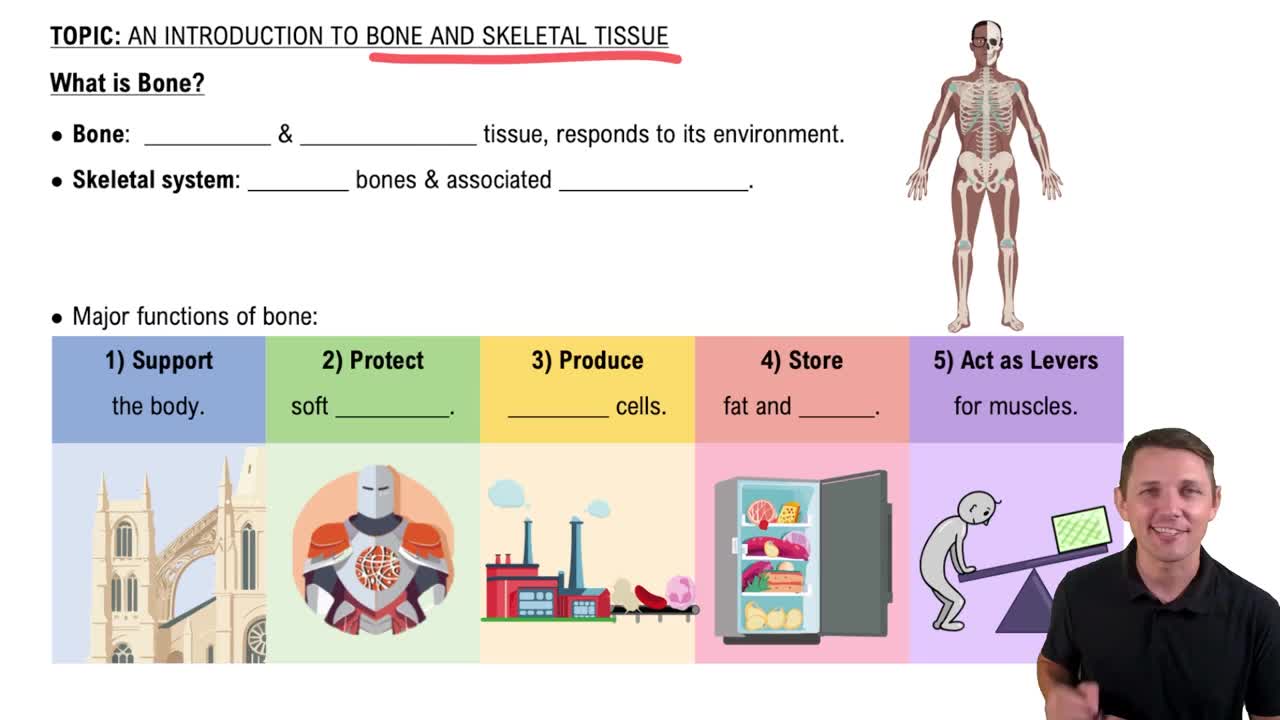
  • Functions of the skeletal system

    • Support and protection
    • Movement - muscles contract to move bones
    • Storage of minerals and fats
    • Blood cell production
  • Main divisions of the human skeleton

    Axial skeleton and appendicular skeleton
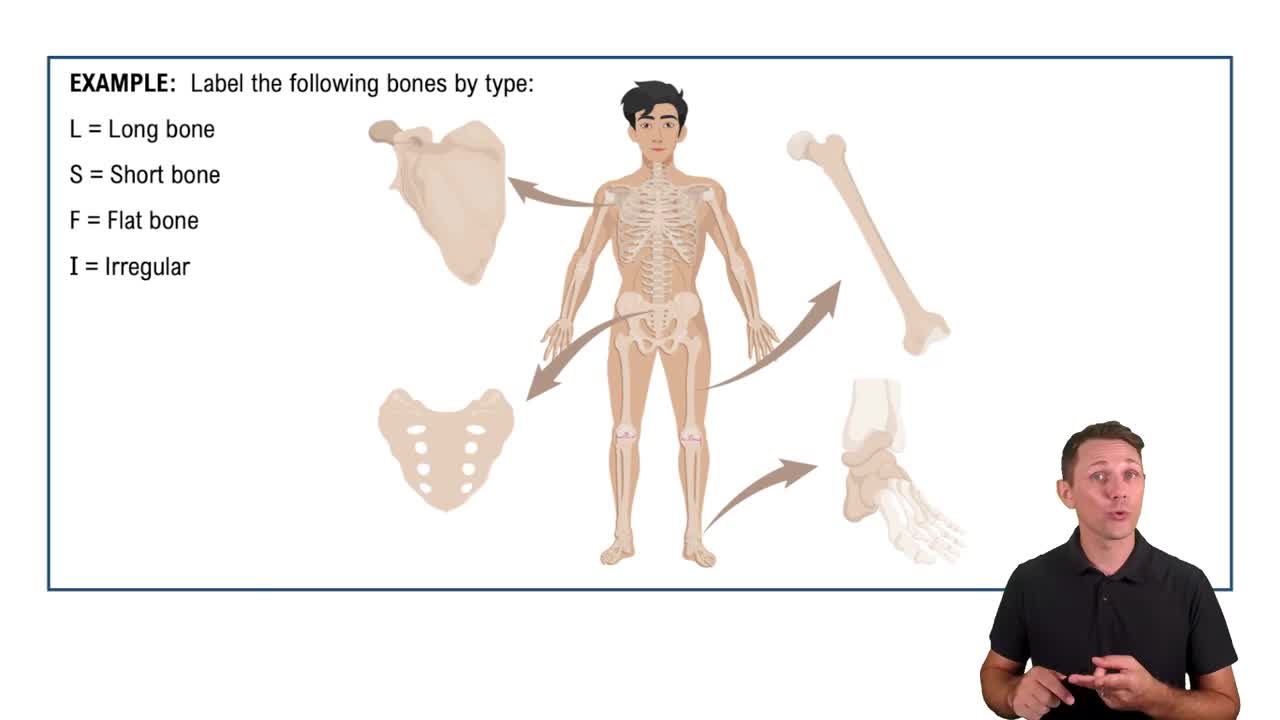
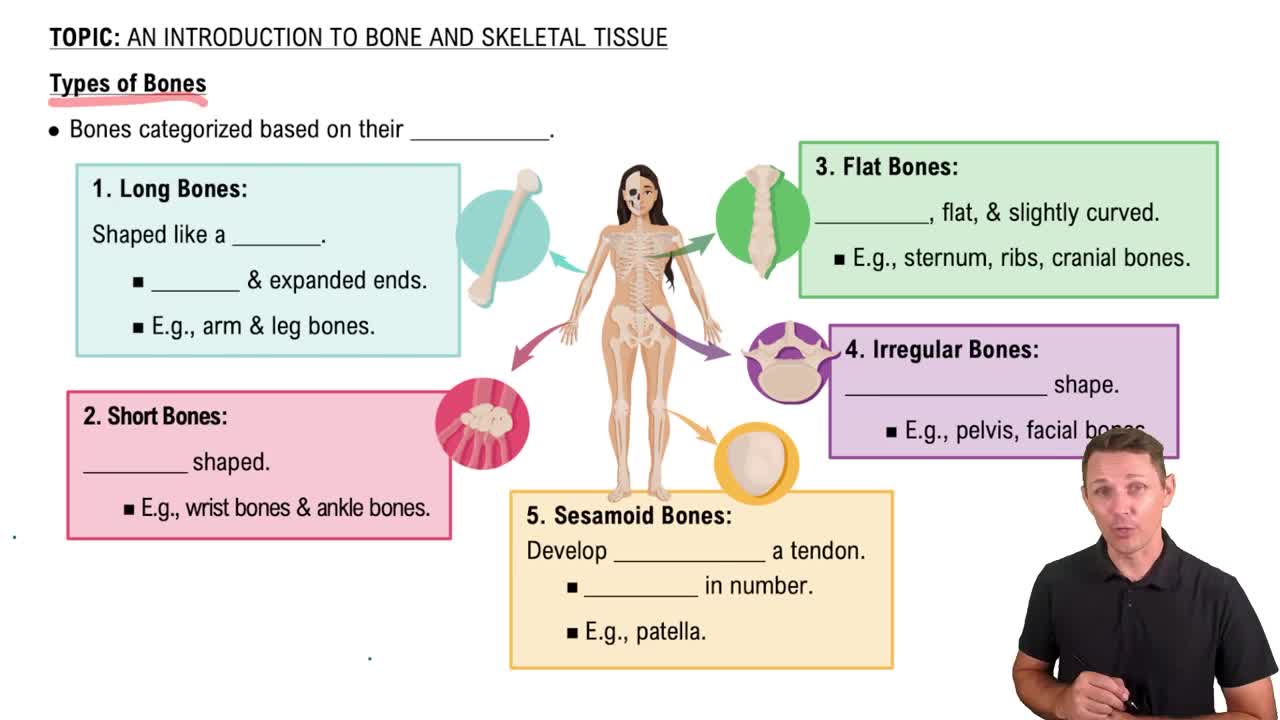
  • Bone shapes

    1. Long
    2. Short
    3. Flat
    4. Irregular
    5. Sutural (wormian)
  • Chemical composition of bone matrix

    Organic part: collagen fibers for flexible strength; inorganic part: mineral salts like calcium phosphate for hardness
  • Effect of removing collagen or mineral salts from bone

    Without collagen, bone becomes brittle. Without mineral salts, bone becomes flexible but weak.
  • Cells found in bone

    1. Osteoblasts
    2. Osteocytes
    3. Osteoclasts
    4. Osteogenic cells
  • Long bone gross anatomy parts

    1. Epiphysis - ends of the bone
    2. Diaphysis - shaft
    3. Metaphysis - region between epiphysis and diaphysis
    4. Articular cartilage - hyaline cartilage covering ends
    5. Periosteum - outer membrane
    6. Medullary cavity - contains bone marrow
    7. Endosteum - membrane lining medullary cavity
  • Bone textures

    Compact bone - dense, strong outer layer; Spongy bone - light, porous interior made of trabeculae containing marrow
  • Microscopic structure of compact bone

    Bone tissue is osseous tissue made of repeating units called osteons.
  • Central canal in osteon

    Contains blood vessels and nerves; runs longitudinally through osteon
  • Osteocytes and lacunae

    Osteocytes are mature bone cells enclosed in small chambers called lacunae
  • Volkmann's canals

    Perpendicular canals that transmit blood vessels from periosteum to central canals
  • Canaliculi function

    Tiny channels connecting osteocytes in lacunae for nutrient and waste exchange
  • Lamellae

    Concentric rings of bone matrix in osteons made of collagen fibers oriented oppositely to resist stress
  • Types of ossification

    Intramembranous ossification forms flat bones like skull; endochondral ossification forms most other bones from cartilage models
  • Bone remodeling cells

    Osteoclasts dissolve bone matrix; osteoblasts secrete new bone matrix
  • Wolff's Law

    Bone grows or remodels in response to the mechanical stress placed on it
  • Parathyroid hormone (PTH) role

    Secreted when blood calcium is low; increases blood calcium by stimulating osteoclasts and calcium absorption
  • Calcitonin role

    Secreted when blood calcium is high; lowers blood calcium by inhibiting osteoclasts and promoting calcium deposition in bone
  • Bone markings and projections

    Sites of muscle/ligament attachment or passageways for nerves and blood vessels; projections indicate stress from pulling muscles or form joint surfaces
  • Types of bone fractures

    1. Open (compound)
    2. Closed (simple)
    3. Comminuted
    4. Greenstick
    5. Compression
    6. Colles'
    7. Spiral
  • Stages of fracture healing

    1. Hematoma formation
    2. Fibrocartilage callus formation
    3. Hard bony callus formation
    4. Bone remodeling
  • Medical interventions for fractures

    Reduction: repositioning bone fragments (open or closed); Fixation: devices to stabilize bones (internal or external)
  • Aging bones and osteoporosis

    Bone resorption outpaces bone deposition, causing porous, fragile bones prone to fractures
  • Cranial bones examples

    Frontal (forehead), Parietal (sides/top), Occipital (back/base), Temporal (sides), Sphenoid (base), Ethmoid (nasal roof)
  • Facial bones examples

    Maxilla (upper jaw), Mandible (lower jaw), Zygomatic (cheekbones)
  • Sutures of the skull

    1. Coronal - between frontal and parietal bones
    2. Lambdoid - between parietal and occipital bones
    3. Squamous - between temporal and parietal bones
    4. Sagittal - between parietal bones
  • Vertebral regions

    Cervical (neck), Thoracic (mid-back), Lumbar (lower back), plus Sacrum and Coccyx
  • Thoracic cage components

    True ribs (first 7 pairs attach directly to sternum), False ribs (last 5 pairs), Floating ribs (last 2 pairs, no anterior attachment)
  • Pectoral girdle bones

    Clavicle (collar bone) and scapula (shoulder blade)
  • Arm and hand bones

    Arm: humerus; Forearm: radius and ulna; Wrist: 8 carpal bones; Hand: metacarpals; Fingers: phalanges
  • Pelvic girdle and lower limb bones

    Pelvic girdle: two hip bones; Thigh: femur; Kneecap: patella; Leg: tibia and fibula; Ankle: 7 tarsal bones; Heel bone: calcaneus; Foot: metatarsals; Toes: phalanges