Back

Anatomy & Physiology: Bones, Skeletal Tissues, and Joints

Control buttons has been changed to "navigation" mode.
1/29
  • What is skeletal cartilage primarily composed of and what is its key characteristic?

    Skeletal cartilage is made of highly resilient cartilage tissue consisting primarily of water. It contains no blood vessels or nerves.
  • Name the three types of cartilage and a key location for each.

    Hyaline cartilage: most abundant, found in articular joints.
    Elastic cartilage: contains elastic fibers, found in external ear.
    Fibrocartilage: thick collagen fibers, found in menisci of knee.
  • What are the two ways cartilage grows?

    Appositional growth: matrix secreted on cartilage surface.
    Interstitial growth: chondrocytes divide and secrete matrix from within.
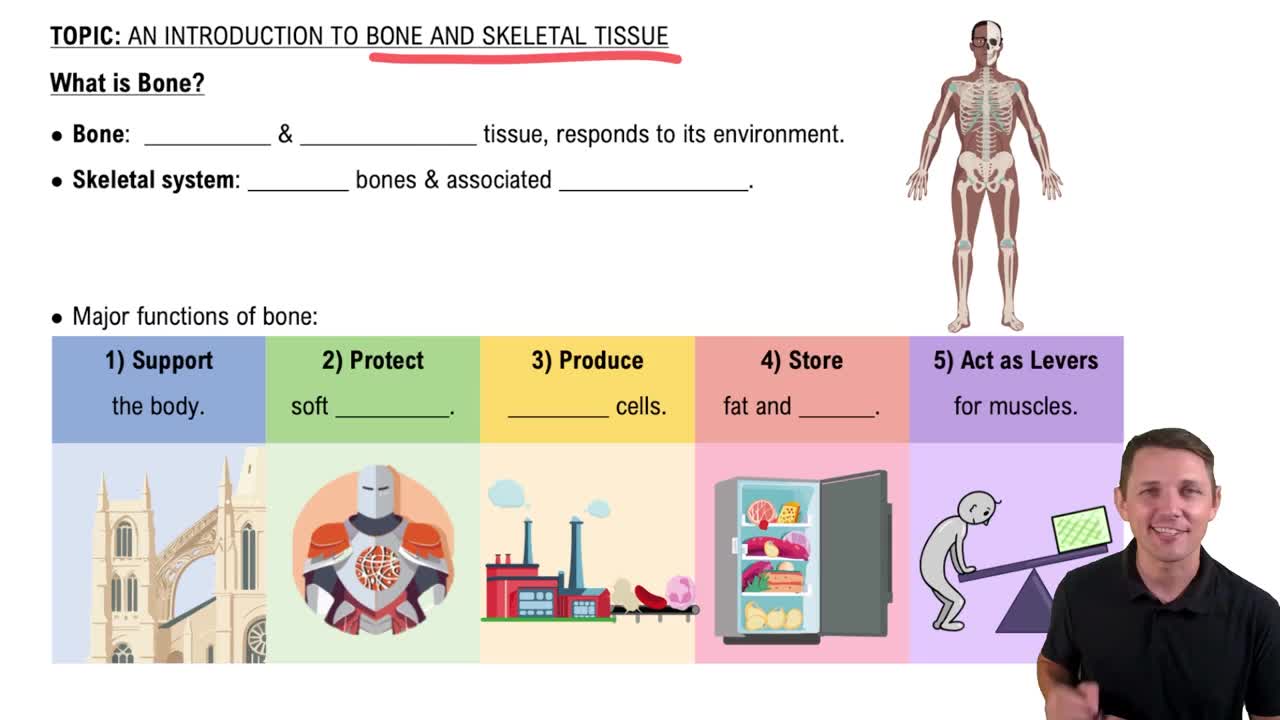
  • List the seven functions of bones.

    Support, protection, movement, mineral and growth factor storage, blood cell formation, triglyceride storage, and hormone production.
  • How are bones classified by location?

    Axial skeleton: long axis of body (skull, vertebral column, rib cage).
    Appendicular skeleton: limbs and girdles attaching limbs to axial skeleton.
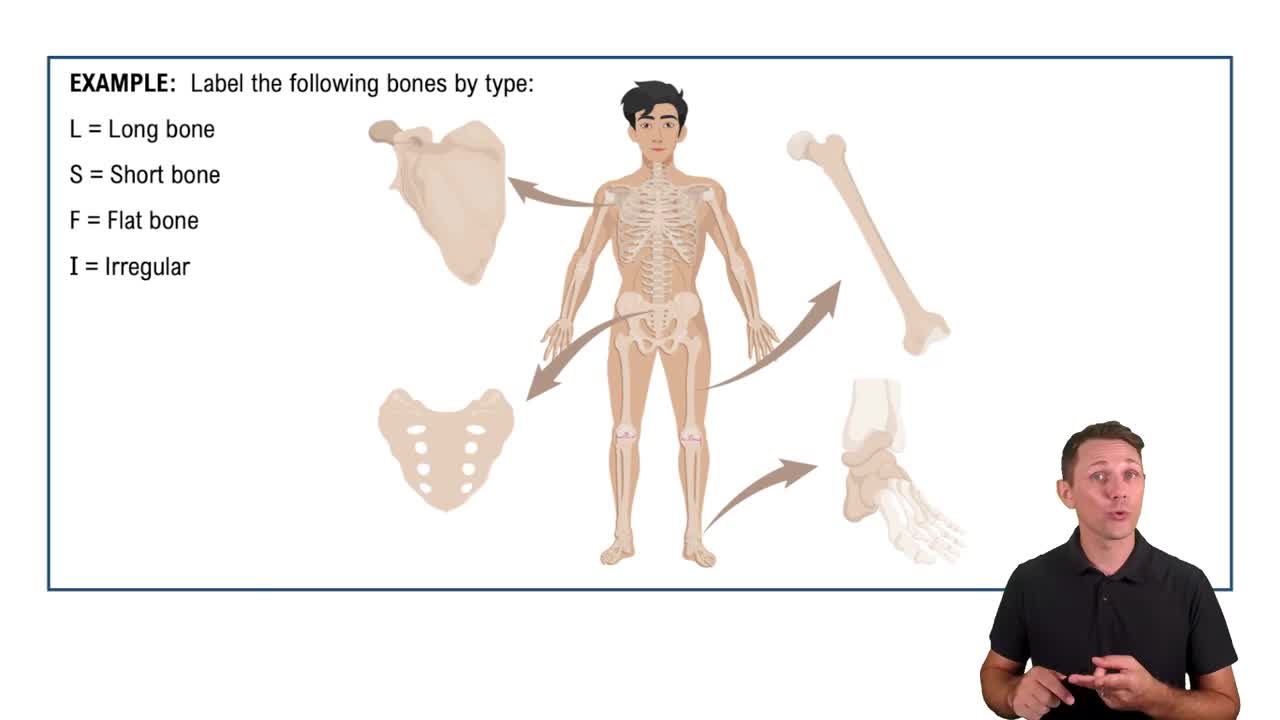
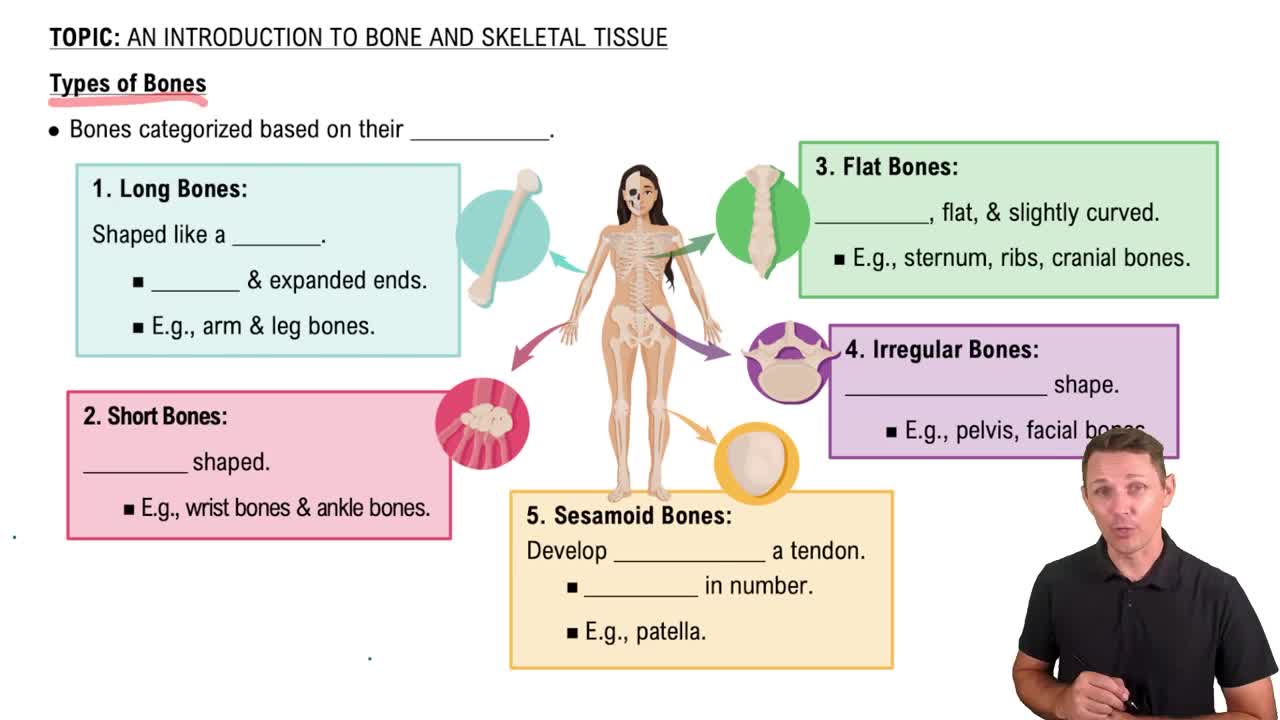
  • What are the four shapes of bones and an example of each?

    Long bones (femur), short bones (carpals), flat bones (sternum), irregular bones (vertebrae).
  • What are the two main types of bone tissue and their characteristics?

    Compact bone: dense, smooth outer layer.
    Spongy bone: honeycomb of trabeculae with marrow-filled spaces.
  • Describe the structure of a typical long bone.

    Has a diaphysis (shaft) of compact bone with medullary cavity, epiphyses (ends) with spongy bone, articular cartilage on joint surfaces, and membranes (periosteum and endosteum).
  • What is the periosteum and its layers?

    A double-layered membrane covering bone except joints.
    Fibrous layer: dense irregular connective tissue.
    Osteogenic layer: contains stem cells for bone growth.
  • Name the five major types of bone cells and their functions.

    Osteogenic cells: stem cells.
    Osteoblasts: bone-forming.
    Osteocytes: mature bone cells maintaining matrix.
    Bone-lining cells: maintain matrix.
    Osteoclasts: bone-resorbing cells.
  • What is an osteon and its components?

    Structural unit of compact bone; consists of concentric lamellae around a central (Haversian) canal containing blood vessels and nerves.
  • What are canaliculi and their function?

    Hairlike canals connecting lacunae and central canal, allowing osteocytes to communicate and exchange nutrients and wastes.
  • What is the organic and inorganic composition of bone?

    Organic: cells and osteoid (collagen and ground substance) providing tensile strength.
    Inorganic: hydroxyapatites (calcium phosphate crystals) providing hardness and resistance to compression.
  • What are the two types of ossification in bone development?

    Endochondral ossification: bone replaces hyaline cartilage.
    Intramembranous ossification: bone develops from fibrous membrane.
  • Describe the zones of the epiphyseal plate involved in bone length growth.

    Resting zone, proliferation zone (cell division), hypertrophic zone (cell enlargement), calcification zone, ossification zone (new bone formation).
  • What hormones regulate bone growth and how?

    Growth hormone stimulates epiphyseal plate activity.
    Thyroid hormone modulates growth hormone.
    Sex hormones (testosterone, estrogen) promote growth spurts and induce plate closure.
  • What is bone remodeling and which cells are involved?

    Continuous process of bone deposit by osteoblasts and bone resorption by osteoclasts to maintain bone strength and mineral homeostasis.
  • How does parathyroid hormone (PTH) regulate blood calcium levels?

    PTH is released when blood calcium is low, stimulating osteoclasts to resorb bone and release calcium into blood, restoring balance.
  • What is Wolff's law regarding bone remodeling?

    Bones grow or remodel in response to mechanical stress, becoming thicker and stronger where stress is greatest.
  • What are the four stages of bone fracture repair?

    Hematoma formation, fibrocartilaginous callus formation, bony callus formation, and bone remodeling.
  • What is osteoporosis and its risk factors?

    Disease where bone resorption exceeds deposit, leading to fragile bones. Risk factors include age, postmenopausal status, low calcium, smoking, and lack of exercise.
  • What are the three structural classifications of joints?

    Fibrous joints (dense connective tissue, no cavity), cartilaginous joints (cartilage, no cavity), synovial joints (fluid-filled cavity, freely movable).
  • What are the functional classifications of joints by movement?

    Synarthroses: immovable.
    Amphiarthroses: slightly movable.
    Diarthroses: freely movable.
  • Name the six general features of synovial joints.

    Articular cartilage, joint cavity, articular capsule, synovial fluid, reinforcing ligaments, nerves and blood vessels.
  • What factors influence the stability of synovial joints?

    Shape of articular surface, number and location of ligaments, and muscle tone (most important).
  • List the types of movements allowed by synovial joints.

    Gliding, angular (flexion, extension, abduction, adduction, circumduction), rotation, and special movements like supination, pronation, dorsiflexion.
  • What are the six types of synovial joints based on shape?

    Plane, hinge, pivot, condylar, saddle, ball-and-socket joints.
  • What are common joint injuries and their characteristics?

    Cartilage tears (often in menisci), sprains (ligament tears), dislocations (bones forced out of alignment).
  • Describe osteoarthritis and rheumatoid arthritis.

    Osteoarthritis: degenerative wear-and-tear arthritis.
    Rheumatoid arthritis: chronic autoimmune inflammation causing joint destruction.