Skip to main content
Anatomy & Physiology
My Course
Learn
Exam Prep
AI Tutor
Study Guides
Textbook Solutions
Flashcards
Explore
Try the app
My Course
Learn
Exam Prep
AI Tutor
Study Guides
Textbook Solutions
Flashcards
Explore
Try the app
Back
Anatomy & Physiology: Cardiovascular, Lymphatic, Respiratory, Digestive, Urinary, Reproductive, and Development Systems
You can tap to flip the card.
Myocardium
You can tap to flip the card.
👆
Myocardium
The thick, muscular layer of the heart wall composed of specialized cardiac muscle cells called cardiomyocytes responsible for rhythmic contractions.
Track progress
Control buttons has been changed to "navigation" mode.
1/29
Recommended videos
Guided course
6:13
Control of Heart Rate
6783
views
139
rank
Guided course
8:41
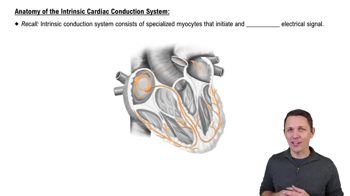
Anatomy of the Intrinsic Cardiac Conduction System
11264
views
280
rank
1
comments
Guided course
3:42
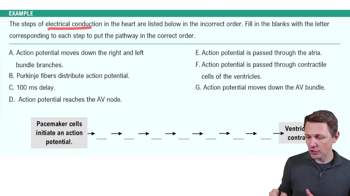
Electrical Conduction System of the Heart Example 2
6396
views
155
rank
Terms in this set (29)
Hide definitions
Myocardium
The thick, muscular layer of the heart wall composed of specialized cardiac muscle cells called cardiomyocytes responsible for rhythmic contractions.
Intercalated Discs
Specialized junctions between cardiomyocytes containing desmosomes for mechanical attachment and gap junctions for electrical impulse passage.
Right Atrium
Heart chamber that receives deoxygenated blood from the body via the superior and inferior vena cava.
Left Ventricle
Heart chamber that pumps oxygenated blood to the body through the aorta; has the thickest wall for high-pressure systemic circulation.
Tricuspid Valve
Valve between right atrium and right ventricle that prevents backflow into the atrium.
Pulmonary Circuit
Circulatory pathway: right ventricle → pulmonary arteries → lungs → pulmonary veins → left atrium.
Tunica Media
Middle layer of blood vessels made of smooth muscle and elastic fibers that regulate vessel diameter and blood pressure.
Differences between Arteries and Veins
Arteries have thick muscular walls, smaller lumen, no valves, and high pressure; veins have thin walls, larger lumen, valves, and low pressure.
Capillaries
Blood vessels with a single endothelial layer where exchange of gases, nutrients, and wastes occurs.
Lymph
Clear fluid derived from interstitial fluid that returns excess tissue fluid to the bloodstream and transports immune cells.
Right Lymphatic Duct
Drains lymph from the right upper quadrant of the body into the right subclavian vein.
Diaphragm function in respiration
Main muscle of ventilation; contracts for inhalation and relaxes for exhalation.
Medulla Oblongata and Pons
Brain centers that control breathing rate and depth.
Digestive tract pathway
Mouth → Pharynx → Esophagus → Stomach → Small Intestine → Large Intestine → Anus.
Histological layers of the digestive tube
Mucosa (secretion, absorption), Submucosa (support), Muscularis externa (peristalsis), Serosa/Adventitia (protection).
Nephron
Functional unit of the kidney including renal corpuscle and renal tubule responsible for filtration, reabsorption, and secretion.
RAAS system
Renin-Angiotensin-Aldosterone System that increases blood pressure by producing angiotensin II and aldosterone.
Spermatogenesis vs Spermiogenesis
Spermatogenesis is sperm formation; spermiogenesis is maturation of spermatids into spermatozoa.
Ovarian cycle phases
Follicular phase (FSH stimulates follicles), ovulation (LH surge), luteal phase (corpus luteum secretes progesterone).
Germ layers formed during gastrulation
Ectoderm (skin, nervous system), Mesoderm (muscles, bones, cardiovascular), Endoderm (epithelial linings).
Placenta function
Site of nutrient, gas, and waste exchange between maternal and fetal blood.
Fetal circulation structures
Foramen ovale (atria opening) and ductus arteriosus (connects pulmonary artery to aorta) close after birth.
Umbilical cord vessels
Two arteries carry deoxygenated blood to placenta; one vein carries oxygenated blood to fetus.
Cardiac cycle phases
Systole: ventricular contraction ejecting blood; Diastole: ventricular relaxation filling chambers.
Pulmonary arteries vs pulmonary veins
Pulmonary arteries carry deoxygenated blood to lungs; pulmonary veins return oxygenated blood to the heart.
Precapillary sphincters
Muscle rings that regulate blood flow into capillary beds.
Lymphocyte types and functions
B cells produce antibodies; T cells mediate cell immunity; NK cells destroy infected or tumor cells.
Hormonal regulation of early pregnancy
hCG maintains corpus luteum; progesterone and estrogen support endometrium.
Labor stages
Cervical dilation, fetal descent, and expulsion of fetus and placenta.
 BackBack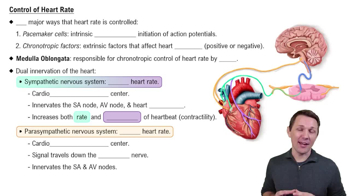
 6:13
6:13