 Back
BackAnatomy & Physiology: Cell Structure and Membrane Functions
 02:21
02:21
Terms in this set (29)
Cell metabolism, transport of substances, communication, and cell reproduction.
Plasma membrane, cytoplasm (cytosol, organelles, cytoskeleton), and nucleus.
Separates extracellular fluid (ECF) from intracellular fluid (ICF) and controls substance movement between compartments.
Hydrophilic phosphate heads face cytosol and ECF; hydrophobic fatty acid tails face inward.
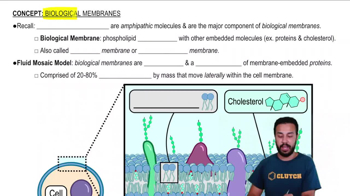
Membrane is a dynamic, fluid structure with components moving laterally within the phospholipid bilayer.
Integral proteins (including transmembrane) and peripheral proteins on one membrane side.
Act as channels, carriers, enzymes, receptors, and provide structural support.
Allows some substances to pass while restricting others, maintaining internal environment.
Passive transport requires no ATP and moves substances down gradients; active transport requires ATP to move substances against gradients.
Movement of solutes directly through the phospholipid bilayer down their concentration gradient.
Movement of polar or ionic solutes across membrane via protein channels or carrier proteins without ATP.
Passive movement of water across a selectively permeable membrane from low to high solute concentration.
Isotonic: no net water movement; hypertonic: water leaves cell; hypotonic: water enters cell.
Membrane protein uses ATP to pump solutes against their concentration gradient (e.g., sodium-potassium pump).
Uses energy from a primary active transport-created gradient to move another solute against its gradient.
Charge separation across the membrane with positive charges in ECF and negative charges in cytosol
Active transport involving membrane-enclosed vesicles to move large substances into or out of the cell.
Phagocytosis: ingestion of large particles; pinocytosis: ingestion of dissolved substances; receptor-mediated endocytosis: ligand-specific uptake.
Process of releasing large substances from the cell by vesicle fusion with the plasma membrane.
Provides cell shape, mechanical support, moves organelles, divides the cell, and enables cell movement.
Actin filaments (shape and movement), intermediate filaments (mechanical strength), microtubules (organelle positioning, cilia, flagella).
Microvilli increase surface area; cilia move substances; flagella propel the cell.
Contains most DNA and controls cell functions.
DNA in nucleoplasm as chromatin condenses into chromosomes during cell division; humans have 23 pairs.
Non-membrane organelles that synthesize proteins.
Rough ER has ribosomes and modifies proteins; Smooth ER synthesizes lipids, stores calcium, detoxifies substances.
Modifies, packages, and directs proteins for secretion, membrane insertion, or lysosome incorporation.
Contain digestive enzymes to break down substances and worn-out organelles.
Interphase (G1, S, G2 phases) and M phase (mitosis and cytokinesis).