Skip to main content
Anatomy & Physiology
My Course
Learn
Exam Prep
AI Tutor
Study Guides
Textbook Solutions
Flashcards
Explore
Try the app
My Course
Learn
Exam Prep
AI Tutor
Study Guides
Textbook Solutions
Flashcards
Explore
Try the app
Back
Anatomy & Physiology: Cell Structure, Transport, and Genetics
You can tap to flip the card.
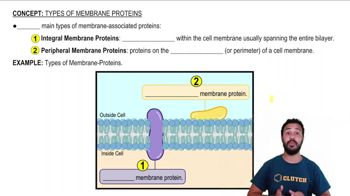
Ion channels are examples of which type of membrane protein?
You can tap to flip the card.
👆
Ion channels are examples of which type of membrane protein?
Ion channels are examples of
integral proteins
because they are embedded within the membrane.
Track progress
Control buttons has been changed to "navigation" mode.
1/24
Recommended videos
03:54
Membrane Protein Functions
18178
views
268
rank
03:05
Types of Membrane Proteins
20544
views
357
rank
Terms in this set (24)
Hide definitions
Ion channels are examples of which type of membrane protein?
Ion channels are examples of
integral proteins
because they are embedded within the membrane.
In which direction do substances diffuse relative to their concentration gradient?
Substances diffuse
down their concentration gradient
, moving from higher to lower concentration.
Ion pumps and phagocytosis are examples of what type of transport?
They are examples of
active transport
, requiring energy to move substances against gradients or engulf particles.
Complete the analogy: Diffusion is to ________ as endocytosis is to ________.
Diffusion is to
gradient
as endocytosis is to
chemical energy
.
Cytoplasm is to cytosol as a swimming pool with chlorine and toys is to what?
Cytoplasm is to cytosol as the pool water containing chlorine is to the cytosol, the fluid portion inside the cell.
Why is the rough ER called 'rough'?
Because it has
ribosomes
attached to its surface.
What is a primary function of the rough ER?
The rough ER is responsible for the
production of proteins
.
What common feature do all cytoskeleton components share?
They are all
polymers of protein subunits
.
Which organelle produces large quantities of ATP when glucose and oxygen are available?
The
mitochondria
produce large amounts of ATP under these conditions.
What feature do the nucleus and mitochondria share?
Both have a
double membrane
.
Which structure is found within the nucleolus?
The nucleolus contains
ribosomes
.
What is the complementary DNA sequence to GCTTATAT?
The complementary sequence is
CGAATATA
.
Order these from least to most complex: chromatin, nucleosome, DNA, chromosome.
The correct order is
DNA, nucleosome, chromatin, chromosome
.
What happens during the elongation step of DNA synthesis?
Complementary nucleotides are
attached to the template strand
.
Which is NOT a difference between DNA and RNA?
DNA contains alternating sugar-phosphate molecules whereas RNA does not contain sugars is
not true
; both have sugar-phosphate backbones.
Where do transcription and translation occur in the cell?
Transcription occurs in the
nucleus
and translation in the
cytoplasm
.
How many RNA nucleotides code for one amino acid?
Three RNA nucleotides (a codon) code for one amino acid.
Which is not mostly made of RNA?
The
messenger RNA (mRNA)
provides the code for protein synthesis but is not mostly RNA in structure like ribosomes or tRNA.
Which cell cycle phase is characterized by preparation for DNA synthesis?
The
G1 phase
prepares the cell for DNA synthesis.
What might a mutation in a cyclin gene cause?
It might cause
cancer
or abnormal amounts of genetic material in cells.
What is the primary function of tumor suppressor genes?
They
stop certain cells from dividing
to prevent uncontrolled growth.
Order these stem cell potencies from least to most specialized: oligopotency, pleuripotency, unipotency, multipotency.
The order is
pleuripotency, multipotency, oligopotency, unipotency
.
Which stem cell type gives rise to red and white blood cells?
The
hematopoietic stem cells
produce red and white blood cells.
What multipotent stem cells from children are sometimes banked by parents?
Cells from the
umbilical cord and baby teeth
are often banked.
 BackBack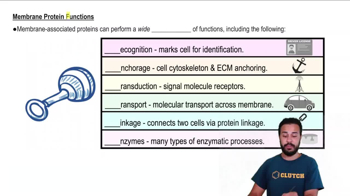
 03:54
03:54