 Back
BackAnatomy & Physiology: Central Nervous System and Brain
 0:50
0:50
Terms in this set (29)
Consists of the brain and spinal cord, responsible for processing and integrating information.
Rostral means toward the nose; caudal means toward the tail.
Provides a two-way conduction pathway, serves as a major center for reflexes, and spinal nerves attach to it.
Runs through the vertebral canal, extending from the foramen magnum to vertebra L1 or L2.
The inferior end of the spinal cord.
A long filament of connective tissue that attaches the spinal cord to the coccyx inferiorly.
A collection of spinal nerve roots resembling a horse's tail below the spinal cord.
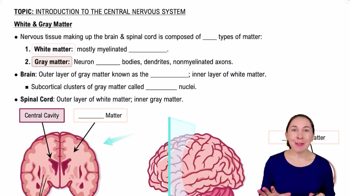
Located in the outer region, composed of myelinated and unmyelinated axons, allowing communication between spinal cord and brain.
Shaped like an H, contains dorsal horns (interneurons) and ventral/lateral horns (motor neuron cell bodies).
Three layers: dura mater (outer), arachnoid mater (middle), and pia mater (innermost, delicate layer).
Provides a liquid cushion, nourishes brain and spinal cord, removes wastes, and carries chemical signals within the CNS.
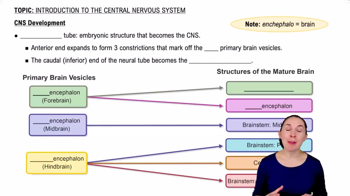
Prosencephalon (forebrain), mesencephalon (midbrain), and rhombencephalon (hindbrain).
Prosencephalon divides into telencephalon and diencephalon; rhombencephalon divides into metencephalon and myelencephalon; mesencephalon remains undivided.
Includes the midbrain, pons, and medulla oblongata.
Produces automatic behaviors for survival, serves as a passageway for fiber tracts, and innervates the face and head.
Includes pyramids (ventral surface), decussation of pyramids (motor tract crossing), inferior cerebellar peduncles, and the olive (inferior olivary nucleus).
Cranial nerves VIII (Vestibulocochlear), IX (Glossopharyngeal), X (Vagus), XI (Accessory), and XII (Hypoglossal).
Acts as a bridge between midbrain and medulla; contains nuclei for cranial nerves V (Trigeminal), VI (Abducens), and VII (Facial).
Contains the cerebral aqueduct, cerebral peduncles (corticospinal tracts), superior cerebellar peduncles, and nuclei like substantia nigra and red nucleus.
Coordinates body movements, maintains equilibrium, and receives input about limb, neck, and trunk movements.
Includes the thalamus, hypothalamus, and epithalamus, surrounding the third ventricle.
Acts as a relay station for sensory messages to the cerebral cortex and modulates signal intensity.
Controls autonomic nervous system, emotional responses, body temperature, hunger, thirst, sleep-wake cycles, endocrine system, and memory formation.
Forms part of the roof of the third ventricle; pineal gland secretes melatonin to regulate circadian rhythms.
Home of the conscious mind; enables awareness, voluntary movement, communication, memory, and understanding.
Located in the postcentral gyrus; involved in conscious awareness and spatial discrimination of somatic senses.
A body map of the motor cortex showing spatial representation of body parts controlling voluntary movements.
Located in the left cerebral hemisphere; responsible for speech production and connected to language comprehension areas.
Protects the brain by preventing most blood-borne toxins from entering; allows nutrients like oxygen but permits alcohol, nicotine, and anesthetics.