Back

Anatomy & Physiology: Central Nervous System and Brain Functions

Control buttons has been changed to "navigation" mode.
1/29
  • Central Nervous System (CNS) main function

    The CNS performs the integrative nervous system functions, processing and coordinating sensory data and motor commands.
  • Four divisions of the brain

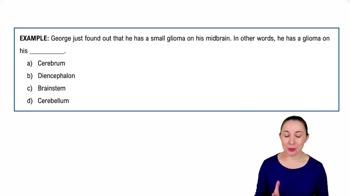
    The brain is divided into the cerebrum, diencephalon, cerebellum, and brainstem.
  • Composition of the CNS

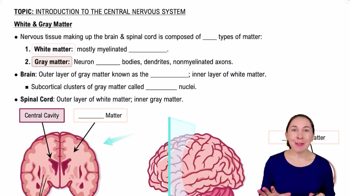
    The CNS contains gray matter (nuclei) and white matter (myelinated axons).
  • Development of the CNS

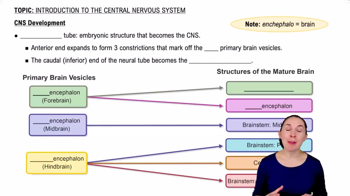
    The CNS develops from the neural tube, which forms primary and secondary brain vesicles by the fourth week of development.
  • Cerebral cortex function and lobes

    The cerebral cortex is the outer gray matter of the cerebrum involved in conscious processes, with five lobes: frontal, parietal, occipital, temporal, and insula.
  • Types of neocortex

    The neocortex includes the primary motor cortex, primary sensory cortices, and association areas.
  • Basal nuclei and their role

    The basal nuclei (caudate nucleus, putamen, globus pallidus) function in movement control.
  • Types of cerebral white matter fibers

    Commissural fibers connect hemispheres, projection fibers connect cerebrum to CNS, and association fibers connect gyri.
  • Limbic system components and functions

    Includes the limbic lobe gyri, hippocampus, amygdala; functions in memory, learning, emotion, and behavior.
  • Diencephalon divisions and key functions

    Includes the thalamus (sensory gateway), hypothalamus (homeostasis and endocrine control), subthalamus, and epithalamus (pineal gland).
  • Hypothalamus roles

    Regulates homeostasis, sleep/wake cycle, autonomic nervous system, endocrine system, emotion, behavior, and memory.
  • Cerebellum structure and function

    Located below occipital lobe, has three lobes and two hemispheres connected by the vermis; coordinates movement.
  • Brainstem divisions and functions

    Includes midbrain (movement, sensation, reflexes), pons (movement, breathing, sleep), and medulla oblongata (decussation of tracts, autonomic functions).
  • Reticular formation functions

    A group of nuclei in the brainstem involved in sleep, pain transmission, motor functions, autonomic control, mood, and sensation.
  • Systems maintaining homeostasis

    The endocrine system and nervous system maintain homeostasis.
  • Nervous system structures key to homeostasis

    The hypothalamus and reticular formation are most involved in homeostasis.
  • Autonomic nervous system control

    The hypothalamus regulates the ANS by relaying instructions to the reticular formation nuclei.
  • Sleep regulation

    Sleep follows a circadian rhythm set by the suprachiasmatic nucleus of the hypothalamus and involves stages I-IV and REM sleep.
  • Language centers in the brain

    Broca's area controls language production, and Wernicke's area controls language comprehension, mostly lateralized to the left hemisphere.
  • Memory types and consolidation

    Declarative memory is conscious facts; nondeclarative is subconscious skills. Consolidation moves short-term memory into long-term memory.
  • Protection of the brain: meninges

    The three cranial meninges are dura mater, arachnoid mater, and pia mater, with subdural and subarachnoid spaces.
  • Cerebrospinal fluid (CSF) functions

    CSF cushions the brain, increases buoyancy, maintains temperature, and is produced by the choroid plexus in ventricles.
  • Blood-brain barrier purpose

    It separates blood in brain capillaries from extracellular fluid, protecting the CNS from harmful substances.
  • Spinal cord roles

    Acts as a relay between brain and body and performs some processing and integration.
  • Spinal cord gray matter horns

    Anterior horn contains lower motor neurons; posterior horn processes sensory stimuli; lateral horn contains autonomic neurons.
  • White matter funiculi in spinal cord

    The posterior, lateral, and anterior funiculi contain ascending and descending tracts.
  • Somatic sensory pathways to brain

    Posterior columns carry tactile and proprioception; anterolateral system carries pain, temperature, and nondiscriminative touch.
  • Upper motor neurons and voluntary movement

    Upper motor neurons in the cerebral cortex plan and execute voluntary movement by stimulating interneurons and lower motor neurons.
  • Role of basal nuclei and cerebellum in movement

    Basal nuclei inhibit inappropriate movements; cerebellum regulates ongoing movement and corrects motor errors.