Back

Anatomy & Physiology: Chapter 18 Heart and Cardiac Function Review

Control buttons has been changed to "navigation" mode.
1/23
  • Route of deoxygenated blood through the heart

    Deoxygenated blood enters the right atrium via the superior and inferior vena cava, passes through the tricuspid valve into the right ventricle, then is pumped through the pulmonary semilunar valve into the pulmonary trunk and arteries to the lungs.
  • Route of oxygenated blood through the heart

    Oxygenated blood returns from the lungs via pulmonary veins to the left atrium, passes through the bicuspid (mitral) valve into the left ventricle, then is pumped through the aortic semilunar valve into the aorta and out to the body.
  • Major heart valves and their functions

    Tricuspid valve controls flow from right atrium to right ventricle; pulmonary semilunar valve controls flow from right ventricle to pulmonary trunk; bicuspid (mitral) valve controls flow from left atrium to left ventricle; aortic semilunar valve controls flow from left ventricle to aorta.
  • Structural differences between cardiac and skeletal muscle

    Cardiac muscle cells are short, branched, with a single nucleus and intercalated discs; skeletal muscle fibers are long, cylindrical, multinucleated, and lack intercalated discs.
  • Functional differences between cardiac and skeletal muscle

    Cardiac muscle is involuntary, autorhythmic, has a long refractory period preventing tetany, and is rich in mitochondria; skeletal muscle is voluntary, requires nervous stimulation, has a short refractory period, and fewer mitochondria.
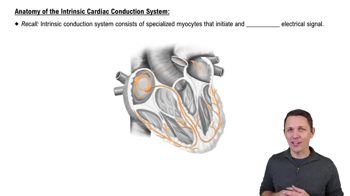
  • Components of the cardiac conduction system

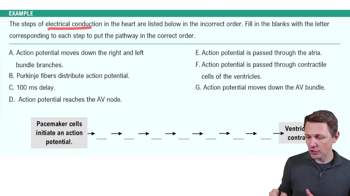
    SA node (pacemaker), internodal pathways, AV node (delays impulse), AV bundle (Bundle of His), right and left bundle branches, and Purkinje fibers.
  • Role of the SA node in the heart

    The SA node initiates the heartbeat by generating the action potential that spreads through the atria.
  • Function of the AV node

    The AV node delays the electrical impulse to allow atrial contraction before ventricular contraction.
  • Phases of cardiac muscle action potential

    Depolarization: Na+ influx; Plateau: Ca2+ influx prolongs contraction; Repolarization: K+ efflux.
  • ECG wave components and their meanings

    P wave: atrial depolarization; QRS complex: ventricular depolarization and atrial repolarization; T wave: ventricular repolarization.
  • What does the PR interval represent on an ECG?

    The time from atrial depolarization to ventricular depolarization.
  • Sequence of events in the cardiac cycle

    Ventricular filling (diastole), atrial contraction, isovolumetric contraction (systole), ventricular ejection (systole), isovolumetric relaxation (diastole).
  • Heart sounds and their causes

    "Lub" is caused by AV valves closing; "Dub" is caused by semilunar valves closing.
  • Formula for cardiac output (CO)

    CO = Heart Rate × Stroke Volume, where CO is cardiac output.
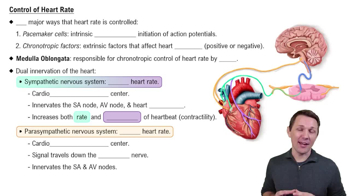
  • Sympathetic nervous system effect on the heart

    Increases heart rate and contractility via norepinephrine.
  • Parasympathetic nervous system effect on the heart

    Decreases heart rate via acetylcholine released by the vagus nerve.
  • Factors affecting cardiac output besides nervous control

    Hormones (epinephrine, thyroid), physical fitness, preload (venous return), afterload (arterial pressure), and contractility.
  • Definition of arrhythmias

    Abnormal heart rhythms including bradycardia, tachycardia, and atrial or ventricular fibrillation.
  • What is heart block?

    Impaired conduction between atria and ventricles, which can be partial or complete.
  • Causes of heart murmurs

    Abnormal heart sounds caused by valve defects such as stenosis (narrowing) or regurgitation (leakage).
  • Definition of congestive heart failure

    A condition where the heart cannot pump enough blood to meet the body's needs.
  • What causes a myocardial infarction?

    A heart attack caused by blocked coronary arteries leading to heart muscle damage.
  • Types of valve disorders

    Stenosis (narrowing of valve), regurgitation (leakage), and prolapse (valve flaps bulge backward).