 Back
BackAnatomy & Physiology: Chemistry Basics
 02:13
02:13
Terms in this set (44)
Matter is anything that has mass and occupies space. It can be seen, smelled, or felt and exists in three states: solid, liquid, and gas.
Energy is the capacity to do work or put matter into motion. It exists as kinetic energy (energy in action) and potential energy (stored energy).
Carbon, oxygen, hydrogen, and nitrogen make up 96% of the human body.
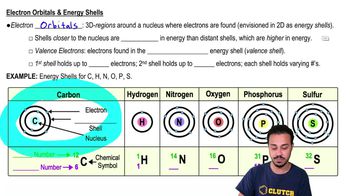
An atom consists of a nucleus containing protons (positive charge) and neutrons (neutral), with electrons (negative charge) orbiting around the nucleus.
Atomic number is the number of protons in the nucleus. Mass number is the total number of protons and neutrons in the nucleus.
Isotopes are structural variations of the same element with the same number of protons but different numbers of neutrons.
Mixtures are physical combinations of two or more components. Types include solutions (homogeneous), colloids (heterogeneous, cloudy), and suspensions (heterogeneous, particles settle out).
Mixtures do not involve chemical bonding and can be separated physically; compounds involve chemical bonds and are homogeneous.
Electrons in the outermost shell (valence shell) determine chemical bonding by being gained, lost, or shared to achieve full valence shells.
Ionic bonds form when valence electrons are transferred from one atom to another, creating oppositely charged ions that attract each other.
Covalent bonds form by sharing valence electrons. Types include nonpolar (equal sharing) and polar (unequal sharing) covalent bonds.
Hydrogen bonds are weak attractions between a slightly positive hydrogen atom and a slightly negative atom in another molecule, important in water properties and molecular shapes.
Synthesis (combination), decomposition (breakdown), and exchange (displacement) reactions.
Exergonic reactions release energy; endergonic reactions absorb energy.
Temperature, concentration of reactants, particle size, and presence of catalysts affect reaction speed.
Inorganic compounds lack carbon (e.g., water, salts). Organic compounds contain carbon and are usually large (e.g., carbohydrates, lipids, proteins, nucleic acids).
Acids donate hydrogen ions (H+), while bases accept hydrogen ions.
The pH scale measures hydrogen ion concentration from 0 to 14; acidic solutions have pH <7, neutral is 7, and alkaline (basic) solutions have pH >7.
Dehydration synthesis joins monomers by removing water; hydrolysis breaks bonds by adding water.
Monosaccharides are single sugars, disaccharides are two sugars linked, and polysaccharides are many sugars linked.
Saturated fats have single bonds and are solid at room temperature; unsaturated fats have double bonds causing kinks and are liquid at room temperature.
Phospholipids have a polar hydrophilic head and nonpolar hydrophobic tails, important in cell membrane structure.
Primary (amino acid sequence), secondary (alpha helix or beta sheet), tertiary (3D folding), and quaternary (multiple polypeptides).
Loss of protein's 3D shape due to pH or temperature changes, often causing loss of function.
Enzymes are biological catalysts that lower activation energy and speed up chemical reactions without being consumed.
Nucleic acids (DNA and RNA) are polymers of nucleotides, which consist of a nitrogen base, pentose sugar, and phosphate group.
ATP stores and provides immediate energy for cellular work by transferring phosphate groups.
Biochemistry
the study of chemical composition and reactions of living matter
Inorganic compounds
water, salts and many acids and bases
-does not contain carbon
Organic compounds
carbohydrates, fats, protiens and nucleic acids
-contain carbon, usually large and are covalent bonded
Acids and bases
are both electrolytes
acids
they release Hydrogen ions
-proton donors
-Important acids: HCl (hydrochloric acid)
Bases
they pick up Hydrogen ions
-proton acceptors
-when it dissolves in a solution it releases a hydroxyl ion (OH-)
-Important bases: Bicorbonate and ammonia
Neutralization reaction
acids and bases are mixed together
-displacement reactions occur, forming water and a salt
ex. NaOH + HCl -> NaCl + H2O
Buffers
resist abrupt and large swings in pH
-can release hydrogen ions if the pH rises
-can bind hydrogen ions if pH falls
keeps the pH from changing
Carbonic acid-bicarbonate system
Important buffer system of blood
Carbon
-shares electrons; never gain or lose them
-forms 4 covalent bonds with other elements
Carbon is unique to living systems
4 Major organic compunds:
carbohydrates
lipids
proteins
nucleic acids
Carbohydrates
Sugara and starches
(CH2)n
n = number of carbon atoms
monomer
building block of all of the carbohydrates
Important monosaccharides
-Pentose sugar
ribose and deoxyribose
-Hexose sugar
glucose (blood sugar)
Important disaccharides
-Sucrose
-Maltose
-Lactose
Important polysaccharides
-Starch: carbohydrate storage from used plants
-Gylcogen: carbohydrate storage form used by animals
not very soluble
polymers of monosaccharides
Main types of lipids
-Triglycerides
-Phospholipids
-Steroids
-Eicosanoids