 Back
BackAnatomy & Physiology: Chemistry of Life
 02:13
02:13
Terms in this set (26)
Matter is anything that occupies space and has mass.
Mass is the amount of matter in a substance; Weight is the force of gravity on that mass.
An element cannot be split into smaller substances by ordinary means.
96% of the body is made of 4 elements: Oxygen (O), Carbon (C), Nitrogen (N), Hydrogen (H).
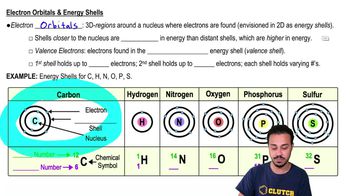
An atom has a nucleus with protons (+) and neutrons (neutral), and electrons (-) orbiting in energy shells.
Atomic number = number of protons; Mass number = protons + neutrons.
An isotope is an atom of the same element with a different number of neutrons.
An ion is an atom that has gained or lost electrons, acquiring a charge.
A molecule is 2+ atoms bonded; a compound is 2+ atoms of different elements bonded.
Suspension: large particles settle out; Colloid: small particles do not settle; Solution: solute dissolved in solvent, clear.
Ionic bonds form when cations (+) and anions (-) attract each other.
Covalent bonds form when atoms share electrons; can be nonpolar (equal sharing) or polar (unequal sharing).
Hydrogen bonds are weak bonds that link molecules together, important for water properties.
Synthesis: A + B → AB; Decomposition: AB → A + B; Exchange: A + BC → AB + C.
Exergonic reactions release energy; endergonic reactions require energy; activation energy is needed to start reactions.
Enzymes are catalysts that speed reactions, specific to substrates, and are not changed by the reaction.
Inorganic: no C-H chains (water, salts, acids, bases); Organic: contain C-H chains, usually with oxygen.
Water is polar, a solvent, has high heat capacity, and provides lubrication and cushioning.
Acids dissociate into H+ and anions; Bases dissociate into OH- and cations; Salts dissociate into cations and anions without H+ or OH-.
pH measures H+ concentration; buffers maintain homeostasis by converting strong acids/bases to weak ones.
Dehydration builds polymers by removing water; Hydrolysis breaks polymers by adding water.
Contain C, H, O in 1:2:1 ratio; provide energy; include monosaccharides, disaccharides, and polysaccharides like glycogen and starch.
Contain C, H, O; hydrophobic; include triglycerides, phospholipids (cell membranes), and cholesterol.
Contain C, H, O, N; made of amino acids linked by peptide bonds; functions include regulation, protection, contraction, and transport.
Contain C, H, O, N, P; made of nucleotides with nitrogenous base, sugar, and phosphate; include DNA and RNA.
ATP has 3 phosphate groups, a 5-carbon sugar, and adenosine; it provides energy for cellular work.