Back

Anatomy & Physiology: Connective Tissue and Blood

Control buttons has been changed to "navigation" mode.
1/22
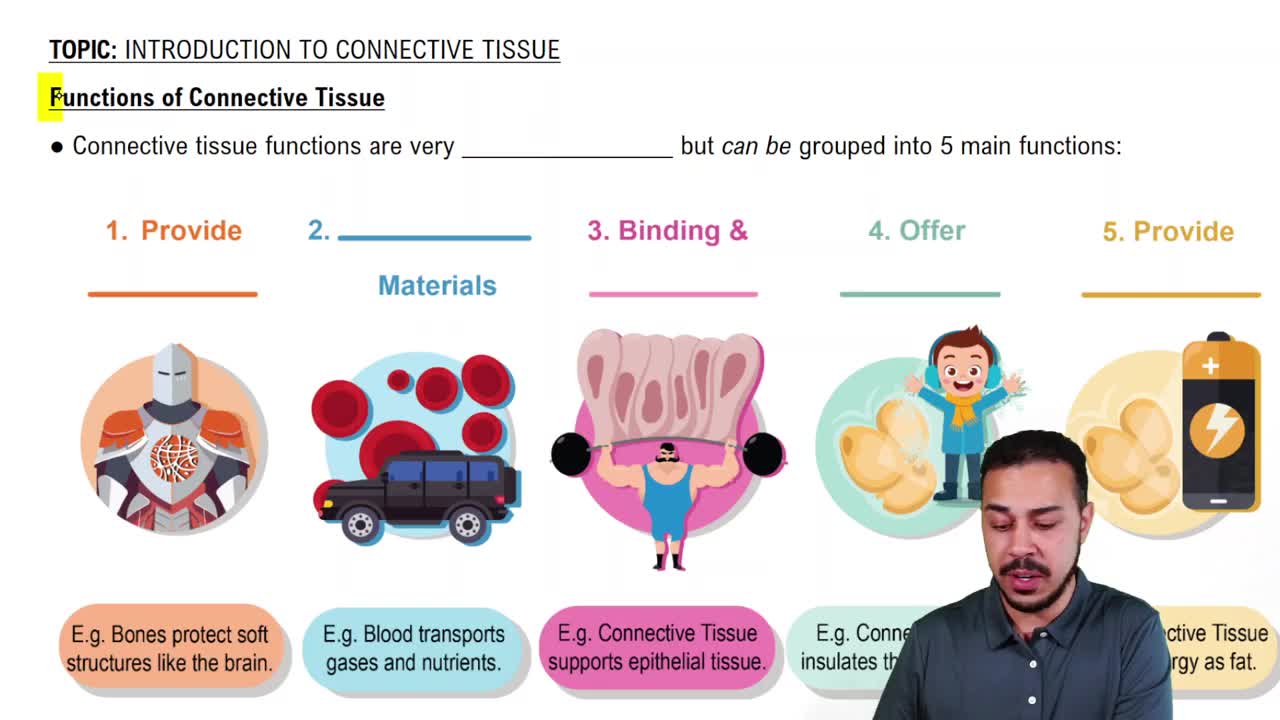
  • Functions of connective tissue

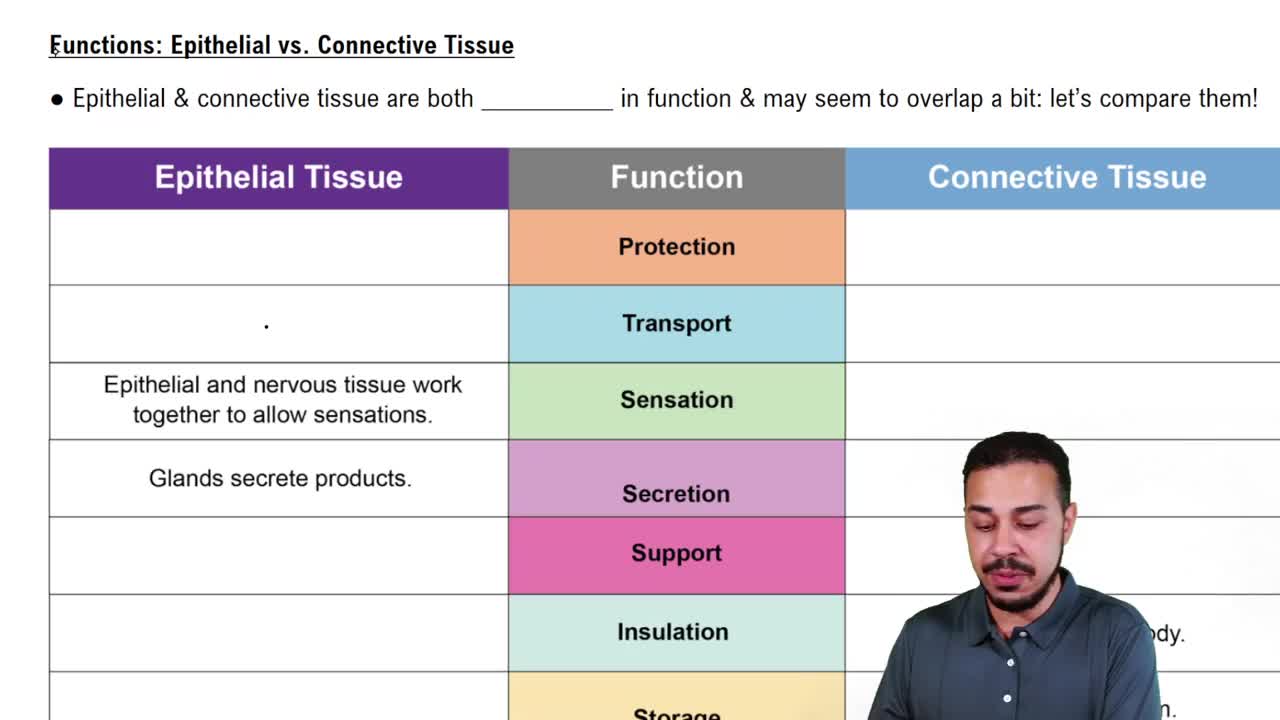
    • Establish structural framework
    • Transport fluids and materials
    • Protect organs
    • Support and interconnect tissues
    • Store energy (triglycerides)
    • Defend against microorganisms
  • Categories of connective tissue

    • Connective tissue proper (connect and protect)
    • Fluid connective tissues (blood and lymph - transport)
    • Supporting connective tissues (structural and strength)
  • Difference between loose and dense connective tissue proper

    Loose connective tissue has more ground substance and fewer fibers; dense connective tissue has more fibers and less ground substance.
  • Main cells of connective tissue proper

    • Fibroblasts: secrete proteins and hyaluronan
    • Fibrocytes: maintain fibers
    • Adipocytes: store fat
    • Mesenchymal cells: stem cells
    • Macrophages: phagocytic immune cells
    • Mast cells: stimulate inflammation
    • Lymphocytes: produce antibodies
  • Functions of fibroblasts

    Most abundant connective tissue cell; secrete proteins and hyaluronan which act as cellular cement.
  • Characteristics of collagen fibers

    Most common fibers; long, straight, unbranched; strong and flexible; resist force in one direction; abundant in tendons and ligaments.
  • Role of reticular fibers

    Form a network (stroma) that stabilizes functional cells and structures; strong and flexible; resist forces in many directions.
  • Properties of elastic fibers

    Contain elastin; branched and wavy; allow tissues to return to original length after stretching; found in elastic ligaments of vertebrae.
  • Ground substance in connective tissue

    Clear, colorless, viscous material filling spaces between cells; slows pathogen movement.
  • Types of loose connective tissue

    • Areolar: open framework, cushions organs
    • Adipose: fat storage, cushions and insulates
    • Reticular: supports functional cells in organs
  • Characteristics of dense regular connective tissue

    Tightly packed, parallel collagen fibers; found in tendons, ligaments, and aponeuroses; resists force in one direction.
  • Function of dense irregular connective tissue

    Interwoven collagen fibers providing strength in many directions; found in dermis, organ capsules, periosteum, and perichondrium.
  • Role of elastic connective tissue

    Made of elastic fibers; stabilizes vertebrae; cushions shocks; permits expansion and contraction of organs.
  • Functions of blood as a connective tissue

    • Transport dissolved gases, nutrients, hormones, wastes
    • Regulate pH and ion composition
    • Restrict fluid loss at injury sites
    • Defend against toxins and pathogens
    • Stabilize body temperature
  • Components of whole blood

    Plasma (fluid, ~55% of blood volume) and formed elements (cells and cell fragments).
  • Red blood cells (erythrocytes) features

    Make up 99.9% of formed elements; contain hemoglobin; biconcave discs; anucleate; live ~120 days; transport oxygen and carbon dioxide.
  • Blood types and surface antigens

    Four types based on antigens: A, B, AB (both), O (none); Rh factor also important for compatibility.
  • Function of white blood cells (leukocytes)

    Defend against pathogens, remove toxins and wastes, attack abnormal cells; capable of amoeboid movement and chemotaxis.
  • Types of white blood cells

    Neutrophils, eosinophils, basophils (granulocytes), monocytes, lymphocytes (agranulocytes).
  • Platelet functions

    Release clotting chemicals, patch damaged vessels, reduce size of vessel breaks; circulate 9-12 days.
  • Cartilage characteristics

    Avascular; firm gel matrix with chondroitin sulfates; cells called chondrocytes in lacunae; covered by perichondrium.
  • Types of cartilage and locations

    • Hyaline: tough, flexible, reduces friction (joints, ribs, trachea)
    • Elastic: supportive, bends easily (ear, epiglottis)
    • Fibrocartilage: durable, resists compression (joints, pubic bones, vertebrae)