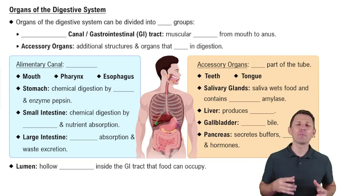
Bounded by lips, cheeks, palate, and tongue; anterior opening is the oral orifice; continuous with oropharynx posteriorly.
Functions of intrinsic and extrinsic tongue muscles
Intrinsic muscles change tongue shape; extrinsic muscles alter tongue position.
Three types of tongue papillae
Filiform (roughness/friction), fungiform (reddish hue), circumvallate (V-shaped row at back).
Three pairs of extrinsic salivary glands
Parotid, submandibular, and sublingual glands.
Functions of saliva
Cleanses mouth, moistens and dissolves food chemicals, aids bolus formation, contains enzymes breaking down starch.
Control of salivation
Extrinsic glands secrete enzyme-rich saliva in response to food stimuli; strong sympathetic stimulation inhibits salivation.
Classification of teeth by shape and function
Incisors cut, canines tear/pierce, premolars and molars grind/crush.
Tooth structure main regions
Crown (exposed, covered by enamel) and root (embedded in jawbone, covered by cementum).
Gomphosis joint
Fibrous joint anchoring tooth in alveolus via periodontal ligament.
Pharynx functions
Passage for food to esophagus and air to trachea; lined with stratified squamous epithelium; has inner longitudinal and outer pharyngeal constrictor muscles.
Soft palate role during swallowing
Closes off nasopharynx to prevent food entry.
Muscle types in esophagus
Skeletal muscle in superior part; smooth muscle in inferior part.
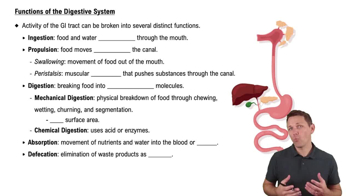
Six essential digestive activities
Ingestion, propulsion, mechanical digestion, chemical digestion, absorption, defecation.
Peritoneum layers and functions
Visceral covers organs; parietal lines body wall; mesentery provides vascular/nerve supply and organ support.
Four tunics of GI tract wall
Mucosa, submucosa, muscularis externa, serosa (or adventitia in esophagus).
Enteric nervous system components
Submucosal plexus (regulates glands and mucosal muscle) and myenteric plexus (controls GI tract motility).
Stomach regions
Cardiac, fundus, body, pyloric region; greater and lesser curvatures.
Four secretory cells in gastric glands
Mucous neck cells (acid mucus), parietal cells (HCl and intrinsic factor), chief cells (pepsinogen), enteroendocrine cells (gastrin and other hormones).
Phases of gastric secretion
Cephalic (before food), gastric (food in stomach), intestinal (food in duodenum).
Liver lobes and ligaments
Right, left, caudate, quadrate lobes; falciform ligament separates right and left lobes; ligamentum teres is fetal umbilical vein remnant.
 Back
Back
 4:06
4:06