 Back
BackAnatomy & Physiology: Endocrine System and Blood
 7:06
7:06
Terms in this set (28)
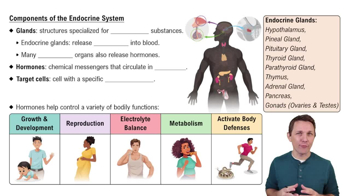
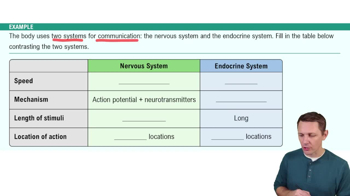
A collection of glands and tissues that secrete hormones directly into the bloodstream to regulate body functions and maintain homeostasis.
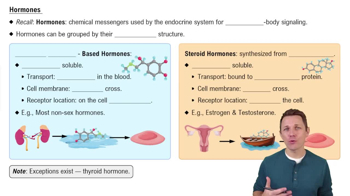
A chemical messenger produced by endocrine glands that travels through the blood to affect distant target cells.
A cell with specific receptors that respond to a particular hormone.
A regulatory mechanism where a change triggers a response that counteracts the initial change to maintain homeostasis.
Known as the "master gland," it secretes hormones that regulate other endocrine glands.
Thyroxine (T4) and Triiodothyronine (T3) regulate metabolism and require iodine for synthesis.
Increases blood calcium by stimulating osteoclasts to break down bone tissue.
Hormones that cannot cross the plasma membrane and bind to cell surface receptors (e.g., peptide hormones, catecholamines).
Hormones that can cross the plasma membrane and bind to intracellular receptors (e.g., steroid hormones, thyroid hormones).
A common second messenger in hormone signaling that activates protein kinases.
Brain region where the hypothalamus controls the pituitary gland via releasing and inhibiting hormones.
Regulates water balance by increasing water reabsorption in the kidneys.
Stimulates growth and metabolism; excess causes gigantism in children and acromegaly in adults.
Adrenal hormone that regulates sodium and potassium balance.
Stress hormone from the adrenal cortex that increases blood glucose levels.
Hormone secreted by the pineal gland that regulates circadian rhythms and sleep-wake cycles.
Pancreatic hormone that lowers blood glucose by promoting cellular uptake and glycogenesis.
Pancreatic hormone that raises blood glucose by promoting glycogenolysis and gluconeogenesis.
Cell that transports oxygen and carbon dioxide in the blood.
Oxygen-carrying protein in erythrocytes containing iron in the heme group.
Formation of blood cells in the red bone marrow.
Cell fragment involved in blood clotting and hemostasis.
Process to stop bleeding involving vascular spasm, platelet plug formation, and coagulation.
Sequence: Prothrombin → Thrombin → Fibrinogen → Fibrin forms a stable clot.
Classification based on presence of A and B antigens on red blood cells.
Presence (+) or absence (−) of the D antigen on red blood cells.
O− blood type; lacks A, B, and Rh antigens, can donate to any blood type.
AB+ blood type; has all antigens and can receive from any blood type.