Skip to main content
Anatomy & Physiology
My Course
Learn
Exam Prep
AI Tutor
Study Guides
Textbook Solutions
Flashcards
Explore
Try the app
My Course
Learn
Exam Prep
AI Tutor
Study Guides
Textbook Solutions
Flashcards
Explore
Try the app
Back
Anatomy & Physiology Exam 2 Study Guide (Chapters 5-8)
You can tap to flip the card.
Type of tissue in the epidermis
You can tap to flip the card.
👆
Type of tissue in the epidermis
Keratinized stratified squamous epithelium
.
Track progress
Control buttons has been changed to "navigation" mode.
1/29
Recommended videos
06:54
Introduction to the Integumentary System
19322
views
652
rank
3
comments
03:40
Integumentary System Functions
12592
views
322
rank
1
comments
02:47
Map of the Lesson on Integumentary System
10990
views
508
rank
2
comments
Terms in this set (29)
Hide definitions
Type of tissue in the epidermis
Keratinized stratified squamous epithelium
.
Most common cells in the epidermis
Keratinocytes
.
Role of melanocytes in the epidermis
Produce
melanin
to protect skin DNA from UV radiation by absorbing rays.
Function of dendritic (Langerhans) cells
Act as
macrophages
that ingest foreign substances and activate the immune system.
Layers of the epidermis in thick skin (superficial to deep)
Stratum corneum, stratum lucidum, stratum granulosum, stratum spinosum, stratum basale.
Difference between thick and thin skin epidermis layers
Thin skin lacks the
stratum lucidum
layer.
Type of tissue in the dermis
Connective tissue
with collagen and elastic fibers; it is vascular.
Two regions of the dermis and their connective tissue types
Papillary region: loose areolar connective tissue; Reticular region: dense irregular connective tissue with scattered adipose.
Effect of carotene on skin color
Yellow to orange pigment that accumulates in the
stratum corneum
and adipose tissue.
What causes erythema?
Increased blood flow causing
reddened skin
, indicating fever, hypertension, inflammation, or allergy.
What is cyanosis?
Bluish skin color due to
poorly oxygenated blood
or lack of hemoglobin.
Structure and function of hair
Flexible strands of
dead keratinized epidermal cells
produced by hair follicles.
Three layers of hair shaft
Medulla (core), cortex (bulky layer), and cuticle (outermost overlapping cells).
Types of human hair
Vellus hair
: fine, nonpigmented;
Terminal hair
: coarse, pigmented hair of eyebrows and scalp.
Function of sebaceous glands
Produce
sebum
that protects against bacterial growth and prevents water loss.
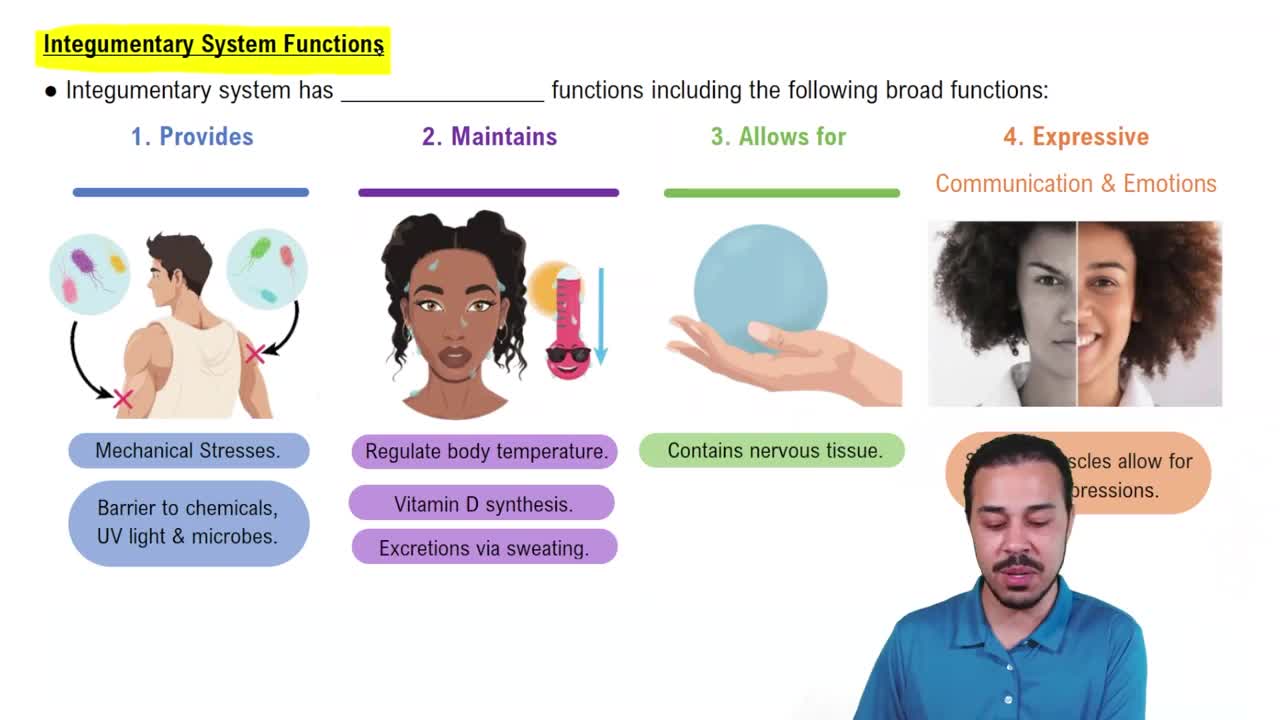
Functions of the integumentary system
Protection, thermoregulation, cutaneous sensation, metabolic functions, blood reservoir, and excretion.
Types of skin cancer
Basal cell carcinoma (least malignant), squamous cell carcinoma, and melanoma (most severe).
ABCDE rule for skin cancer detection
A
symmetry,
B
order irregularity,
C
olor variation,
D
iameter >6mm,
E
volving changes.
Rule of Nines in burn assessment
Body divided into 11 sections, each representing 9% of total body surface area.
Difference between first, second, and third-degree burns
First-degree: epidermis only; Second-degree: epidermis and dermis with blisters; Third-degree: full thickness, no pain initially.
Three types of cartilage
Hyaline
,
elastic
, and
fibrocartilage
.
Functions of bones
Support, protection, movement, mineral storage, blood cell formation, fat storage, and hormone production.
Difference between compact and spongy bone
Compact bone is dense and solid; spongy bone has a latticework of trabeculae.
Role of osteoblasts, osteocytes, and osteoclasts
Osteoblasts build bone; osteocytes maintain bone; osteoclasts resorb bone.
Primary and secondary ossification centers in endochondral ossification
Primary in diaphysis; secondary in epiphysis.
Types of joints based on structure
Fibrous, cartilaginous, and synovial.
Functional classification of joints
Synarthrotic (immovable), amphiarthrotic (slightly movable), diarthrotic (freely movable).
Six distinguishing features of synovial joints
Articular cartilage, joint cavity, articular capsule, synovial fluid, reinforcing ligaments, nerves and blood vessels.
Types of synovial joints and their motions
Planar (gliding), hinge (flexion/extension), pivot (rotation), condyloid and saddle (biaxial), ball and socket (multiaxial).
 BackBack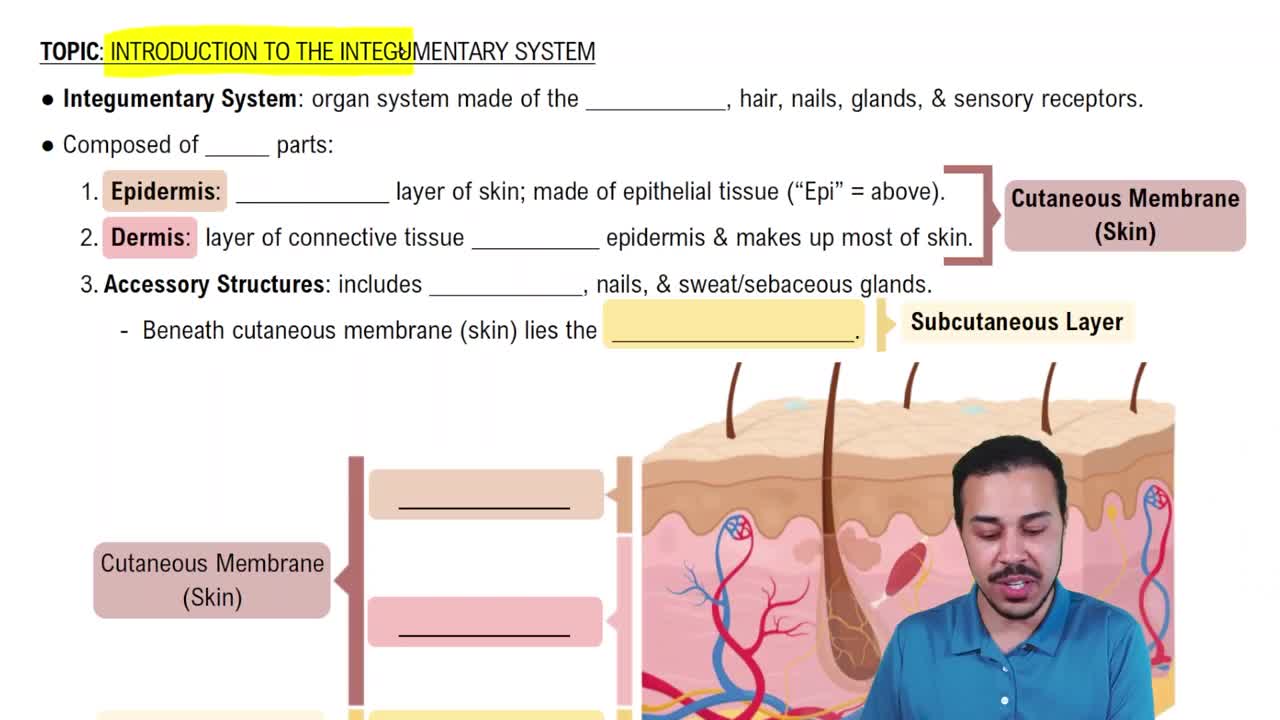
 06:54
06:54