What is the conducting zone vs the respiratory zone in the respiratory system?
The conducting zone includes airways that conduct air to the lungs (e.g., trachea, bronchi). The respiratory zone is where gas exchange occurs (e.g., alveoli).
What is asthma?
Asthma is a chronic inflammatory disease causing airway constriction, mucus buildup, and difficulty breathing.
What is Dalton’s law?
Dalton’s law states that total pressure of a gas mixture equals the sum of the partial pressures of each gas.
What is Henry’s law?
Henry’s law states that the amount of gas dissolved in a liquid is proportional to its partial pressure above the liquid.
What is Boyle’s law?
Boyle’s law states that pressure and volume of a gas are inversely proportional at constant temperature.
Where does internal respiration occur and what is the gas flow?
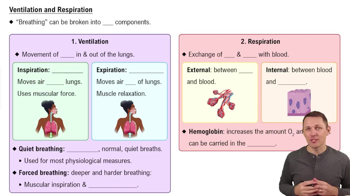
Internal respiration occurs in body tissues; oxygen flows from blood to cells, carbon dioxide flows from cells to blood.
Where does external respiration occur and what is the gas flow?
External respiration occurs in the lungs; oxygen flows from alveoli to blood, carbon dioxide flows from blood to alveoli.
What does the oxygen-hemoglobin saturation curve show?
It shows the % saturation of hemoglobin with oxygen at different partial pressures of oxygen (pO2).
What does a left shift vs a right shift in the oxygen-hemoglobin curve represent?
A left shift means higher affinity for oxygen; a right shift means lower affinity, facilitating oxygen release to tissues.
How do temperature changes and the Bohr effect cause shifts in the oxygen-hemoglobin curve?
Increased temperature and CO2 (Bohr effect) cause a right shift, promoting oxygen release to active tissues.
During inspiration, do the diaphragm and external intercostals contract or relax?
They contract, increasing thoracic volume and decreasing alveolar pressure below atmospheric pressure, allowing air in.
During expiration, do the diaphragm and external intercostals contract or relax?
They relax, decreasing thoracic volume and increasing alveolar pressure above atmospheric pressure, pushing air out.
Which molecule in the blood mainly signals the medulla and pons to regulate respiration?
Carbon dioxide levels in the blood are the primary signal for respiratory regulation.
What is peristalsis and where does it occur?
Peristalsis is wave-like muscle contractions that move food through the digestive tract, occurring throughout the GI tract.
What is segmentation in digestion?
Segmentation is rhythmic contractions that mix food with digestive juices, mainly in the small intestine.
What do parietal cells in the stomach produce?
Parietal cells produce hydrochloric acid (HCl) and intrinsic factor.
What do chief cells in the stomach secrete?
Chief cells secrete pepsinogen, the inactive precursor of pepsin.
Why does the stomach not digest itself?
The mucosal barrier protects the stomach lining via mucus secretion, tight junctions, and rapid cell replacement.
What is gastric emptying?
Gastric emptying is the transfer of chyme from the stomach to the small intestine.
Which organ does the majority of digestion and absorption?
The small intestine is the primary site for digestion and nutrient absorption.
What is lactose intolerance?
Lactose intolerance is the inability to digest lactose due to low lactase; undigested lactose ferments in the large intestine causing gas and bloating.
What are the 3 main accessory organs in digestion and their functions?
The liver produces bile, the pancreas secretes digestive enzymes and bicarbonate, and the gallbladder stores and concentrates bile.
What is bile and what is its function?
Bile, produced by the liver, emulsifies fats to aid in their digestion and absorption.
Why does pancreatic juice contain sodium bicarbonate?
Sodium bicarbonate neutralizes acidic chyme entering the small intestine to protect intestinal lining and optimize enzyme function.
What is the difference between catabolic and anabolic reactions?
Catabolic reactions break down molecules to release energy; anabolic reactions build molecules and consume energy.
What molecule initiates the Krebs cycle?
Acetyl-CoA is the initial substrate that enters the Krebs cycle.
Which step of aerobic cellular respiration generates the most ATP?
Oxidative phosphorylation generates the most ATP during aerobic respiration.
What molecule acts as the final electron acceptor in the electron transport chain?
Oxygen is the final electron acceptor, forming water.
What 2 structures form the renal corpuscle?
The renal corpuscle consists of the glomerulus and Bowman's capsule.
How is plasma filtered but blood cells are retained during glomerular filtration?
The filtration membrane allows plasma through but blocks blood cells and large proteins due to size and charge.
What are podocytes and their function?
Podocytes are specialized cells in Bowman's capsule that wrap around capillaries and form filtration slits.
What are juxtaglomerular cells and their function?
Juxtaglomerular cells sense blood pressure and release renin to initiate the renin-angiotensin-aldosterone system.
What is the role of aldosterone and antidiuretic hormone in blood pressure regulation?
Aldosterone increases sodium reabsorption; ADH increases water reabsorption, both raising blood volume and pressure.
What is the role of the proximal convoluted tubule?
It reabsorbs most filtered nutrients, ions, and water back into the blood.
What special protein channels allow water to flow during tubular absorption?
Water flows through aquaporins down its concentration gradient.
What is the permeability of the loop of Henle limbs and how does the countercurrent mechanism work?
The thin descending limb is permeable to water but not ions; the thick ascending limb is permeable to ions but not water. This creates a gradient that promotes water reabsorption.
What are the 2 types of specialized cells in the collecting duct and their functions?
Principal cells reabsorb sodium and water; intercalated cells regulate acid-base balance.
How does meiosis differ from mitosis?
Meiosis produces 4 haploid cells for sexual reproduction; mitosis produces 2 diploid identical cells for growth and repair.
What is crossing over in meiosis?
Crossing over is the exchange of genetic material between homologous chromosomes, increasing genetic variation.
What occurs during anaphase I vs anaphase II of meiosis?
Anaphase I separates homologous chromosomes; anaphase II separates sister chromatids.
What is spermatogenesis and oogenesis?
Spermatogenesis is sperm production; oogenesis is egg production.
What is folliculogenesis?
Folliculogenesis is the maturation of ovarian follicles through stages leading to ovulation.
What is atresia?
Atresia is the degeneration of ovarian follicles that do not mature.
What role does the corpus luteum play during the luteal phase?
The corpus luteum secretes progesterone to maintain the uterine lining; if no pregnancy occurs, it becomes the corpus albicans.
What are the 3 phases of the menstrual cycle?
The menstrual cycle phases are menstrual (shedding), proliferative (lining rebuilds), and secretory (lining prepares for implantation).
 Back
Back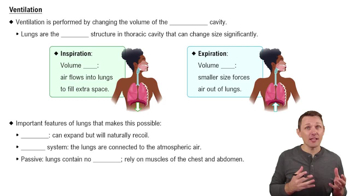
 4:28
4:28