Skip to main content
Anatomy & Physiology
My Course
Learn
Exam Prep
AI Tutor
Study Guides
Textbook Solutions
Flashcards
Explore
Try the app
My Course
Learn
Exam Prep
AI Tutor
Study Guides
Textbook Solutions
Flashcards
Explore
Try the app
Back
Anatomy & Physiology Final Exam Review
You can tap to flip the card.
Tidal volume
You can tap to flip the card.
👆
Tidal volume
The volume of air inhaled or exhaled during normal breathing.
Track progress
Control buttons has been changed to "navigation" mode.
1/30
Recommended videos
Guided course
4:28
Ventilation
6924
views
167
rank
1
comments
Guided course
5:55
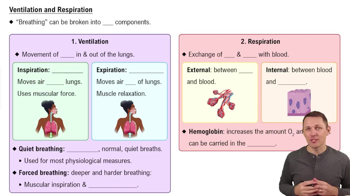
Ventilation and Respiration
10534
views
311
rank
1
comments
Guided course
1:37
Introduction to Lung Physiology Example 1
7044
views
195
rank
1
comments
Terms in this set (30)
Hide definitions
Tidal volume
The volume of air inhaled or exhaled during normal breathing.
Residual volume
The amount of air remaining in the lungs after a forceful exhalation.
Inspiratory reserve volume
The additional volume of air that can be inhaled after a normal inspiration.
Expiratory reserve volume
The additional volume of air that can be exhaled after a normal expiration.
Vital capacity
The total volume of air that can be exhaled after a maximal inhalation.
Blood cells capable of producing antibodies
B lymphocytes (B cells) are responsible for producing antibodies.
Largest lymphatic tissue in the human body
The spleen is the largest lymphatic organ.
Site of destruction of worn-out red blood cells
Worn-out red blood cells are destroyed in the spleen.
Site of T-cell maturation and selection
The thymus gland is where T cells mature and are selected.
Cells that attack infected host cells in cell-mediated immunity
Cytotoxic T cells attack infected host cells.
Main class of antibody secreted immediately after initial antigen exposure
IgM is the first antibody class secreted by plasma cells.
Molecule produced by a virus-infected cell
Infected cells produce interferons to inhibit viral replication.
First line of innate defenses against pathogens
The skin and mucous membranes act as the first line of defense.
Cells macrophages develop from
Macrophages develop from monocytes in the blood.
Four signs or symptoms of inflammation
Redness, heat, swelling, and pain.
Molecules that can act as antigens
Proteins, polysaccharides, lipids, and nucleic acids can act as antigens.
Type of immunity provided by vaccination
Active artificial immunity.
Type of immunity provided by mother’s milk
Passive natural immunity.
Cell type that declines initially in HIV infection
CD4+ T helper cells decline during early HIV infection.
Disease caused by Epstein-Barr virus
Infectious mononucleosis.
Gas exchange between blood in systemic capillaries and tissue cells
Internal respiration.
Structure commonly called the Adam’s apple
The thyroid cartilage of the larynx.
Material of C-shaped rings supporting the trachea
Hyaline cartilage.
Location of gas exchange during external respiration
Alveoli in the lungs.
Alveolar pressure during inspiration
Alveolar pressure decreases below atmospheric pressure to allow air in.
Alveolar pressure during expiration
Alveolar pressure increases above atmospheric pressure to push air out.
Approximate number of alveoli in human lungs
About 300 million alveoli.
Process of gas exchange in lungs
Diffusion across the respiratory membrane.
Main form of oxygen transport in blood
Most oxygen is bound to hemoglobin in red blood cells.
Percentage of CO2 carried as bicarbonate in blood
About 70% of CO2 is transported as bicarbonate ions.
 BackBack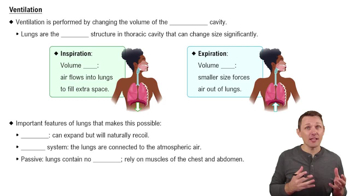
 4:28
4:28