 Back
BackAnatomy & Physiology: Introduction, Anatomical Terms, Body Cavities, Cells, and Integumentary System
 02:40
02:40
Terms in this set (24)
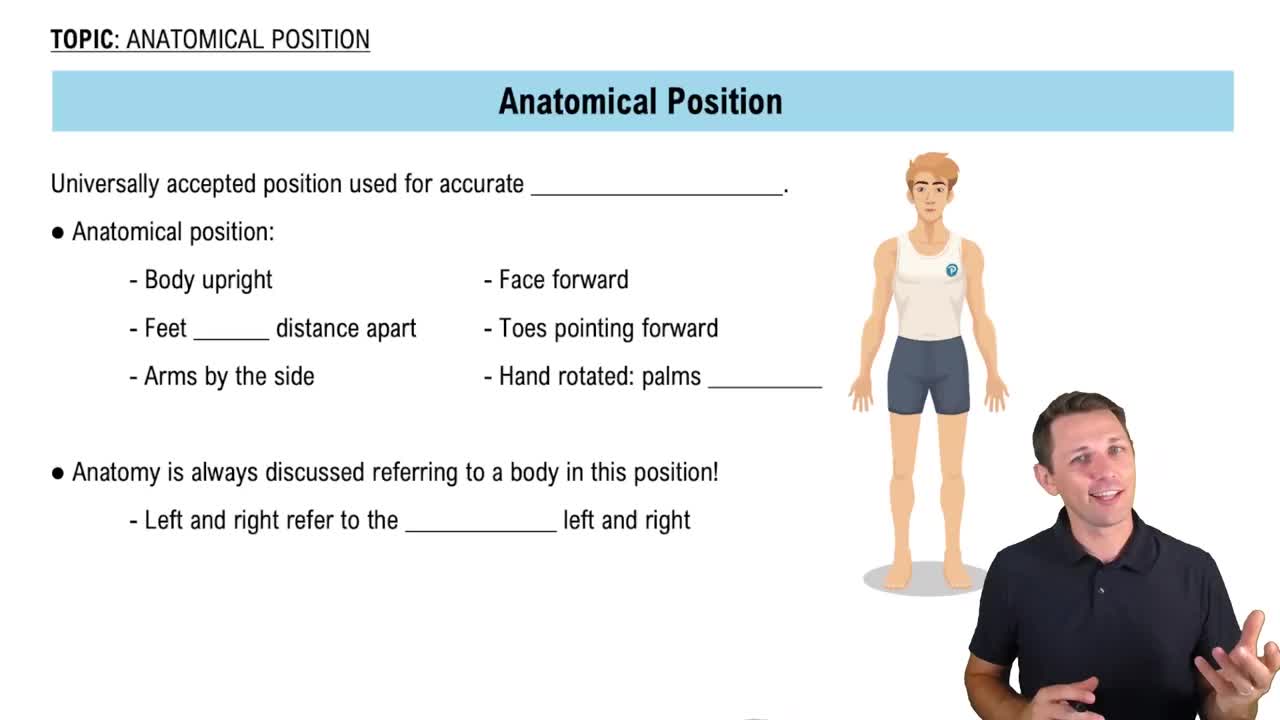
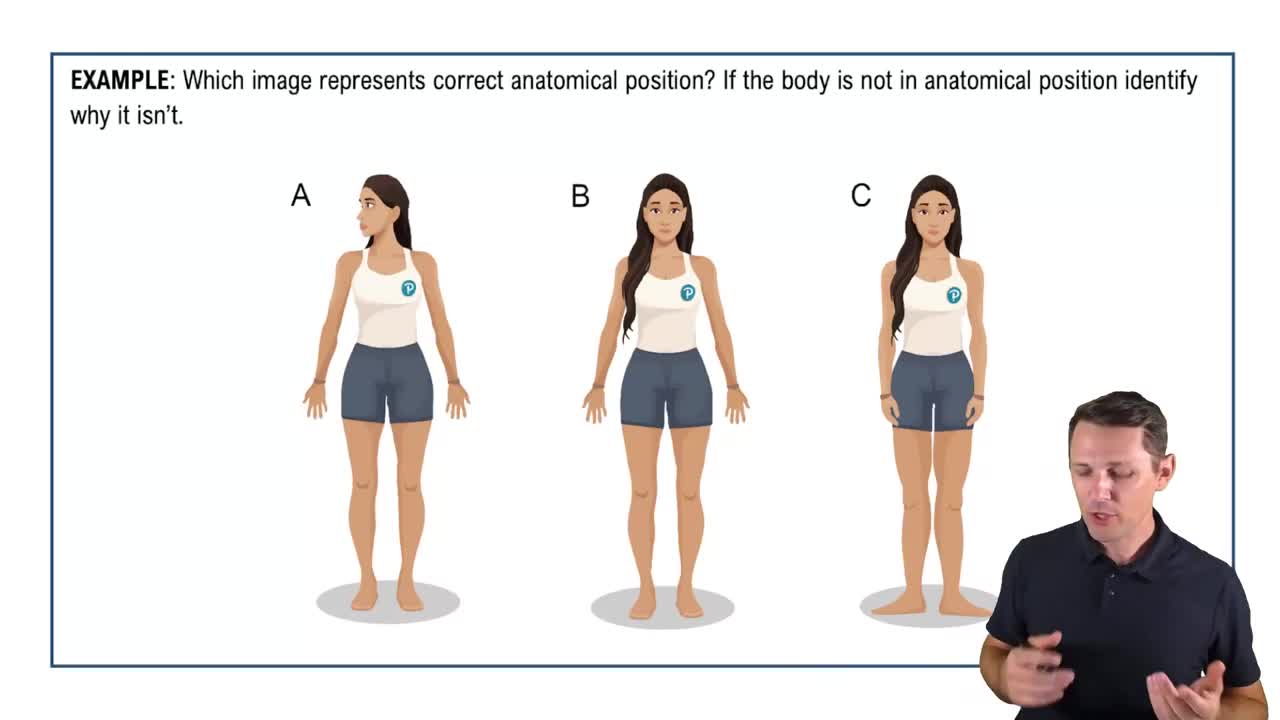
The body is erect, feet slightly apart, palms facing forward with thumbs pointing away from the body.
They describe one body structure in relation to another, always based on the standard anatomical position.
Right and left refer to the body being viewed, not the observer's right and left.
A vertical plane dividing the body into right and left parts; midsagittal is on the midline, parasagittal is off-center.
It divides the body vertically into anterior (front) and posterior (back) parts.
A plane dividing the body horizontally into superior (top) and inferior (bottom) parts, producing cross sections.
Dorsal body cavity and ventral body cavity.
Protects the nervous system; includes the cranial cavity (brain) and vertebral cavity (spinal cord).
Internal organs called viscera; subdivided into thoracic cavity and abdominopelvic cavity.
Two pleural cavities (each surrounds a lung), mediastinum (contains pericardial cavity and other thoracic organs), and pericardial cavity (encloses heart).
Abdominal cavity contains stomach, intestines, spleen, liver; pelvic cavity contains urinary bladder, reproductive organs, and rectum.
Thin, double-layered membranes covering surfaces in the ventral body cavity; parietal lines cavity walls, visceral covers organs.
Serous fluid, secreted by both parietal and visceral layers, fills the slit-like cavity between them.
Pericardium (heart), pleurae (lungs), peritoneum (abdominopelvic cavity).
Into four quadrants: right upper (RUQ), left upper (LUQ), right lower (RLQ), and left lower (LLQ).
Right hypochondriac, epigastric, left hypochondriac, right lumbar, umbilical, left lumbar, right iliac (inguinal), hypogastric, left iliac (inguinal).
Epidermis (keratinized stratified squamous epithelium), dermis (mostly irregular dense connective tissue), hypodermis (subcutaneous layer, mostly adipose tissue).
Absorbs shock, insulates, and anchors skin to underlying structures like muscles.
Skin, hair, nails, sweat glands, and sebaceous (oil) glands.
It is a small band of smooth muscle attached to hair follicles that causes 'goose bumps'.
Medulla (central core), cortex (surrounding layers), and cuticle (outer overlapping layer).
Hair follicle extends from epidermis to dermis surrounding the hair; hair papilla is dermal tissue with capillaries supplying nutrients to growing hair.
Free edge, nail plate, root, nail bed, nail matrix (growth area), nail folds, eponychium (cuticle), hyponychium (under free edge), and lunule (white crescent).
Because of the underlying capillaries in the nail bed.