Skip to main content
Anatomy & Physiology
My Course
Learn
Exam Prep
AI Tutor
Study Guides
Textbook Solutions
Flashcards
Explore
Try the app
My Course
Learn
Exam Prep
AI Tutor
Study Guides
Textbook Solutions
Flashcards
Explore
Try the app
Back
Anatomy & Physiology: Joints Classification and Structure
You can tap to flip the card.
What are the three movement categories of joints?
You can tap to flip the card.
👆
What are the three movement categories of joints?
Synarthrosis
(immovable),
Amphiarthrosis
(slightly movable), and
Diarthrosis
(freely movable).
Track progress
Control buttons has been changed to "navigation" mode.
1/25
Recommended videos
04:06
Introduction to Joints Example 1
9645
views
223
rank
05:29
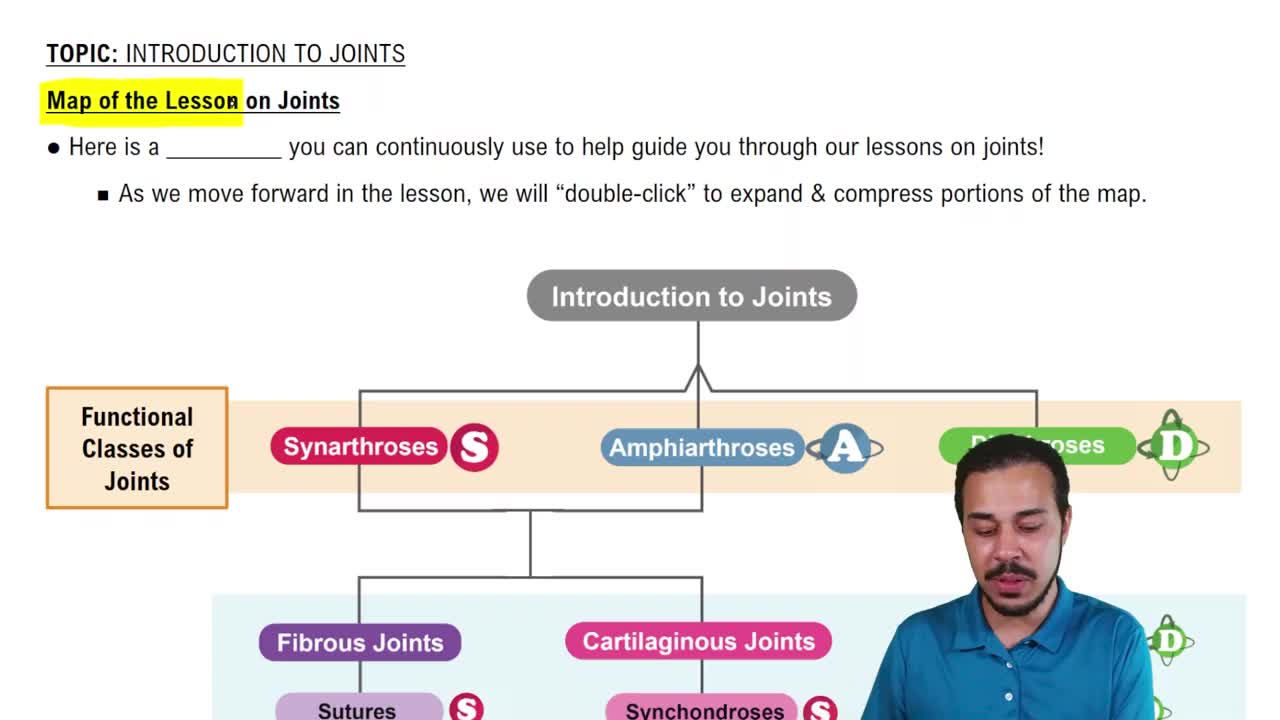
Map of the Lesson on Joints
10068
views
219
rank
1
comments
05:39
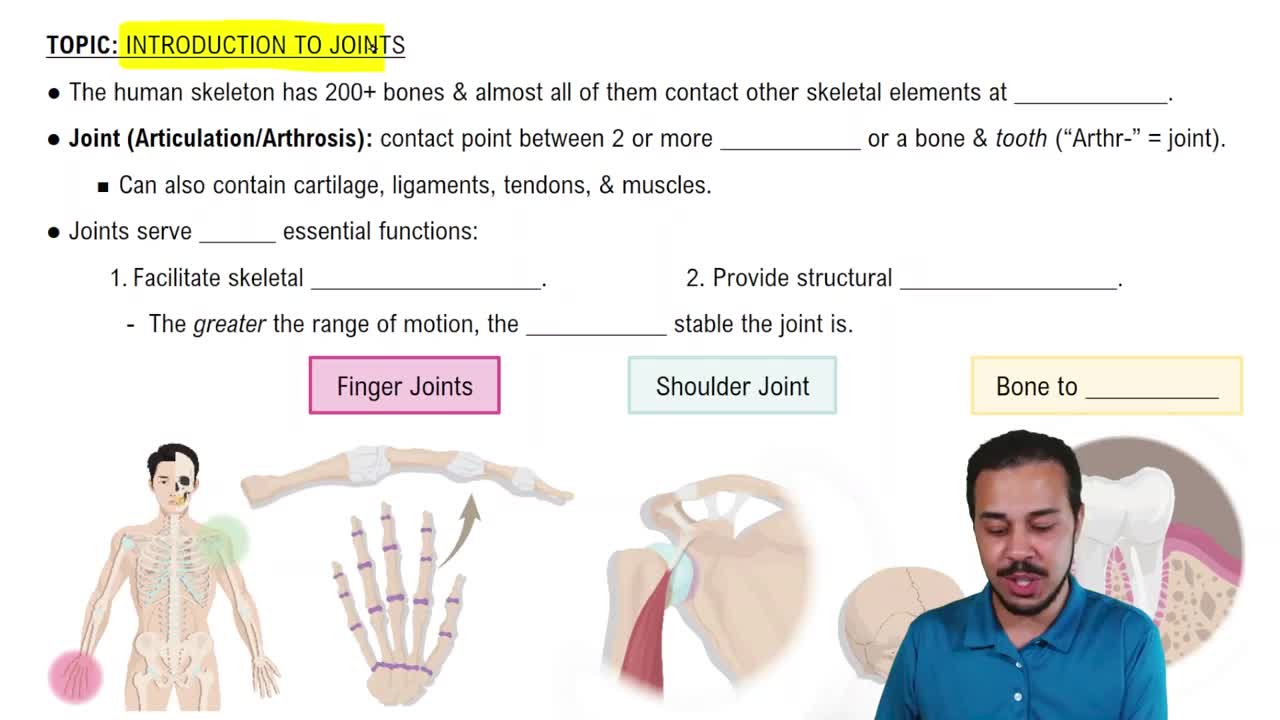
Introduction to Joints
13799
views
351
rank
Terms in this set (25)
Hide definitions
What are the three movement categories of joints?
Synarthrosis
(immovable),
Amphiarthrosis
(slightly movable), and
Diarthrosis
(freely movable).
Give examples of synarthrosis joints.
Sutures of the skull and the tooth in the jaw.
What defines an amphiarthrosis joint?
Bones are slightly movable, such as the pubic symphysis and radius-to-ulna joint.
What is a diarthrosis joint?
A freely movable joint, examples include the shoulder, thumb, elbow, and knuckles.
What are the three structural categories of joints?
Fibrous
,
Cartilaginous
, and
Synovial
joints.
Describe fibrous joints and their types.
Linked by dense regular collagenous connective tissue with no joint space; types include
suture
,
gomphosis
, and
syndesmosis
.
What is a suture joint?
An immovable fibrous joint between skull bones.
Define gomphosis joint.
An immovable fibrous joint between a tooth and the mandible or maxilla, linked by the periodontal ligament.
What is a syndesmosis joint?
A slightly movable fibrous joint where bones are united by an interosseous membrane, e.g., radius-ulna or tibia-fibula.
Describe cartilaginous joints and their types.
Joints linked by cartilage with no joint space; types include
synchondrosis
and
symphysis
.
What is a synchondrosis joint?
An immovable cartilaginous joint linked by hyaline cartilage, such as the epiphyseal plate or sternocostal joint.
Define symphysis joint.
A slightly movable cartilaginous joint linked by fibrocartilage, e.g., pubic symphysis and intervertebral discs.
What characterizes synovial joints?
Joints with a multilayered synovial capsule and fluid-filled joint space; they are freely movable (diarthroses).
List the types of synovial joints from least to most movable.
Plane
,
Hinge
,
Pivot
,
Condylar
,
Saddle
, and
Ball-and-socket
.
What movement does a plane synovial joint allow?
Sliding or twisting movements, e.g., intercarpal and intertarsal joints.
Describe hinge synovial joints and examples.
Allow flexion and extension (uniaxial), e.g., elbow, knee, and interphalangeal joints.
What is a pivot synovial joint?
Allows rotation around a single axis (uniaxial), e.g., radioulnar joint at the elbow and dens-at-atlas joint.
Define condylar synovial joints with examples.
Allow flexion/extension and abduction/adduction (biaxial), e.g., radiocarpal and metacarpophalangeal joints.
What is a saddle synovial joint?
Allows flexion/extension and abduction/adduction with greater freedom (liberal biaxial), e.g., thumb carpometacarpal joint.
Describe ball-and-socket synovial joints.
Multiaxial joints where a bone head fits into a cup-shaped capsule, e.g., hip and shoulder joints.
Match the joint type: Gomphosis.
Joint formed by the union of a tooth root in its bony socket.
Match the joint type: Suture.
Immovable joint between flat bones of the skull united by dense connective tissue.
Match the joint type: Symphysis.
Slightly movable joint where bones are united by fibrocartilage.
Match the joint type: Synchondrosis.
Temporary immovable joint where bones are united by hyaline cartilage.
Match the joint type: Syndesmosis.
Slightly movable joint where bones are united by an interosseous membrane.
 BackBack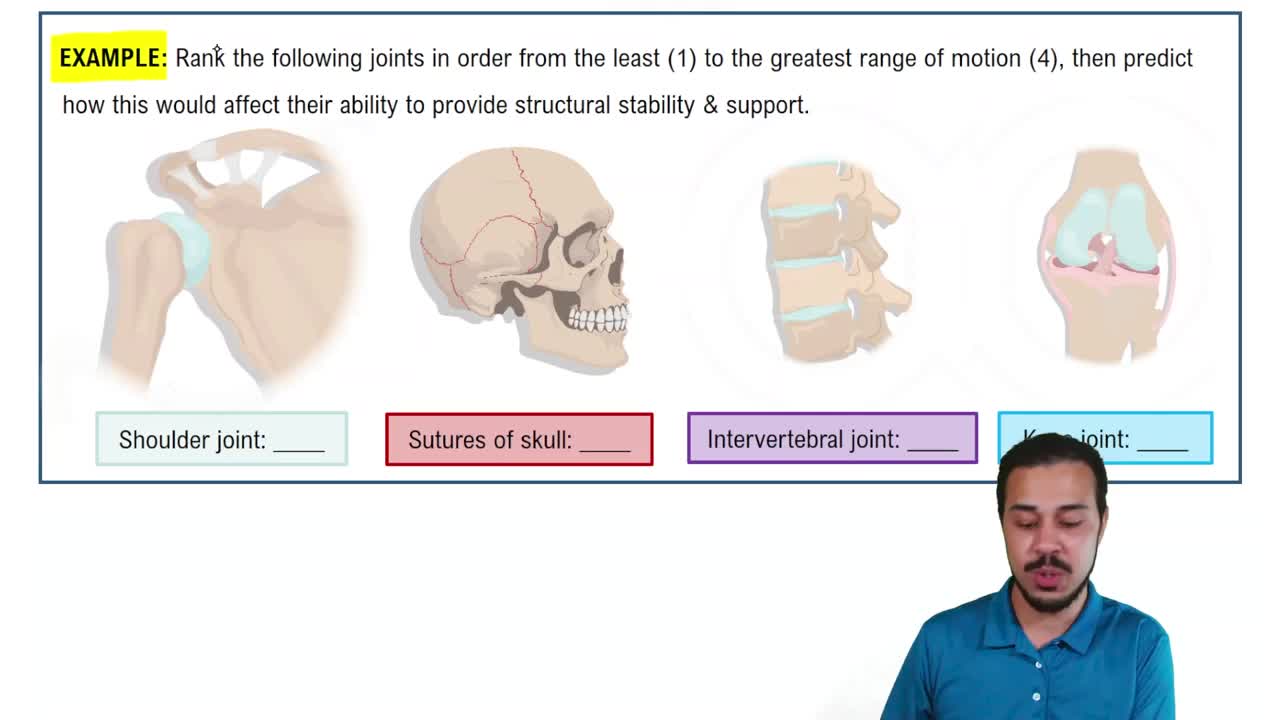
 04:06
04:06