 Back
BackAnatomy & Physiology: Joints Overview
 04:06
04:06
Terms in this set (25)
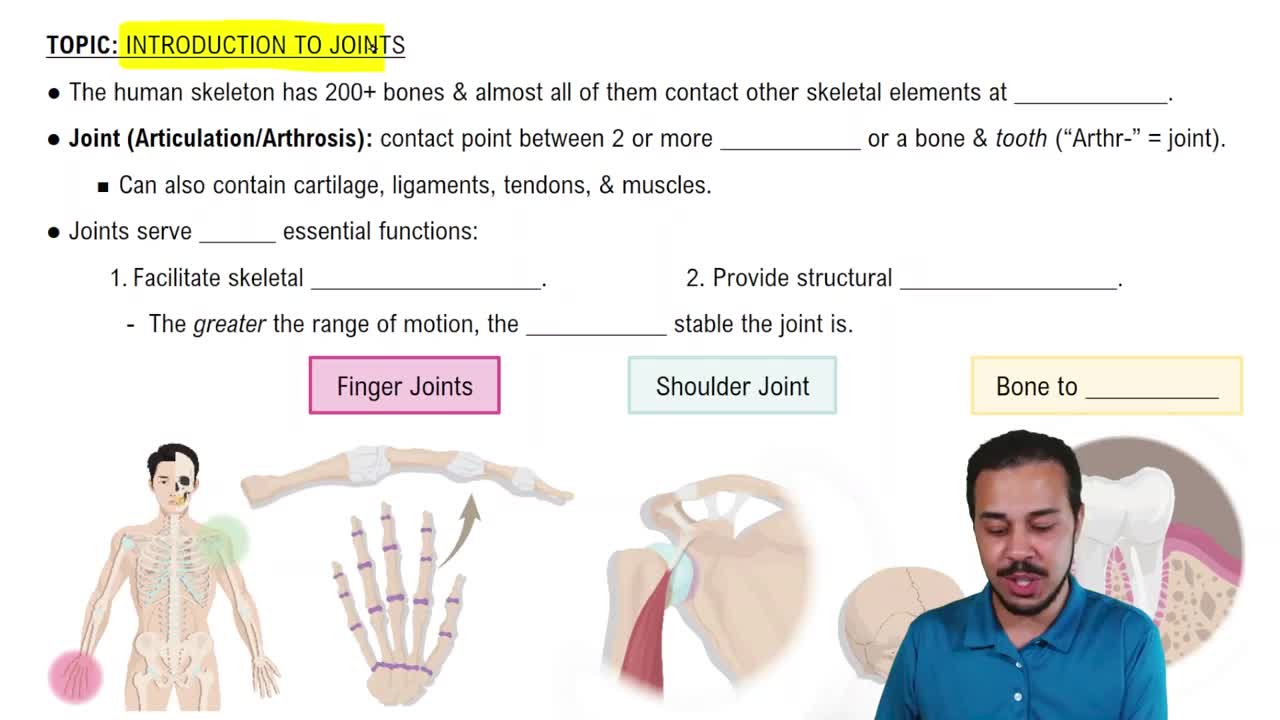
Enable movement, provide stability, and allow growth of long bones.
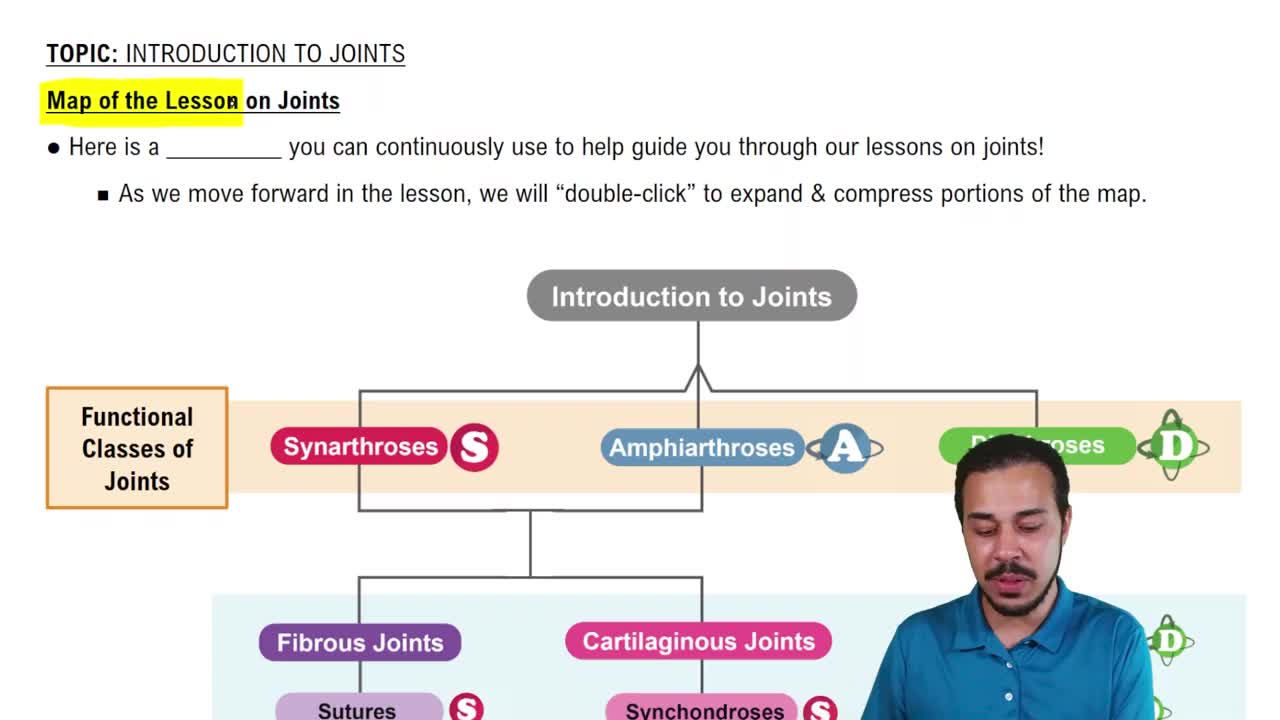
Synarthrosis (immoveable), amphiarthrosis (partially moveable), diarthrosis (freely moveable).
Fibrous (dense collagenous tissue), cartilaginous (cartilage between bones), synovial (fluid-filled joint cavity).
Sutures, gomphoses, and syndesmoses.
Synarthroses between skull bones.
Synarthroses between each tooth and its alveolus in the mandible or maxilla.
Amphiarthroses where bones are joined by an interosseous membrane.
Synchondroses and symphyses.
Synarthroses where bones are held together by hyaline cartilage.
Amphiarthroses where bones are connected by a fibrocartilaginous pad.
Bones separated by a joint cavity, held by an articular capsule lined with synovial membrane.
Covers the ends of bones to reduce friction and absorb shock.
Lubricates the joint, absorbs shock, and performs metabolic functions.
Ligaments, tendons, bursae, and tendon sheaths.
Nonaxial, uniaxial, biaxial, and multiaxial.
Simple back and forth or up and down motion between articulating surfaces.
Change the angle between bones: flexion, extension, abduction, adduction, circumduction.
Nonangular motion where a bone pivots or twists along its long axis.
Opposition, reposition, depression, elevation, protraction, retraction, inversion, eversion, dorsiflexion, plantarflexion, supination, pronation.
Plane, hinge, pivot, condylar, saddle, ball-and-socket.
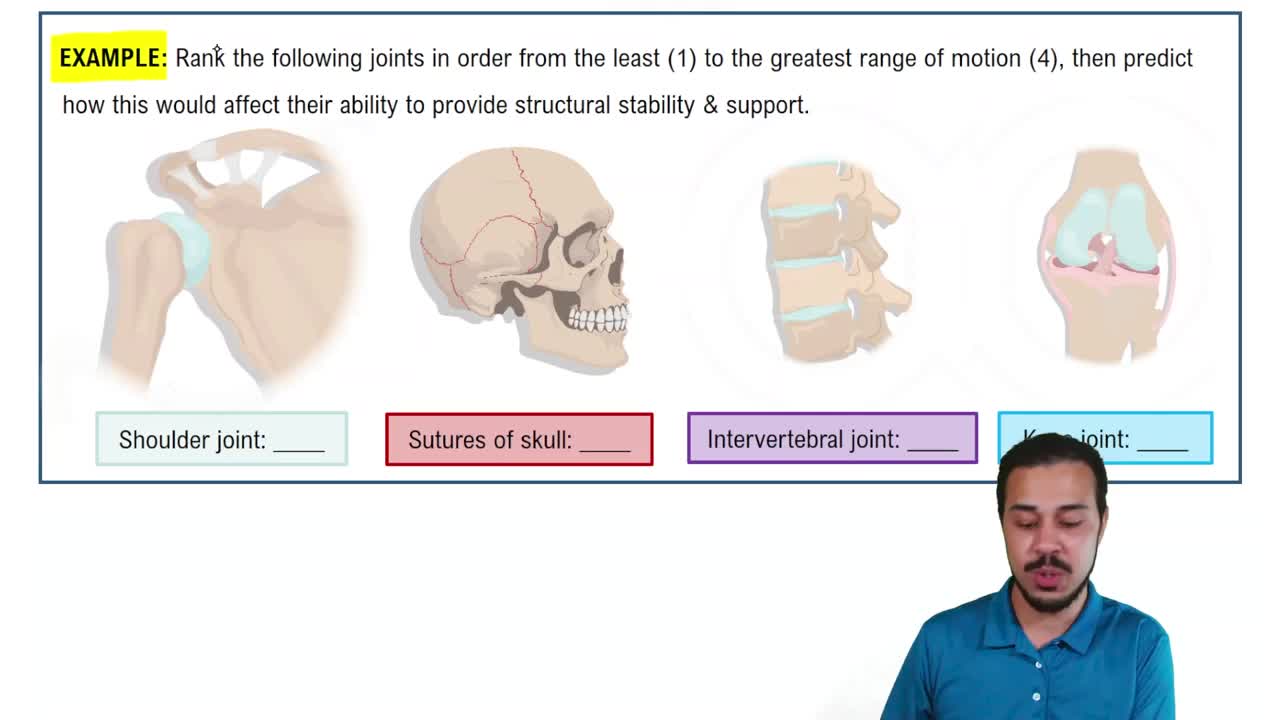
Plane joints are nonaxial and least mobile; ball-and-socket joints are multiaxial and most mobile.
Hinge joint made of two separate joints enclosed in one articular capsule.
Hinge joint with two articulations; largest diarthrosis in the body.
Glenohumeral joint; most mobile and least stable joint in the body.
Ball-and-socket joint between femur head and acetabulum.