Back

Anatomy & Physiology: Lymphatic System and Immunology

Control buttons has been changed to "navigation" mode.
1/27
  • What is the lymphatic system?

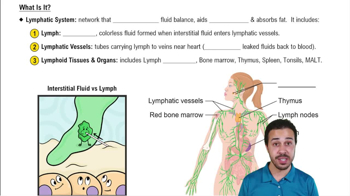
    A network of thin-walled vessels carrying clear fluid called lymph; it is a second circulatory system without a pump like the heart.
  • What is lymph composed of?

    Lymph is similar to blood plasma but contains fewer proteins and no red blood cells.
  • List the major functions of the lymphatic system.

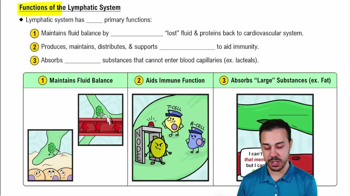
    • Destroys microorganisms and foreign substances
    • Provides long-term protection
    • Collects excess water and proteins from interstitial fluid
    • Transports fats from small intestine to bloodstream
  • What are lymph nodes and their function?

    Small organs along lymph vessels containing macrophages that engulf bacteria and debris; sites of lymphocyte and plasma cell formation.
  • Name the major clusters of lymph nodes.

    Cervical, Axillary, Lumbar, Iliac (Pelvic), Inguinal nodes, and Aggregated Lymph Nodules (Peyer’s Patches).
  • Where does lymph from the lower limbs and left upper body drain?

    Into the thoracic duct, which opens into the left subclavian vein.
  • What is the cisterna chyli?

    An enlargement near the origin of the thoracic duct that collects lymph from the intestines.
  • What are the primary lymphatic organs and their functions?

    • Spleen: filters blood, produces lymphocytes, destroys old red blood cells
    • Thymus: matures lymphocytes into T cells
    • Lymph nodes: filter lymph and form antibodies
  • What are the three pairs of tonsils and their locations?

    • Palatine tonsils: sides of the throat
    • Lingual tonsils: base of the tongue
    • Pharyngeal tonsil: nasopharynx behind the nose
  • What is the role of the vermiform appendix in immunity?

    It serves an immunological function by containing lymphoid tissue but is otherwise vestigial.
  • What cells are found in lymph and their roles?

    Leukocytes including monocytes (which become macrophages) that phagocytize debris and lymphocytes (T and B cells) that mediate immune responses.
  • Difference between T cells and B cells?

    T cells mature in the thymus and attack specific foreign cells; B cells mature elsewhere and produce antibodies via plasma cells.
  • Define antigen and antibody.

    Antigen: foreign substance entering the body. Antibody: protein produced by B lymphocytes that binds specific antigens.
  • What is the immune response?

    The production of antibodies in response to specific antigens.
  • What is agglutination?

    A specific antibody-antigen reaction causing cells to clump together.
  • What is the complement system?

    A group of circulating proteins that assist antibodies in destroying pathogens.
  • Describe the inflammatory response.

    A local tissue-level response to injury or infection that restricts spread and combats infection.
  • What causes fever and its benefits?

    Pyrogens raise body temperature, which inhibits some pathogens and speeds metabolism and tissue repair.
  • What are autoimmune disorders?

    Conditions where the immune system mistakenly attacks the body's own tissues.
  • Differentiate innate and acquired immunity.

    Innate immunity is genetic and present at birth; acquired immunity develops after exposure and can be active or passive.
  • What is passive immunity?

    Temporary immunity from antibodies transferred from another source, e.g., mother to baby or antibody injections.
  • What is active immunity?

    Long-lasting immunity produced by the body's own antibody production after exposure or vaccination.
  • Name the five classes of immunoglobulins (antibodies).

    IgG, IgM, IgD, IgA, and IgE.
  • What is the role of IgG?

    Most abundant antibody in serum; can cross the placenta to provide fetal immunity.
  • What is the function of IgM?

    Activates complement and agglutinates antigens; acts as B cell receptor.
  • Where is IgA found and what is its function?

    In body fluids and mucus; protects mucous membranes by binding and immobilizing antigens.
  • What is the role of IgE?

    Mediates allergic reactions by stimulating histamine release from mast cells and basophils.