 Back
BackAnatomy & Physiology: Muscle Tissue and Contraction
 6:31
6:31
Terms in this set (28)
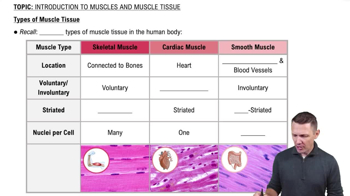
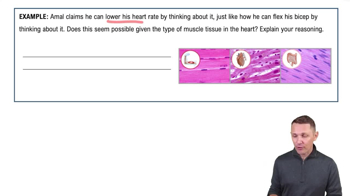
Skeletal (voluntary, striated), cardiac (involuntary, striated), and smooth (involuntary, non-striated).
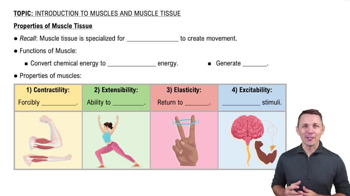
Produce movement, maintain posture, stabilize joints, and generate heat through contractions.
Long cylindrical cells with multiple nuclei, containing myofibrils, sarcoplasm, sarcolemma, and specialized structures like T tubules and sarcoplasmic reticulum.
The smallest contractile unit of a muscle fiber, defined as the segment between two Z discs, containing thick (myosin) and thin (actin) filaments.
Thin filaments slide past thick filaments, increasing overlap and shortening the sarcomere without changing filament length.
Calcium binds to troponin, causing tropomyosin to move and expose myosin-binding sites on actin, enabling cross bridge formation.
Formation, power stroke (myosin head pivots), detachment (ATP binds), and cocking (ATP hydrolysis) of myosin heads.
Motor neuron releases acetylcholine (ACh), which binds to receptors on the sarcolemma, triggering depolarization and muscle fiber excitation.
Latent period (excitation-contraction coupling), contraction period (cross bridge activity), and relaxation period (calcium reuptake).
Increasing stimulation frequency causes twitches to combine, producing stronger, smoother contractions.
Increasing stimulus strength activates more motor units, resulting in stronger muscle contractions.
Isotonic: muscle changes length to move load; isometric: muscle tension increases without length change.
Direct phosphorylation by creatine phosphate, anaerobic glycolysis, and aerobic respiration.
Breakdown of glucose to lactic acid without oxygen, producing 2 ATP quickly but inefficiently.
Oxygen-dependent process in mitochondria producing about 32 ATP per glucose, slower but more efficient.
Ionic imbalances, depletion of ATP and glycogen, accumulation of metabolic byproducts, and contractile mechanism failure.
Slow oxidative (fatigue-resistant, aerobic), fast oxidative (intermediate), and fast glycolytic (fatigue quickly, anaerobic).
Number of fibers recruited, fiber size, stimulation frequency, and muscle stretch degree.
Non-striated, involuntary, spindle-shaped cells with single nucleus, found in hollow organs, contracting slowly and sustained.
Calcium binds calmodulin, activating myosin light chain kinase, which phosphorylates myosin to enable contraction.
Smooth muscle lacks sarcomeres and troponin, uses calmodulin for calcium binding, and contracts via gap junction electrical coupling.
Maintains moderate contraction with low energy cost due to slow ATPase activity and latch state of myosin heads.
Unitary (visceral) smooth muscle contracts as a unit via gap junctions; multi-unit smooth muscle has independent fibers with neural control.
Increased capillaries, mitochondria, and myoglobin, enhancing endurance and fatigue resistance.
Muscle hypertrophy via fiber enlargement, increased myofilaments, and conversion of fiber types to fast glycolytic.
Transmit action potentials deep into muscle fibers, triggering calcium release from sarcoplasmic reticulum.
Stores and releases calcium ions essential for muscle contraction.
Continuous, slight contraction of muscles maintained by spinal reflexes to stabilize joints and posture.