 Back
BackAnatomy & Physiology: Nervous System Fundamentals
 0:50
0:50
Terms in this set (28)
Sensory input: gathers information from sensory receptors.
Integration: processes and interprets sensory input.
Motor output: activates muscles and glands to respond.
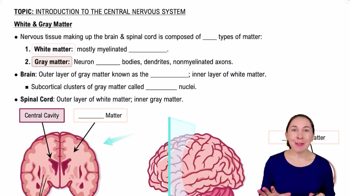
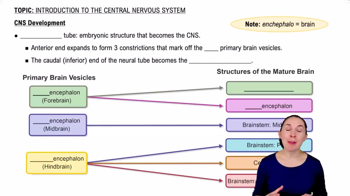
Includes the brain and spinal cord; acts as the integrating and control center interpreting sensory input and dictating motor output.
All nervous system parts outside the CNS, mainly nerves and ganglia; links the body to the CNS.
Supporting cells of the nervous system that maintain and protect neurons; include astrocytes, microglia, ependymal cells, oligodendrocytes in CNS, and Schwann and satellite cells in PNS.
Excitable cells with extreme longevity, amitotic nature, and high metabolic rate; specialized for conducting nerve impulses.
Voltage difference across a resting neuron's membrane, typically around −70 mV, caused by ion concentration differences and membrane permeability.
Short-lived, localized changes in membrane potential that vary in strength and occur in dendrites or cell bodies.
Brief, long-distance electrical signals generated in axons, involving depolarization and repolarization phases.
Insulates axons to protect nerve fibers and increase the speed of nerve impulse transmission.
Schwann cells myelinate axons in the PNS; oligodendrocytes myelinate axons in the CNS.
Multipolar (most common, many dendrites, one axon), bipolar (one dendrite, one axon), unipolar (single process dividing into two branches).
Sensory (afferent) neurons transmit impulses to CNS; motor (efferent) neurons transmit impulses from CNS; interneurons connect neurons within CNS.
Current (I) = Voltage (V) / Resistance (R); voltage drives ion flow across membranes, resistance opposes it.
Leakage (always open), chemically gated (open with neurotransmitter), voltage-gated (open with membrane potential changes), mechanically gated (open with physical deformation).
Junction between two neurons where signals are transmitted chemically or electrically.
Action potential arrives → Ca2+ channels open → neurotransmitter released → neurotransmitter binds postsynaptic receptors → ion channels open → postsynaptic potential generated.
Depolarizes postsynaptic membrane, increasing likelihood of action potential generation.
Hyperpolarizes postsynaptic membrane, decreasing likelihood of action potential generation.
The type of receptor it binds to, which determines whether the effect is excitatory or inhibitory.
Neurotransmitter released at neuromuscular junctions and autonomic neurons; excitatory in skeletal muscle, inhibitory in cardiac muscle.
Include dopamine, norepinephrine, epinephrine, serotonin, and histamine; involved in emotional behavior and biological clock regulation.
Self-propagating wave of depolarization along the axon, moving in one direction due to refractory periods.
Fast action potential propagation in myelinated axons where impulses jump between nodes of Ranvier.
Time during which a neuron cannot fire another action potential because Na+ channels are inactivated.
Period following absolute refractory period when a stronger-than-normal stimulus can trigger an action potential.
Groups of neurons that integrate incoming information and forward it to other destinations.
Serial processing: single pathway, predictable response.
Parallel processing: multiple pathways, simultaneous processing.
Chemicals that modify synaptic transmission strength without directly causing EPSPs or IPSPs, e.g., nitric oxide and adenosine.