Skip to main content
Anatomy & Physiology
My Course
Learn
Exam Prep
AI Tutor
Study Guides
Textbook Solutions
Flashcards
Explore
Try the app
My Course
Learn
Exam Prep
AI Tutor
Study Guides
Textbook Solutions
Flashcards
Explore
Try the app
Back
Anatomy & Physiology: Skeletal Muscle Structure and Function
You can tap to flip the card.
What surrounds a muscle fiber?
You can tap to flip the card.
👆
What surrounds a muscle fiber?
A muscle fiber is surrounded by an extracellular matrix called
endomysium
.
Track progress
Control buttons has been changed to "navigation" mode.
1/28
Recommended videos
Guided course
8:11
Fascicle Arrangements
6924
views
140
rank
Guided course
2:29
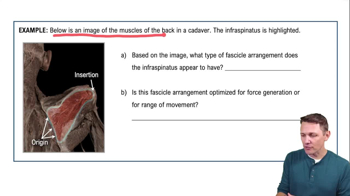
Fascicle Arrangements Example 1
4855
views
77
rank
Terms in this set (28)
Hide definitions
What surrounds a muscle fiber?
A muscle fiber is surrounded by an extracellular matrix called
endomysium
.
What is a fascicle in muscle anatomy?
A
fascicle
is a bundle of many muscle fibers enclosed by the
perimysium
.
What encloses the whole muscle?
The whole muscle consists of many fascicles wrapped by the
epimysium
.
Name the common patterns of fascicle arrangement.
Muscles may have
parallel, convergent, pennate, circular,
or
spiral
fascicle orientations.
How are some muscles named?
Muscles are named for their
shape, appearance, size, position,
or
number of heads
(e.g., triceps).
What is the muscle's action?
The muscle's action is the movement of bones at joints caused by the muscle contracting.
List other functions of skeletal muscle besides movement.
Skeletal muscles also enable
facial expression, breathing,
and
heat generation
to regulate body temperature.
What are the points of attachment of a muscle?
The
origin
is the more stationary attachment, and the
insertion
is the more mobile attachment.
How do bones and muscles work together mechanically?
They work as
lever systems
to produce movement.
Describe a first-class lever in the body.
A first-class lever has the
fulcrum
between the point of force and the load to be moved.
Describe a second-class lever in the body.
A second-class lever places the
load
between the force and the fulcrum.
Describe a third-class lever in the body.
A third-class lever places the
force
between the load and the fulcrum.
Which muscles move the forehead and eyebrows?
The
frontalis, occipitalis,
and
corrugator supercilii
muscles.
What muscle closes the eye?
The circular
orbicularis oculi
muscle closes the eye.
Which muscles produce smiling and grimacing expressions?
The
zygomaticus major, zygomaticus minor, levator labii superioris, risorius,
and
orbicularis oris
muscles.
What muscles contribute to sad and doubtful facial expressions?
The
depressor anguli oris, depressor labii inferioris,
and
mentalis
muscles.
Which muscle pulls the cheeks inward for sucking motions?
The
buccinator
muscle.
Name the six extrinsic eye muscles.
The
superior, inferior, medial, lateral rectus
muscles and the
superior and inferior oblique
muscles.
Which muscles are involved in mastication?
The
masseter, temporalis, medial pterygoid,
and
lateral pterygoid
muscles.
Which muscles move the tongue during swallowing?
The
genioglossus, hyoglossus,
and
styloglossus
muscles.
Which muscles elevate the hyoid bone during swallowing?
The
stylohyoid, mylohyoid, geniohyoid,
and
digastric
muscles.
Which muscles depress the hyoid, larynx, and pharynx during swallowing?
The
sternohyoid, sternothyroid, omohyoid,
and
thyrohyoid
muscles.
What is the role of the pharyngeal constrictor muscles?
They push food into the esophagus during swallowing.
Which muscles move the head by rotation and flexion?
The
sternocleidomastoid
and
scalene
muscles.
Which muscles extend the head?
The
trapezius, splenius capitis,
and
splenius cervicis
muscles.
What muscles maintain posture and extend the vertebral column?
The
erector spinae
muscle group, including iliocostalis, longissimus, and spinalis muscles.
Which muscles support posture and vertebral column extension in the transversospinal group?
The
semispinalis, multifidus,
and
rotatores
muscles.
Which muscle extends the vertebral column laterally?
The
quadratus lumborum
muscle.
 BackBack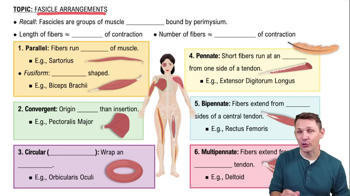
 8:11
8:11