Skip to main content
Anatomy & Physiology
My Course
Learn
Exam Prep
AI Tutor
Study Guides
Textbook Solutions
Flashcards
Explore
Try the app
My Course
Learn
Exam Prep
AI Tutor
Study Guides
Textbook Solutions
Flashcards
Explore
Try the app
Back
Anatomy & Physiology: Skin and Integumentary System
You can tap to flip the card.
Which epidermal layer is most closely associated with the papillary layer of the dermis?
You can tap to flip the card.
👆
Which epidermal layer is most closely associated with the papillary layer of the dermis?
The
stratum basale
is most closely associated with the papillary layer of the dermis.
Track progress
Control buttons has been changed to "navigation" mode.
1/20
Recommended videos
06:54
Introduction to the Integumentary System
19314
views
652
rank
3
comments
03:40
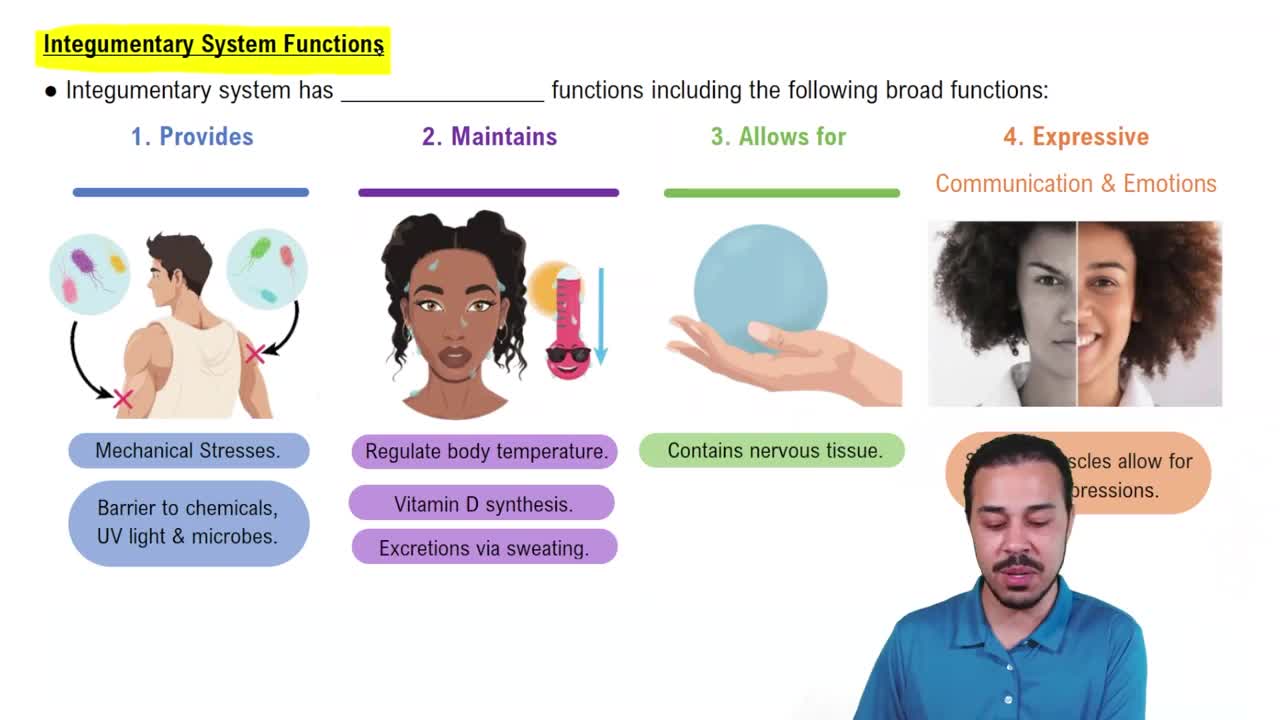
Integumentary System Functions
12588
views
322
rank
1
comments
02:47
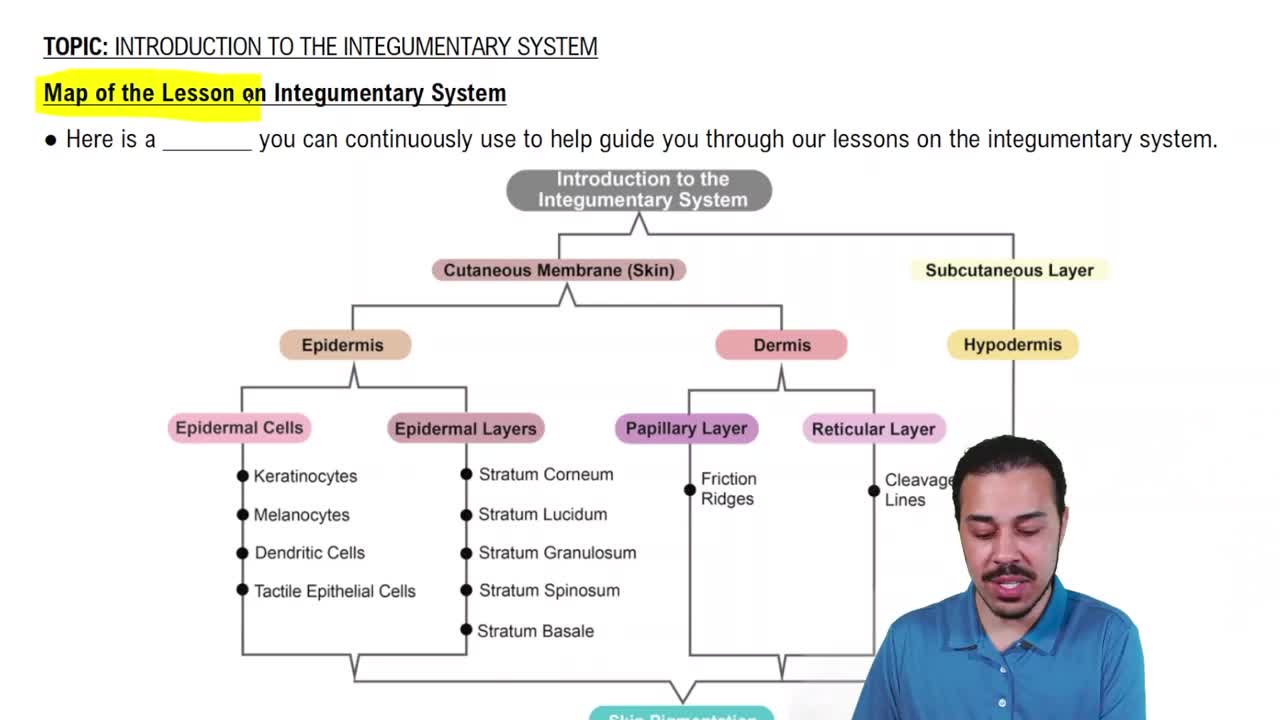
Map of the Lesson on Integumentary System
10984
views
508
rank
2
comments
Terms in this set (20)
Hide definitions
Which epidermal layer is most closely associated with the papillary layer of the dermis?
The
stratum basale
is most closely associated with the papillary layer of the dermis.
Where are Langerhans cells commonly found?
Langerhans cells are commonly found in the
stratum spinosum
of the epidermis.
What type of tissue composes the papillary and reticular layers of the dermis?
The papillary and reticular layers of the dermis are mainly composed of
connective tissue
.
What role does collagen play in the skin?
Collagen lends
structure
to the skin.
Which of the following is NOT a function of the hypodermis?
The hypodermis does NOT serve as a
source of blood vessels in the epidermis
.
What is the function of the arrector pili muscles in response to sympathetic nervous system stimuli?
The arrector pili muscles cause
goose bumps
by contracting.
What does the hair matrix contain?
The hair matrix contains a
layer of basal cells
responsible for hair growth.
What is the primary function of eccrine sweat glands?
Eccrine sweat glands are present throughout the skin and produce
watery sweat
for thermoregulation.
What are sebaceous glands associated with and what do they secrete?
Sebaceous glands are associated with
hair follicles
and secrete
sebum
.
Which part of the nail is furthest from the growth center?
The
hyponychium
is furthest from the nail growth center.
What is required in human skin for vitamin D synthesis?
Exposure of the skin to
sunlight
is required for vitamin D synthesis.
Which structure does NOT directly contribute to the protective function of the integumentary system?
Folic acid synthesis
does not directly contribute to skin protection.
Which skin layer must be cut to cause bleeding?
Cutting into the
papillary dermis
causes bleeding.
Which epidermal layer prevents the skin from drying out?
The
stratum corneum
prevents skin from drying out.
Which cells help remove bacteria if they enter a skin wound?
Langerhans cells
help get rid of bacteria in the skin.
How can skin cancer risk be reduced?
Skin cancer risk can be reduced by
limiting exposure to the sun
.
What causes bedsores and how can they be prevented?
Bedsores are caused by pressure points and can be prevented by
eliminating pressure points
.
Which layers of skin are damaged when blisters form after sunburn?
Blisters indicate damage to both the
epidermis and dermis
.
What is the next step in wound healing after blood clot formation?
The next step is
increased production of connective tissue
to repair the wound.
Which cells are affected by squamous cell carcinoma?
Squamous cell carcinoma affects
keratinocytes of the stratum spinosum
.
 BackBack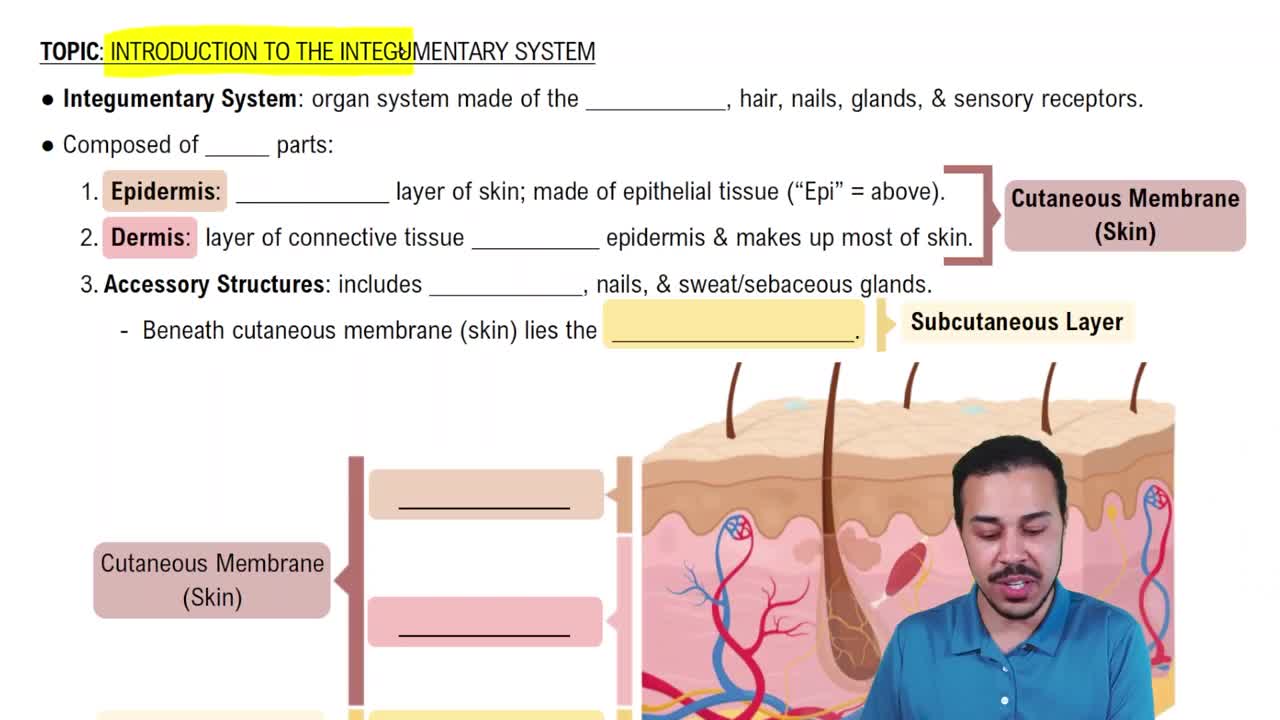
 06:54
06:54