 Back
BackAnatomy & Physiology: Skull Bones and Structures
 2:12
2:12
Terms in this set (51)
The part of the skeleton consisting of the skull, spine, and rib cage. Its main function is protection of organs like the brain, heart, and spinal cord.
Includes all upper and lower extremities and the girdles (pectoral and pelvic) that attach limbs to the trunk. Its main function is movement.
The bony structure that attaches the upper extremities to the trunk, associated with the chest (pectoral) region.
The bony structure that attaches the lower extremities to the trunk; the pelvis functions as this girdle, not part of the axial skeleton.
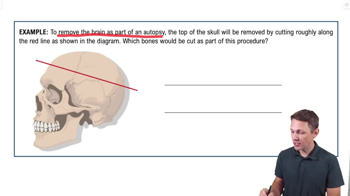
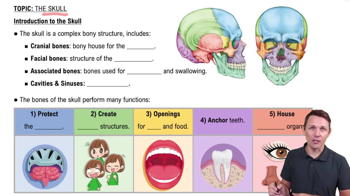
Bones forming the protective case for the brain. Includes frontal, parietal, temporal, occipital, sphenoid, and ethmoid bones.
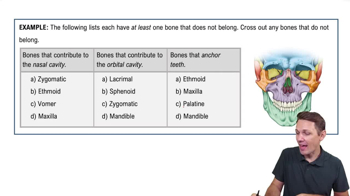
Bones that form the facial features such as cheeks and jaw. Examples include mandible, maxilla, nasal, lacrimal, vomer, zygomatic, and inferior nasal concha.
A flat bone forming the forehead and upper eye sockets. Contains the glabella (flat area between eyebrows) and supraorbital margin (edge above the eye socket), both muscle attachment sites.
Two flat bones forming the sides and roof of the cranial cavity. No specific structures to learn.
Divided into four regions: squamous, tympanic, mastoid, and petrous. Each has distinct structures.
A passageway in the petrous region of the temporal bone for the jugular veins, which drain blood from the brain, head, and neck.
A hole in the tympanic region of the temporal bone that transmits sound waves to the ear.
A pointed projection of the temporal bone serving as an attachment point for a ligament connecting to the hyoid bone, important for tongue and mouth muscle stability.
A large bump behind the ear on the temporal bone that serves as a muscle attachment site.
An indentation in the squamous region of the temporal bone where the mandibular condyle fits to form the temporomandibular joint (TMJ).
A passageway in the temporal bone for the carotid arteries, which supply 80% of oxygenated blood to the brain.
A bony bridge forming the cheekbone, made of the zygomatic process of the temporal bone (posterior) and the temporal process of the zygomatic bone (anterior). It is a muscle attachment site.
Flat bone forming the back and base of the skull. Contains the foramen magnum, occipital condyles, hypoglossal canals, and external occipital protuberance.
The large opening in the occipital bone where the brainstem and spinal cord connect.
Smooth, rounded projections on either side of the foramen magnum that articulate with the first cervical vertebra, allowing the yes head movement.
Small holes on either side of the foramen magnum that transmit the hypoglossal nerve to tongue muscles.
An irregular, deep cranial bone called the keystone bone because it contacts all other cranial bones. Contains greater and lesser wings, sella turcica, optic canals, and pterygoid processes.
An indentation in the sphenoid bone that houses the pituitary gland.
Openings in the sphenoid bone that allow passage of the optic nerve for vision.
Projections of the sphenoid bone that serve as muscle attachment sites near the jaw and mouth.
A deep cranial bone located behind the nose. Contains the crista galli, perpendicular plate, and middle and superior nasal conchae.
A projection of the ethmoid bone that serves as an attachment site for brain membranes (meninges).
Part of the ethmoid bone forming the superior portion of the nasal septum, dividing the nasal cavity into right and left sides.
Curved bones inside the nasal cavity that speed up airflow to clean and warm air before it reaches the lungs. Superior and middle are part of ethmoid; inferior is a separate facial bone.
Openings in the ethmoid bone that serve as passageways for nerves and blood vessels controlling eye muscles.
Immovable joints between flat cranial bones. Key sutures include coronal (frontal-parietal), sagittal (between parietals), lambdoid (parietal-occipital), and squamous (temporal-parietal).
The largest and strongest facial bone, known as the lower jaw. Holds lower teeth and forms the only freely movable skull joint (TMJ).
A smooth, rounded projection of the mandible that fits into the mandibular fossa of the temporal bone to form the temporomandibular joint (TMJ).
The ridge of bone surrounding the sockets of the teeth, found on both the mandible and maxilla.
A hole on the external surface of the mandible body that allows passage of blood vessels and nerves to the skin of the lower lip and chin.
A hole on the internal surface of the mandible ramus that transmits blood vessels and nerves to the gums of the lower teeth.
The upper jaw facial bone holding upper teeth. Known as the keystone facial bone because it contacts all other facial bones.
A projection of the maxilla extending from the upper jaw to the forehead, between the nose and cheekbones, serving as a muscle attachment site.
The part of the maxilla forming the anterior two-thirds of the hard palate (roof of the mouth).
A small flat bone forming the bridge of the nose, located at the top center of the nose.
A small facial bone inside the eye socket containing a hole for tear drainage from the eyes to the nasal cavity.
The facial bone forming the anterior part of the zygomatic arch (cheekbone), with a projection called the temporal process that connects to the temporal bone.
A facial bone forming the inferior part of the nasal septum, below the perpendicular plate of the ethmoid bone.
The largest of the three nasal conchae, a separate facial bone that helps clean and speed airflow in the nasal cavity.
Air-filled cavities within certain skull bones that lighten the skull and enhance voice resonance. Lined with mucus membranes.
Sinuses located in the frontal bone above the eyebrows, often associated with forehead headaches when inflamed.
Sinuses located behind the eyes; inflammation causes pressure behind the eyes or on the nose bridge.
The largest facial sinus in the maxilla; inflammation can cause facial pain, toothache, ear, or neck pain.
An irregular, free-floating bone below the mandible that anchors tongue muscles and is important for swallowing and speech.
Soft spots on a fetal skull made of fibrous membranes that allow skull growth and compression during childbirth. Four main fontanelles: anterior, posterior, mastoid, and sphenoid.
The largest fontanelle located between the frontal and parietal bones; may take 2-3 years to fully ossify.
Smaller fontanelles that typically close and ossify within 3-6 months after birth.