 Back
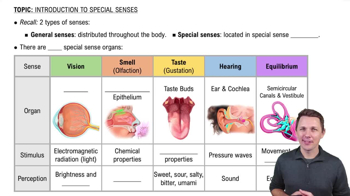
BackAnatomy & Physiology: Special Senses - Eye, Ear, Taste, and Smell
 5:05
5:05
Terms in this set (27)
Eyebrows, eyelids, eyelashes, conjunctiva, lacrimal apparatus, and extrinsic eye muscles.
A thin mucous membrane that covers the anterior surface of the eye and lines the eyelids, protecting and lubricating the eye.
Lateral rectus (VI), medial rectus (III), superior rectus (III), inferior rectus (III), superior oblique (IV), inferior oblique (III).
Sclera (outer fibrous), choroid (vascular), and retina (inner neural layer).
Transparent, flexible, avascular; focuses light onto the retina by changing shape via ciliary muscles.
Contracts to bulge the lens for near vision (accommodation) and relaxes to flatten the lens for distant vision.
Accommodation: lens bulges; constriction: pupil size decreases; convergence: eyes rotate medially to focus on close objects.
Electromagnetic radiation with wavelengths from 400 to 700 nanometers.
The cornea provides the majority of the eye's refractive power; the lens provides adjustable refractive power.
Cells in the retina that detect light: rods (dim light) and cones (color and bright light).
A visual pigment in rod cells' outer segments that changes shape in response to light, initiating phototransduction.
Light changes rhodopsin shape, activating transducin, which activates phosphodiesterase to reduce cGMP, closing Na+ channels and hyperpolarizing the cell.
Light adaptation: rods turn off, cones adjust to bright light; dark adaptation: cones stop, rhodopsin regenerates to improve night vision.
Olfactory sensory neurons, supporting cells, and olfactory stem cells located in the roof of the nasal cavity.
Must be volatile and soluble to bind to olfactory receptors and generate receptor potentials.
Olfactory neurons → olfactory bulbs (glomeruli) → mitral cells → olfactory cortex.
Fungiform (few taste buds), vallate (many taste buds), foliate (many taste buds, decrease with age).
Sweet (organic substances), sour (acids), salty (metal ions), bitter (alkaloids), umami (glutamate/aspartate).
Salty: direct Na+ influx; sour: H+ ions open depolarizing channels.
A G protein activated by bitter, sweet, and umami receptors to initiate metabotropic signaling pathways.
External ear (collects sound), middle ear (transmits vibrations), internal ear (hearing and balance).
Scala vestibuli, scala media, scala tympani, basilar membrane, spiral organ with hair cells.
Pitch: location of stimulation on basilar membrane; loudness: amplitude of waves causing more neurotransmitter release.
Structures for equilibrium: semicircular canals, utricle, saccule, and their sensory receptors.
Maculae detect linear acceleration; crista ampullaris detects rotational movement.
Conduction: sound cannot reach inner ear fluids; sensorineural: damage to hair cells or neural pathways.
Perception of ringing or buzzing without external stimuli, often due to hair cell damage.