Back

Anatomy & Physiology: The Skeleton and Skull
Control buttons has been changed to "navigation" mode.
1/41
  • What are the main components of the skeletal system?

    The skeletal system is composed of bones, cartilages, joints, and ligaments. Bones form the majority, cartilage occurs in isolated areas, and ligaments connect bones and reinforce joints.
  • What are the two major divisions of the skeleton?

    The skeleton is divided into the axial skeleton and the appendicular skeleton.
  • What bones make up the axial skeleton?

    The axial skeleton consists of 80 bones divided into the skull, vertebral column, and thoracic cage.
  • What are the three functions of the axial skeleton?

    The axial skeleton forms the longitudinal axis of the body, supports the head, neck, and trunk, and protects the brain, spinal cord, and thoracic organs.
  • What are the two sets of bones forming the skull?

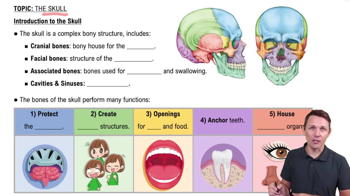
    The skull is formed by cranial bones that enclose the brain and facial bones that form the face framework and contain cavities for special senses.
  • What are sutures in the skull?

    Sutures are joints between skull bones that are serrated and firmly lock most skull bones together, except the mandible.
  • What are the three major regions of the cranial base?

    The cranial base is divided into three fossae: anterior, middle, and posterior cranial fossae, which support the brain.
  • Name the eight cranial bones.

    The eight cranial bones are: frontal, two parietal, occipital, two temporal, sphenoid, and ethmoid bones.
  • What is the function of the frontal bone?

    The frontal bone forms the anterior cranium, forehead, superior orbit walls, and anterior cranial fossa. It contains the supraorbital foramen for artery and nerve passage.
  • What are the four major sutures involving the parietal bones?

    The parietal bones articulate with other bones at the coronal, sagittal, lambdoid, and squamous sutures.
  • What is the significance of the foramen magnum in the occipital bone?

    The foramen magnum is a large opening in the occipital bone through which the brain connects with the spinal cord.
  • What are the three major regions of the temporal bone?

    The temporal bone has the squamous (zygomatic process) , tympanic, and petrous regions, housing ear cavities and forming part of the middle cranial fossa.

  • What is the sphenoid bone known as and why?

    The sphenoid bone is the keystone bone because it articulates with all other cranial bones and contains important foramina and the sella turcica.
  • What are the key features of the ethmoid bone?

    The ethmoid bone is the deepest skull bone, with cribriform plates, crista galli, perpendicular plate, and ethmoidal air cells.
  • How many facial bones are there and which are single?

    There are 14 facial bones; mandible and vomer are single, the rest are paired.

    -mandible

    -maxillary (2)

    -zygomatic (2)

    -nasal (2)

    -lacrimal (2)

    -palatine (2)

    -vomer

    -inferior nasal conchae (2)

  • What is the largest and strongest facial bone?

    The mandible is the largest and strongest facial bone, forming the lower jaw.
  • What bones form the orbits of the eyes?

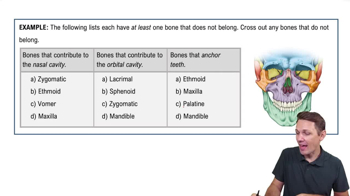
    The orbits are formed by parts of seven bones: frontal, sphenoid, zygomatic, maxilla, palatine, lacrimal, and ethmoid.
  • What are paranasal sinuses and their functions?

    Paranasal sinuses are mucosa-lined, air-filled spaces in frontal, sphenoid, ethmoid, and maxillary bones. They warm and humidify air, lighten the skull, and enhance voice resonance.
  • What are fontanelles in the infant skull?

    Fontanelles are unossified fibrous membrane remnants between skull bones that ease birth and allow brain growth.
  • What changes occur in the skeleton with aging?

    With age, intervertebral discs thin and lose elasticity, costal cartilages ossify, bones lose mass, and fracture risk increases.
  • cranium is divided into a vault and a base


    -cranial vault-forms superior, lateral and posterior portion of skull as well as forehead

    -branial base: inferior aspect

  • skull has 85 named openings


    -foramina, canals, fissures

    -provide passageways for spinal cord, major blood vessels and the 12 cranial nerves

  • glabella


    area of frontal bone between eye orbits

  • frontal sinuses


    located lateral to glabella

  • supraorbital margins


    just under the eyebrow

  • hypoglossal canal


    allows cranial nerve XII to pass through

  • external occipital protuberance


    protrusion just superior to foramen magnum

    -external occipital crest: ridges that are site of attachment for ligamentum nuchae

    -superior and inferior lines: site of attachment for many neck and back muscles

  • petrous


    houses middle and internal ear cavaties

  • several foramina penetrate petrous region


    jugular foramen, carotid canal, foramen lacerum, internal acoustic meatus and stylomastoid foramen

  • mastoid and styloid processes:


    areas for attachment of several neck and tongue muscles

  • temporal bone


    -external acoustic meatus

    -squamous part

    -zygomatic process

    -tympanic part

    -mastoid process

    -styloid process

    -mandibular fossa

    -petrous part

  • sphenoid bone


    complex, bat shaped bone

    -greater wing, lesser wing, pterygoid processes

    -several foramina: optic canals, superior orbital fissure, foramen rotundum, foramen ovale, foramen spinosum

  • ethmoid bone


    deepest skull bone, form roof of nasal cavity

    -cribriform plate

    -crista galli

    -perpendicular plate:flanked by lateral masses that contain sinuses called ethmoidal air cells

    -orbital plates

  • sutural bones


    tiny, irregular shaped bones that appear within sutures

  • mandible


    U-shaped lower jawbone made up of body (chin) and the upright rami

    -mandibular angle

    -coronoid process

    -condylar process

    -mandibular notch

    -body-alveolar process, mandibular symphysis

    -foramina: mandibular nerves, mental foramina

  • maxillary bones


    medially fused to form upper jaw and central facial skeleton

    -upper teeth held in alveolar processes

    -anterior nasal spine

    -palatine process

    -frontal process

    -zygomatic processes

    -maxillary sinuses

    -openings: inferior orbital fissure, infraorbital foramen, incisive fossa and canal

  • zygomatic bones


    forms the cheekbones and inferolateral margins of orbits

    -articulates with zygomatic processes of temporal, frontal, and maxillary bones

  • nasal bones


    forms bridge of nose

    -articulate with frontal, maxillary, and ethmoid bones

  • lacrimal bones


    form medial walls of orbits

    -articulate with frontal, maxillary, and ethmoid bones

    -lacrimal fossa

  • palatine bones


    L-shaped bones made from two bony plates

    -horizontal plate: completes posterior one-third of hard palate

    -perpendicular plate: forms part of the posterolateral walls of the nasal cavity and a small part of the orbits

  • vomer


    plow-shaped bone, forms part of the nasal septum