Back

Anatomy & Physiology: The Skeleton and Skull

Control buttons has been changed to "navigation" mode.
1/27
  • What are the main components of the skeletal system?

    The skeletal system is composed of bones, cartilages, joints, and ligaments. Mostly bone, with cartilage in isolated areas, and ligaments connecting bones and reinforcing joints.
  • What percentage of body mass does the skeleton account for?

    The skeleton accounts for 20% of body mass.
  • What are the two major divisions of the skeleton?

    The skeleton is divided into the axial skeleton and the appendicular skeleton.
  • What bones make up the axial skeleton?

    The axial skeleton consists of 80 bones divided into the skull, vertebral column, and thoracic cage.
  • What are the three main functions of the axial skeleton?

    1. Form the longitudinal axis of the body
    2. Support the head, neck, and trunk
    3. Protect the brain, spinal cord, and thoracic organs
  • What are the two sets of bones forming the skull?

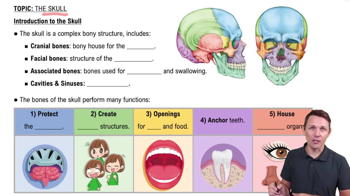
    The skull is formed by cranial bones (cranium) and facial bones.
  • What is the function of cranial bones?

    Cranial bones enclose the brain in the cranial cavity and provide sites of attachment for head and neck muscles.
  • What are the functions of facial bones?

    Facial bones form the framework of the face, contain cavities for special senses, provide openings for air and food passage, secure teeth, and anchor facial muscles for expression.
  • What are sutures in the skull?

    Sutures are joints between skull bones with a serrated, saw-tooth appearance; most skull bones are flat and firmly locked together except the mandible.
  • What are the two main parts of the cranium?

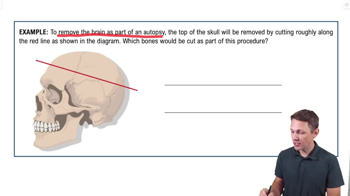
    The cranium is divided into the cranial vault (calvaria) forming the superior, lateral, and posterior skull and forehead, and the cranial base forming the inferior aspect.
  • How many cranial bones are there and name them?

    There are eight cranial bones: frontal, two parietal, occipital, two temporal, sphenoid, and ethmoid bones.
  • What is the significance of the frontal bone's supraorbital foramen?

    The supraorbital foramen allows the supraorbital artery and nerve to pass to the forehead.
  • Name the four major sutures involving the parietal bones.

    1. Coronal suture (parietal and frontal)
    2. Sagittal suture (between parietal bones)
    3. Lambdoid suture (parietal and occipital)
    4. Squamous sutures (parietal and temporal)
  • What is the foramen magnum and where is it located?

    The foramen magnum is a large opening in the occipital bone through which the brain connects with the spinal cord.
  • What are the three major regions of the temporal bone?

    1. Squamous (includes zygomatic process and mandibular fossa)
    2. Tympanic (surrounds external acoustic meatus)
    3. Petrous (houses middle and internal ear cavities)
  • What important structures pass through foramina in the petrous region of the temporal bone?

    Jugular foramen (cranial nerves), carotid canal (internal carotid artery), foramen lacerum (cartilage-covered), internal acoustic meatus and styloidmastoid foramen (cranial nerves).
  • What is mastoiditis and why is it clinically significant?

    Mastoiditis is an infection of the mastoid air cells in the mastoid process that can spread to the brain due to the thin bony plate separating them.
  • Why is the sphenoid bone called the keystone bone?

    Because it articulates with all other cranial bones, providing central support to the skull.
  • What important structure is housed in the sella turcica of the sphenoid bone?

    The pituitary gland is enclosed in the hypophyseal fossa within the sella turcica.
  • What are the three pairs of processes on the sphenoid bone?

    Greater wings, lesser wings, and pterygoid processes.
  • What is the cribriform plate and which bone contains it?

    The cribriform plate is part of the ethmoid bone; it forms the roof of the nasal cavity and floor of the anterior cranial fossa, allowing passage of olfactory nerves.
  • What is the function of the crista galli on the ethmoid bone?

    It is a triangular process that serves as the point of attachment for the brain's dura mater covering.
  • What bones form the facial skeleton?

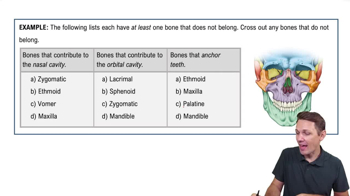
    14 bones: mandible, maxillae (2), zygomatic (2), nasal (2), lacrimal (2), palatine (2), vomer, and inferior nasal conchae (2).
  • What is unique about the mandible compared to other skull bones?

    It is the largest, strongest facial bone and the only movable skull bone.
  • What is the function of the hyoid bone?

    It acts as a movable base for the tongue and attachment site for muscles of swallowing and speech; it does not articulate with any other bone.
  • Which bones contribute to the formation of the orbits?

    Frontal, sphenoid, zygomatic, maxilla, palatine, lacrimal, and ethmoid bones.
  • What are paranasal sinuses and their functions?

    Air-filled mucosa-lined spaces in frontal, sphenoid, ethmoid, and maxillary bones that warm and humidify air, lighten the skull, and enhance voice resonance.