Skip to main content
Anatomy & Physiology
My Course
Learn
Exam Prep
AI Tutor
Study Guides
Textbook Solutions
Flashcards
Explore
Try the app
My Course
Learn
Exam Prep
AI Tutor
Study Guides
Textbook Solutions
Flashcards
Explore
Try the app
Back
Anatomy & Physiology Tissue and Cell Review
You can tap to flip the card.
Which of the following is not a type of tissue?
You can tap to flip the card.
👆
Which of the following is not a type of tissue?
Muscle
,
nervous
, and
epithelial
are types of tissue; the question is incomplete but these are all tissue types.
Track progress
Control buttons has been changed to "navigation" mode.
1/25
Recommended videos
Guided course
03:32
Map of the Lesson on Tissues
11688
views
522
rank
2
comments
Guided course
02:52
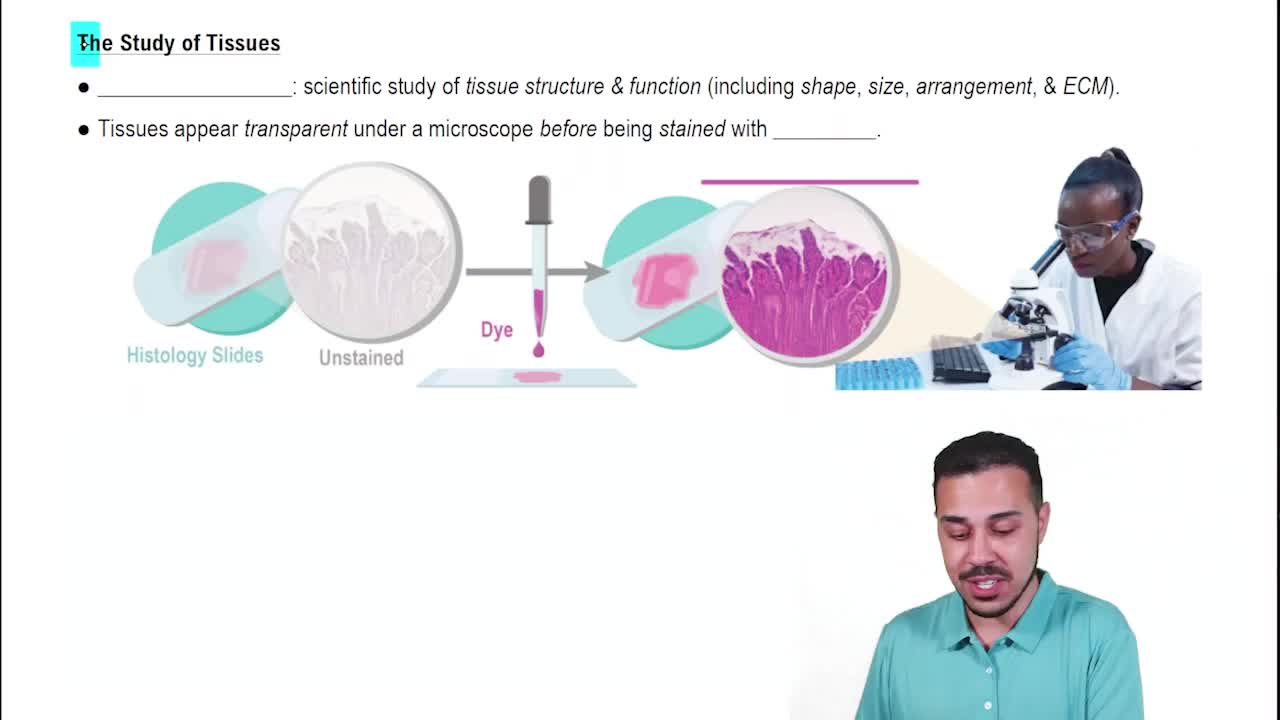
What is Histology?
11831
views
265
rank
Guided course
04:14
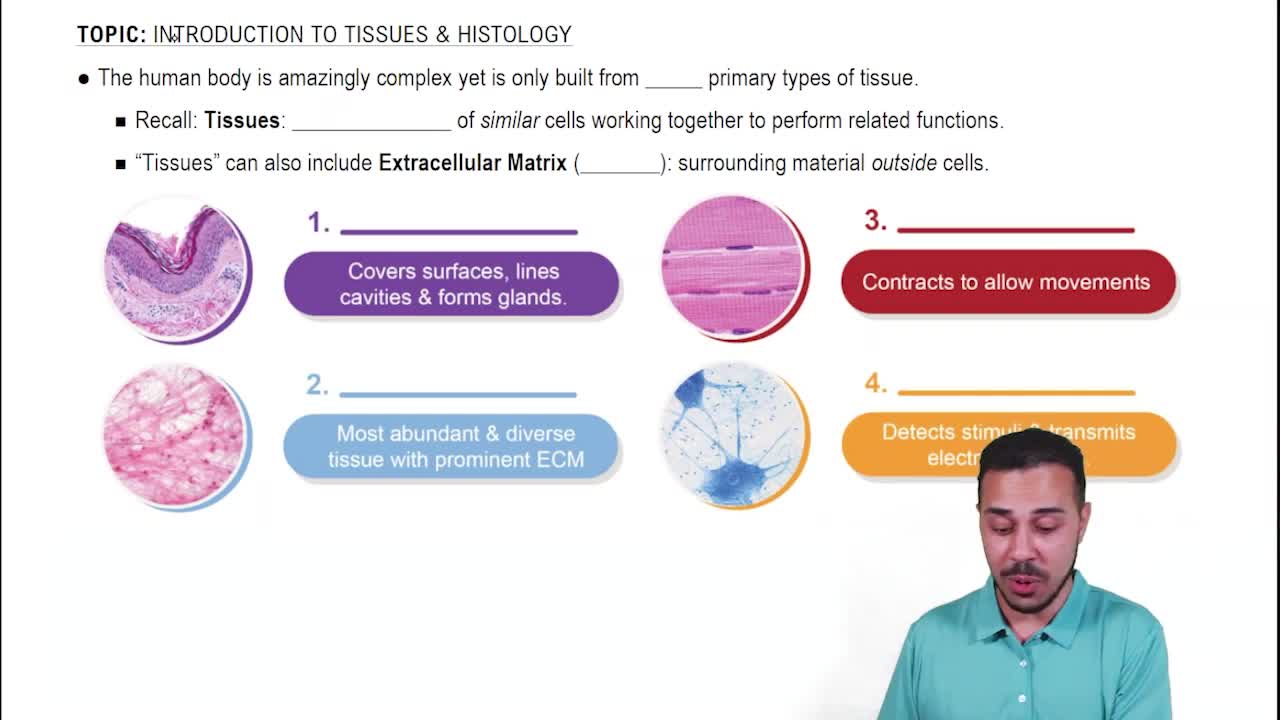
Intro to Human Tissues
19632
views
654
rank
Terms in this set (25)
Hide definitions
Which of the following is not a type of tissue?
Muscle
,
nervous
, and
epithelial
are types of tissue; the question is incomplete but these are all tissue types.
What is the process by which a less specialized cell matures into a more specialized cell?
The process is called
specialization
.
From which tissues do differentiated cells in a developing embryo derive?
They derive from
connective tissue, epithelial tissue, and muscle tissue
.
Which tissue lines body cavities exposed to the external environment?
The
mesothelium
lines body cavities exposed to the external environment.
What type of epithelial tissue has cells arranged in a single layer, tall and narrow, with nuclei near the basal side?
This describes
columnar epithelial tissue
.
Which epithelial tissue lines the interior of blood vessels?
The
endothelium
lines the interior of blood vessels.
Which epithelial tissue specializes in moving particles across its surface?
The
pseudostratified epithelium
specializes in moving particles across its surface.
Which exocrine gland stores secretion until the glandular cell ruptures?
The
holocrine gland
stores secretion until the cell ruptures.
Which exocrine gland releases its apical region and reforms?
The
apocrine gland
releases its apical region and reforms.
What are the three essential components of connective tissue?
Cells, ground substance, and protein fibers
are the three essential components.
What type of connective tissue shows cells scattered in spaces in a transparent background under a microscope?
This is characteristic of
loose connective tissue
.
Which connective tissue specializes in fat storage?
Adipose tissue
specializes in fat storage.
What type of connective tissue do ligaments contain to withstand stress?
Dense regular connective tissue
is found in ligaments.
From which germ layer do new connective tissue cells originate in adults?
They originate from the
mesoderm
.
What are the main cells found in bone?
The main cells are
osteocytes
(not listed in the question but correct), but from options,
fibroblasts
are incorrect; correct answer is
osteocytes
.
Which muscle types show striations, cylindrical cells, and multiple nuclei?
Skeletal and cardiac muscles
show these features.
From which germ layer do muscle cells (myocytes) develop?
Muscle cells develop from the
mesoderm
.
Which organelles are abundant in skeletal muscle cells?
Mitochondria and nuclei
are abundant; striations are structural features.
Which cells are responsible for transmitting nerve impulses?
Neurons
transmit nerve impulses.
Which part of the neuron carries the nerve impulse away from the cell body?
The
axon
carries impulses away from the cell body.
Which CNS cells regulate ions, neurotransmitter uptake, and contribute to the blood-brain barrier?
Astrocytes
perform these functions.
Which of the following is not a cardinal sign of inflammation?
Loss of permeability
is not a cardinal sign; redness, heat, and swelling are.
What chemical does a mast cell release in response to irritation?
Mast cells release
histamine
(not listed but correct), not collagen or hyaluronic acid.
What does atrophy refer to?
Atrophy refers to the
loss of cell size or tissue mass
.
Which lifestyle aspect cannot slow the rate of aging?
Stress
management, diet, and exercise can slow aging; stress itself cannot be ignored.
 BackBack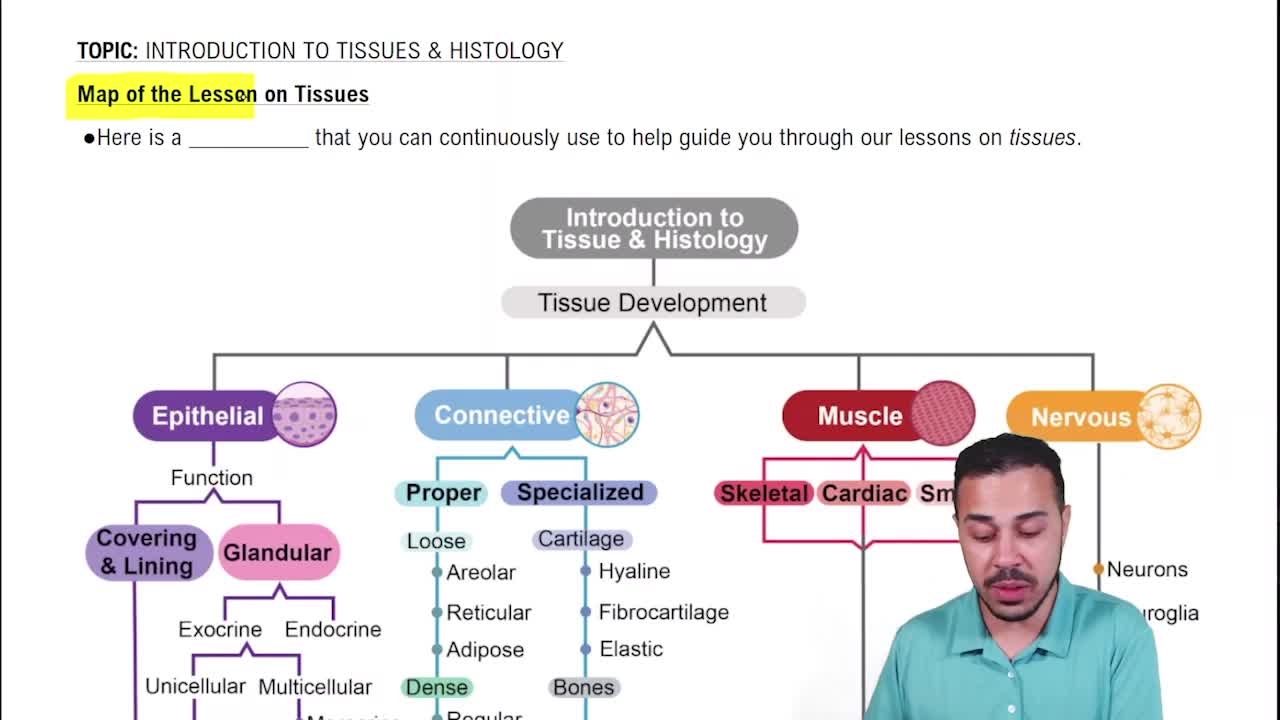
 03:32
03:32