 Back
BackAnatomy & Physiology: Tissue Structure and Function
 03:32
03:32
Terms in this set (30)
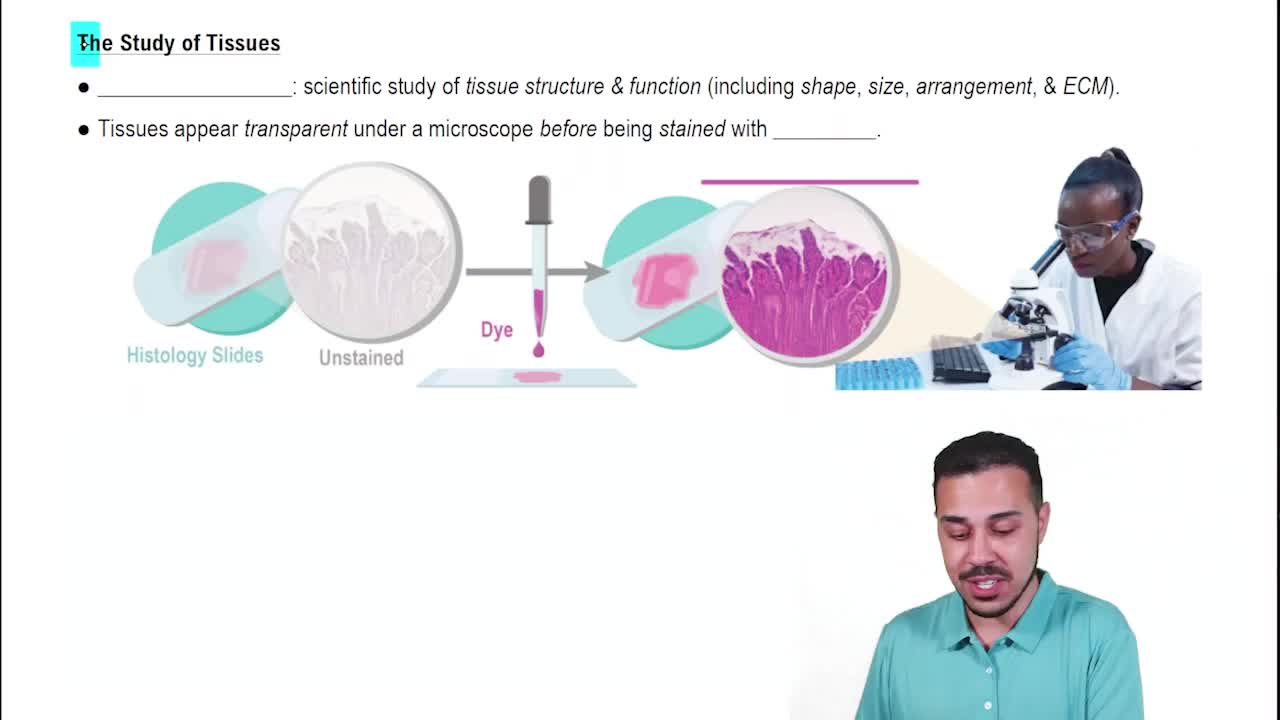
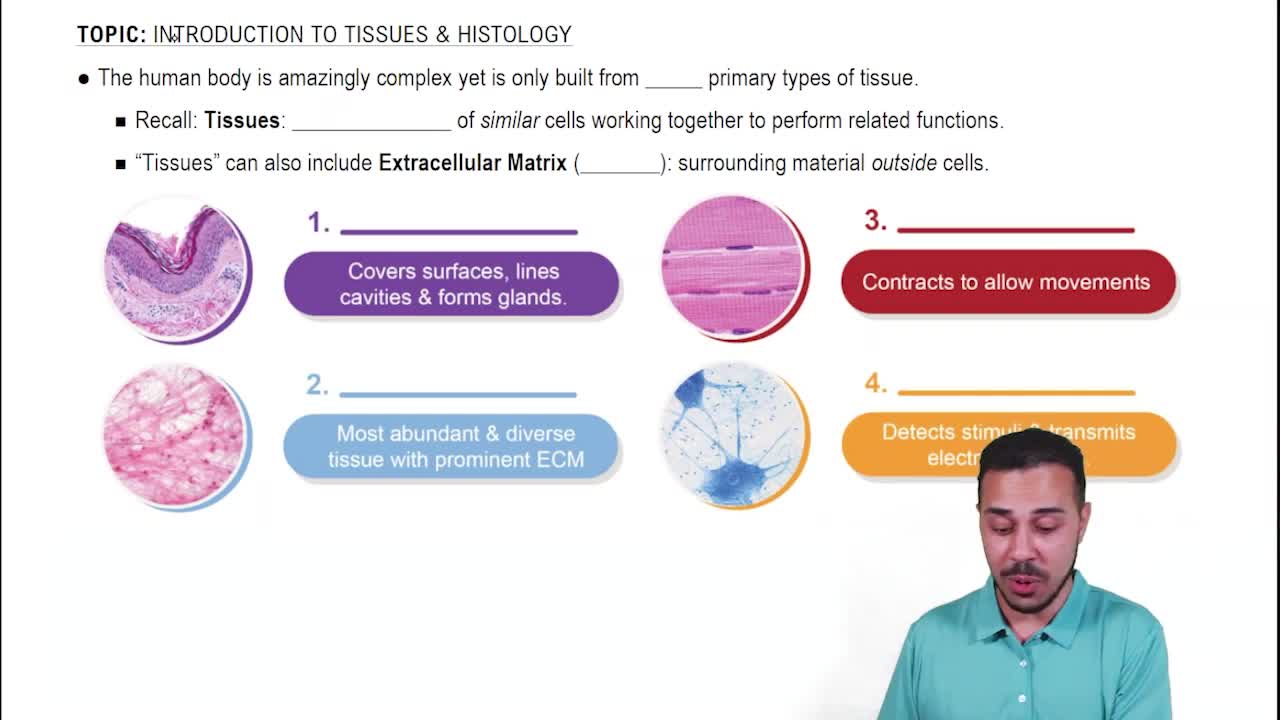
Tissue is a group of cells similar in structure that perform a common or related function.
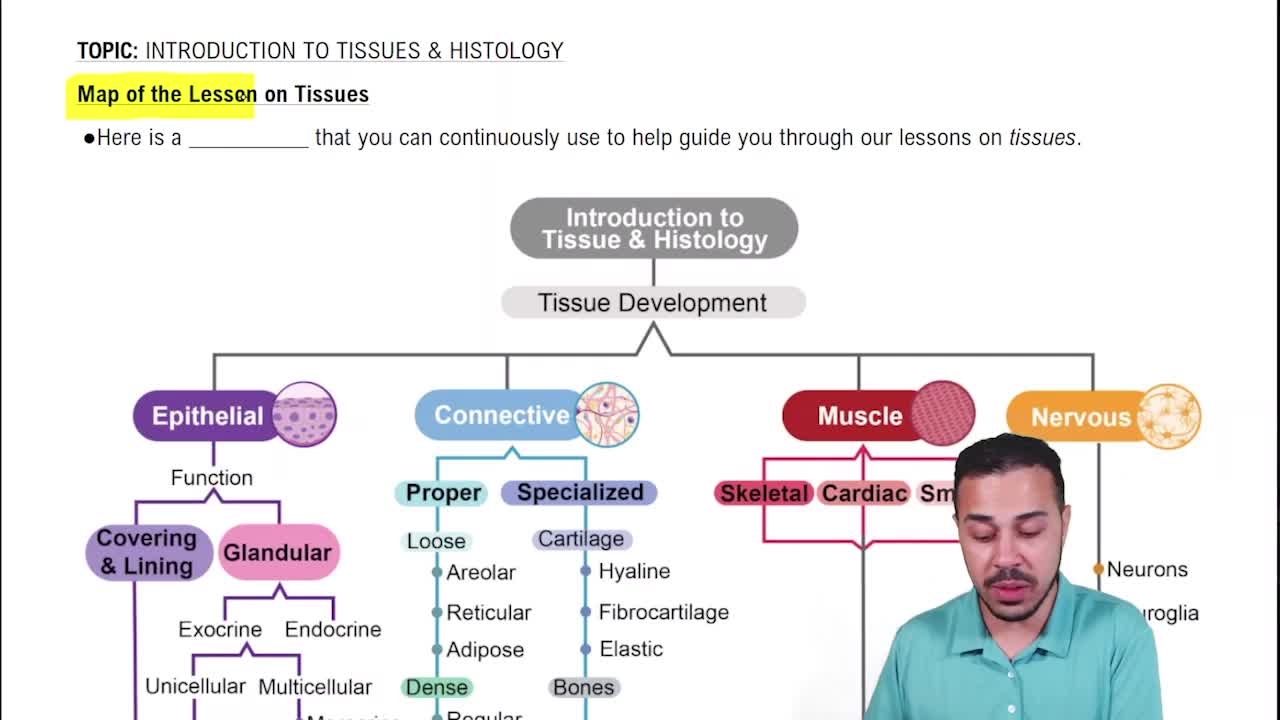
The four basic tissue types are epithelial, connective, muscle, and nervous tissue.
Protection, absorption, filtration, excretion, secretion, and sensory reception.
1. Polarity
2. Specialized contacts
3. Supported by connective tissues
4. Avascular but innervated
5. Regeneration
Polarity means cells have a top (apical surface) exposed to a cavity or surface and a bottom (basal surface) attached to underlying tissue via the basal lamina.
Covering and lining epithelia (external and internal surfaces) and glandular epithelia (secretory tissue in glands).
By layers: Simple (one layer), Stratified (multiple layers).
By shape: Squamous (flat), Cuboidal (cube-shaped), Columnar (tall column-like).
Allows materials to pass by diffusion and filtration where protection is not important; found in kidney, lungs, and lining of blood vessels.
Found in kidney tubules and gland ducts; functions in secretion and absorption.
Single layer of tall cells, often with microvilli or cilia; involved in absorption and secretion of mucus and enzymes; found in digestive tract and uterine tubes.
Single layer of cells of varying heights that appears stratified; often ciliated and involved in mucus secretion and movement; found in respiratory tract.
Protection; they have two or more layers and regenerate from basal cells.
Stratified epithelium that can stretch and change shape; found lining urinary organs like bladder and ureters.
By site of product release: endocrine (ductless, secrete hormones internally) and exocrine (secrete onto surfaces or cavities via ducts).
Single-celled glands like goblet cells that produce mucin to form mucus for protection and lubrication.
Merocrine (exocytosis), holocrine (cell ruptures), and apocrine (apex of cell pinches off).
Ground substance, fibers, and cells; ground substance and fibers form the extracellular matrix.
Collagen (strongest, tensile strength), elastic (stretch and recoil), reticular (fine branched networks).
Connective tissue proper, cartilage, bone, and blood.
Supports and binds other tissues, acts as packing material, holds interstitial fluid, and contains fibroblasts, macrophages, and fat cells.
Loose connective tissue with closely packed adipocytes; stores energy, insulates, and cushions organs.
Closely packed collagen fibers aligned parallel to resist tension in one direction; found in tendons and ligaments.
Dense regular has parallel collagen fibers for unidirectional tension; dense irregular has irregularly arranged fibers to resist tension from multiple directions.
Hyaline (most abundant, glassy), elastic (more elastic fibers, found in ear), fibrocartilage (strong, found in intervertebral discs).
Supports and protects body structures, stores fat, synthesizes blood cells, and is highly vascularized.
It consists of cells suspended in a fluid matrix (plasma) and functions in transport of nutrients, wastes, and gases.
Skeletal (voluntary, striated, multinucleated), cardiac (involuntary, striated, branched, intercalated discs), smooth (involuntary, no striations, spindle-shaped).
Neurons (generate and conduct impulses) and supporting cells (insulate and protect neurons).
Cutaneous (skin), mucous (line body cavities open to exterior), and serous (line closed ventral body cavities).
Regeneration (replacement with same tissue) and fibrosis (replacement with connective tissue scar).