Skip to main content
Anatomy & Physiology
My Course
Learn
Exam Prep
AI Tutor
Study Guides
Textbook Solutions
Flashcards
Explore
Try the app
My Course
Learn
Exam Prep
AI Tutor
Study Guides
Textbook Solutions
Flashcards
Explore
Try the app
Back
Anatomy & Physiology: Tissue Types and Characteristics
You can tap to flip the card.
What are the four primary types of body tissues?
You can tap to flip the card.
👆
What are the four primary types of body tissues?
Epithelial tissue
,
Connective tissue
,
Muscle tissue
, and
Nervous tissue
.
Track progress
Control buttons has been changed to "navigation" mode.
1/29
Recommended videos
Guided course
03:32
Map of the Lesson on Tissues
11704
views
522
rank
2
comments
Guided course
02:52
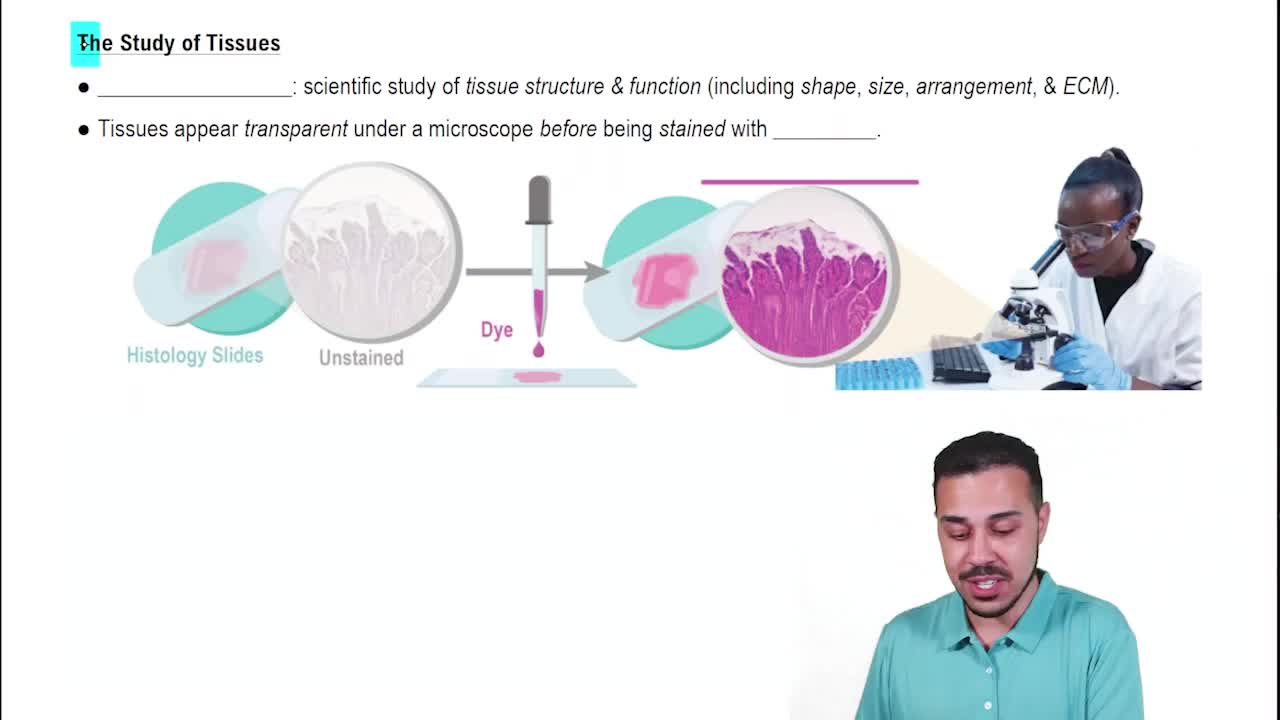
What is Histology?
11843
views
265
rank
Guided course
04:14
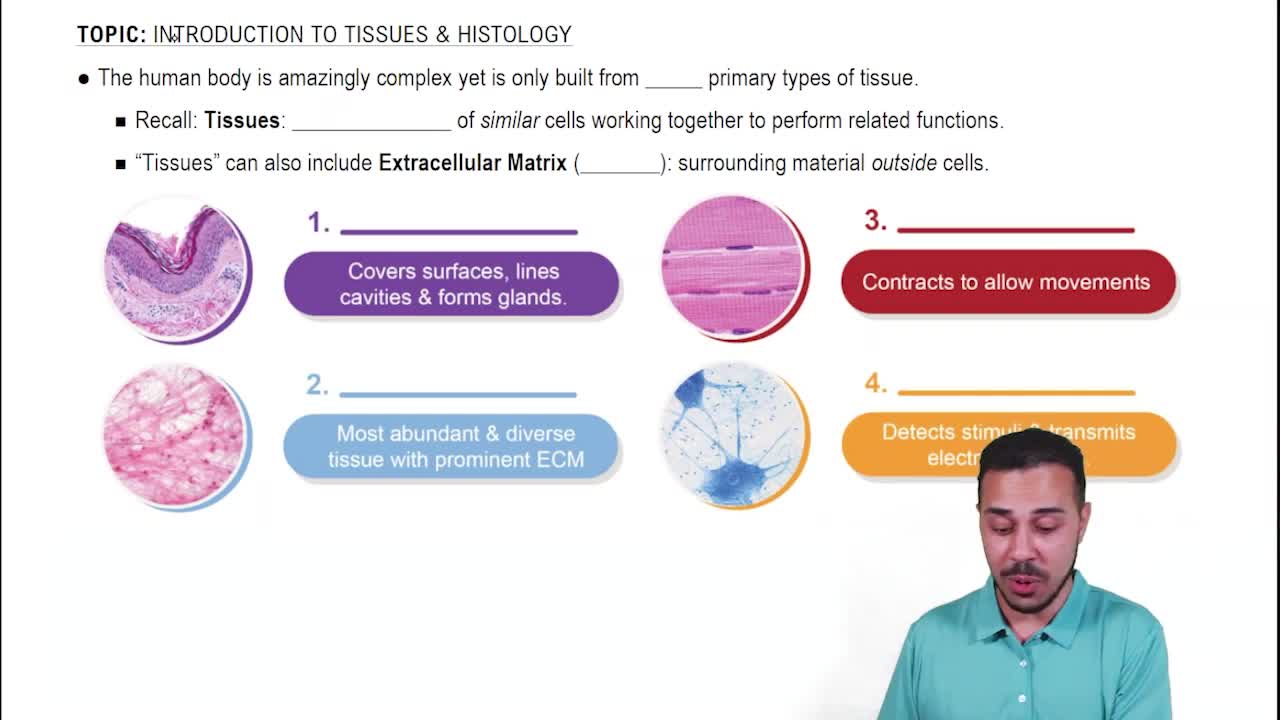
Intro to Human Tissues
19652
views
654
rank
Terms in this set (29)
Hide definitions
What are the four primary types of body tissues?
Epithelial tissue
,
Connective tissue
,
Muscle tissue
, and
Nervous tissue
.
What are the main functions of epithelial tissue?
Protection, absorption, filtration, and secretion.
What are key characteristics of epithelial tissue?
Cells fit closely together forming continuous sheets, are avascular, polarized with apical and basal surfaces, and highly regenerative.
What does it mean that epithelial tissue is polarized?
It has two distinct surfaces: the
apical surface
exposed to the exterior or cavity, and the
basal surface
resting on the basement membrane.
How is epithelial tissue classified by cell layers?
Simple
(one layer) and
Stratified
(multiple layers).
How is epithelial tissue classified by cell shape?
Squamous (flattened), Cuboidal (cube-shaped), and Columnar (column-like).
Describe simple squamous epithelium and its function.
Single layer of flattened cells; allows diffusion and filtration; found in kidney glomeruli, air sacs of lungs, and lining of blood vessels.
Where is simple cuboidal epithelium found and what is its function?
Found in kidney tubules and small gland ducts; functions in secretion and absorption.
What is the function of simple columnar epithelium?
Absorption and secretion of mucus, enzymes; ciliated type propels mucus by ciliary action.
What distinguishes stratified squamous epithelium?
Multiple layers with basal cells cuboidal or columnar and surface cells flattened; protects against abrasion; keratinized type forms skin epidermis.
What is the function of transitional epithelium?
Stretches readily to permit distension of urinary organs like bladder and ureters.
Describe pseudostratified columnar epithelium.
Single layer with nuclei at different levels; often ciliated and contains mucus-secreting goblet cells; found in respiratory tract.
What are the main functions of connective tissue?
Protection, binding tissues together, and structural support.
List connective tissue types from most fluid to most rigid.
Blood, loose connective tissue, dense connective tissue, cartilage, bone.
What is the function of blood as a connective tissue?
Transports respiratory gases, nutrients, wastes, and other substances.
Describe areolar connective tissue and its function.
Gel-like matrix with collagen, elastic fibers; wraps and cushions organs; plays role in inflammation.
What is the role of adipose tissue?
Provides reserve food fuel, insulates against heat loss, and supports/protects organs.
Where is reticular connective tissue found and what is its function?
Found in lymphoid organs; forms soft internal skeleton supporting other cells.
What is the function of dense regular connective tissue?
Attaches muscles to bones or bones to bones; withstands tensile stress in one direction.
How does dense irregular connective tissue differ in function?
Withstands tension in many directions; provides structural strength.
What is the function of dense elastic connective tissue?
Allows tissue recoil after stretching; maintains pulsatile blood flow; aids lung recoil.
Describe hyaline cartilage and its function.
Firm matrix with collagen fibers; supports and reinforces; cushions and resists compressive stress.
What is fibrocartilage and where is it found?
Matrix with thick collagen fibers; provides tensile strength and absorbs compressive shock; found in intervertebral discs.
What distinguishes elastic cartilage?
Similar to hyaline but with more elastic fibers; maintains shape with flexibility; found in ear and epiglottis.
What are the characteristics and functions of bone tissue?
Hard, calcified matrix with collagen; supports and protects; stores minerals; site of blood cell formation.
Describe skeletal muscle tissue.
Long, cylindrical, multinucleate cells with striations; voluntary movement and locomotion.
What are key features of cardiac muscle?
Branching, striated, uninucleate cells with intercalated discs; involuntary contraction to pump blood.
Describe smooth muscle tissue and its function.
Spindle-shaped cells without striations; involuntary control; propels substances through hollow organs.
What is the function of nervous tissue?
Transmits electrical signals; supports and protects neurons.
 BackBack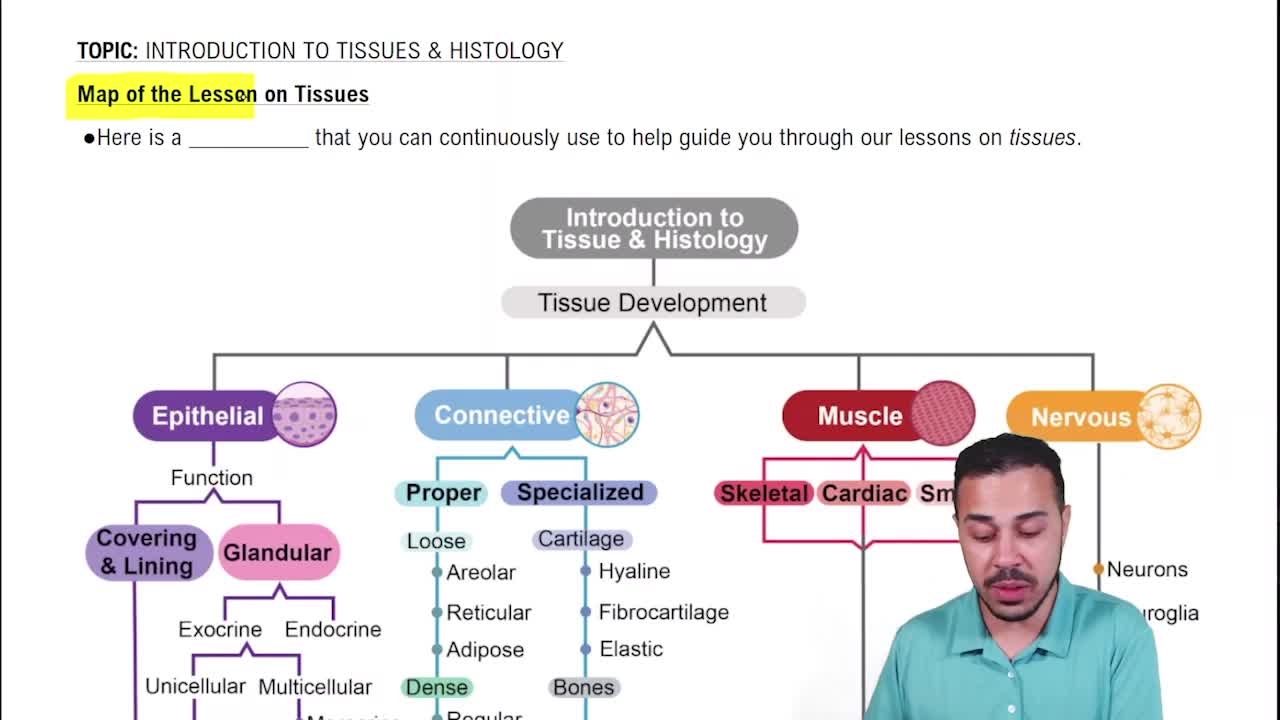
 03:32
03:32