 Back
BackAnatomy & Physiology: Tissue Types and Characteristics
 03:32
03:32
Terms in this set (30)
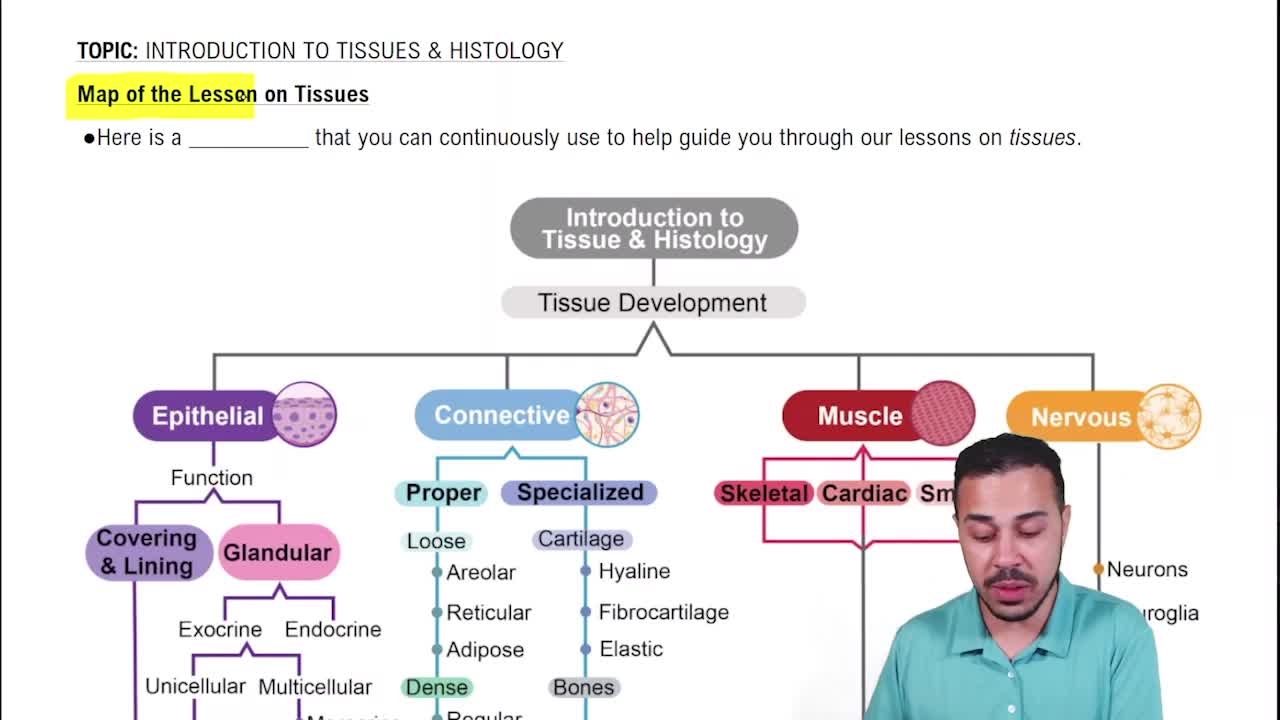
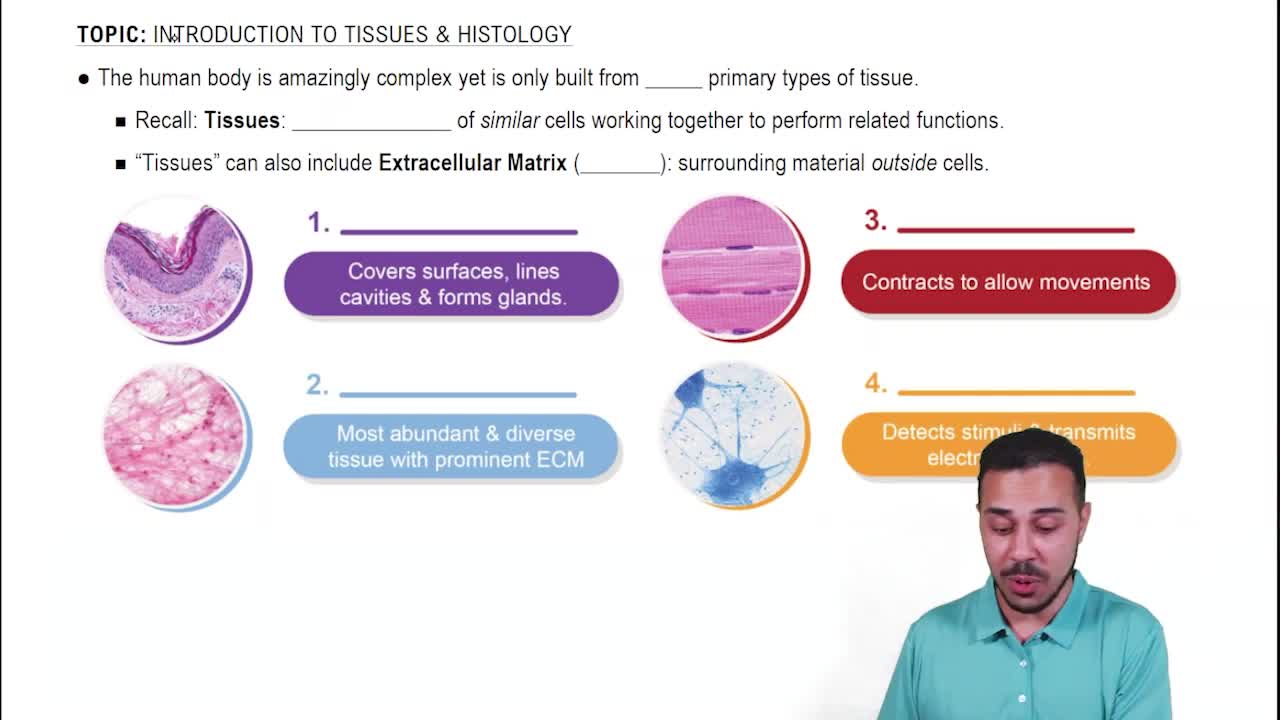
Epithelial (covering and secretion), Connective (support and attachment), Muscle (movement), Nervous (electrical impulse transmission).
Protection, absorption, filtration, excretion (waste removal), and secretion (purposeful, e.g., sweat).
Cellularity (tightly packed cells), contacts (tight junctions, desmosomes), polarity (apical surface and basement membrane), innervated, and highly regenerative.
Exposed to cavity, involved in absorption and secretion, may have microvilli or cilia.
Made of glycoproteins, acellular; consists of basal lamina (secreted by epithelial cells) and reticular lamina (made by connective tissue).
Tight junctions (water tight), gap junctions (interlocking proteins), desmosomes (resist stretching and twisting).
Layers: simple (one layer), stratified (multiple layers). Shapes: squamous (flat), cuboidal (cube-shaped), columnar (tall).
One layer of flat cells; functions in diffusion and filtration; found in endothelium (cardiovascular) and mesothelium (serous membranes).
One layer of cube cells; absorption and secretion; found in kidney tubules, salivary glands, pancreas.
One layer of column cells; functions in diffusion, secretion, protection, absorption; may have microvilli and goblet cells; located in digestive and respiratory tracts.
Appears stratified but is single-layered; found in respiratory tract and male reproductive tract; functions in mucus production and protection.
Multiple layers of flat cells; main function is protection; keratinized type waterproofs (skin), non-keratinized stays moist (mouth, esophagus).
Ability to stretch; apical cells change shape; found in urinary bladder, ureters, urethra; allows holding changing fluid volumes.
Exocrine glands have ducts and secrete externally; endocrine glands are ductless and secrete hormones internally.
Merocrine (exocytosis, no cell damage), holocrine (cells burst), apocrine (loss of cytoplasm and product).
Protection, support, insulation, energy reserves, and transportation.
Ground substance (amorphous matrix), fibers (collagen, elastic, reticular), and cells (fibroblasts, adipocytes, macrophages).
Loose connective tissue (areolar, adipose, reticular) and dense connective tissue (regular and irregular).
Flexible, tough, withstands tension and compression, avascular, cells called chondrocytes, slow repair.
Hyaline (firm support), elastic (flexible), fibrocartilage (strong, resists pressure).
Supports soft tissue, stores fat, synthesizes blood; osteoblasts deposit calcium salts; well vascularized.
Mucous (line cavities open to outside), serous (line closed cavities), cutaneous (skin), synovial (joint cavities).
Voluntary, striated, long cylindrical multinucleate cells, movement by pulling, cannot divide but satellite cells regenerate.
Involuntary, striated, branched short cells, uni-nucleate, intercalated discs, limited repair ability.
Involuntary, no striations, spindle-shaped cells, uni-nucleate, found in walls of hollow organs.
Brain, spinal cord, nerves; neurons conduct electrical impulses; neuroglia support cells.
Regeneration (replacement with same tissue) and fibrosis (scar tissue formation).
Inflammation (clotting and immune response), organization (restoring blood flow, granulation tissue), regeneration or fibrosis.
Epithelial, bone, areolar CT, dense irregular CT, blood-forming tissue.
Cardiac muscle and nervous tissue (brain and spinal cord), replaced by scar tissue.