 Back
BackAnatomy & Physiology: Tissue Types and Characteristics
 03:32
03:32
Terms in this set (36)
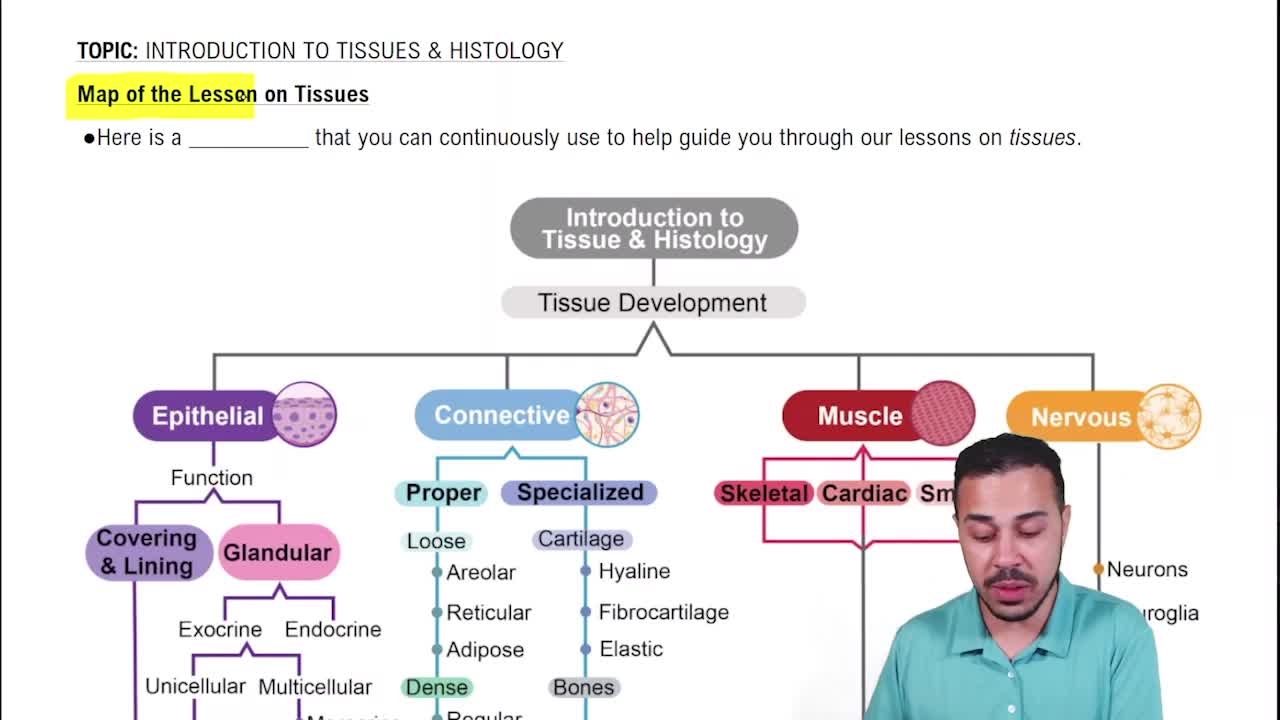
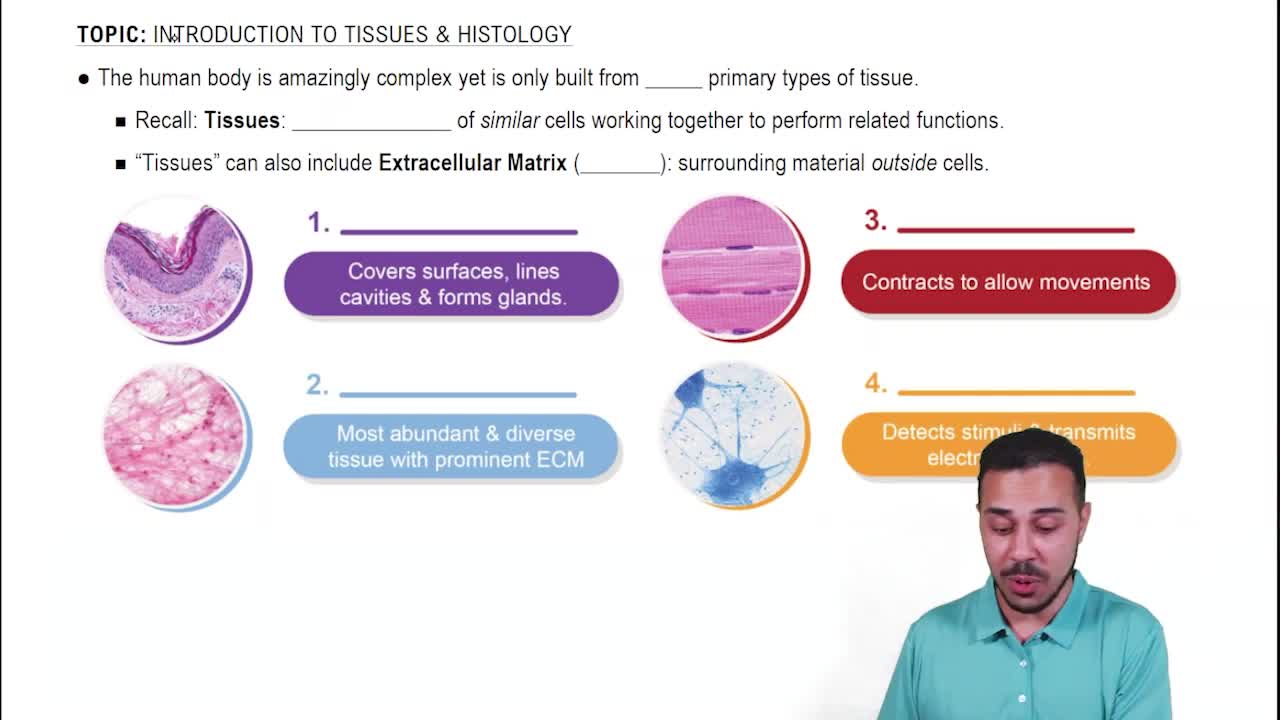
1. Epithelial tissue
2. Connective tissue
3. Muscle tissue
4. Nervous tissue
The basement membrane attaches epithelial tissue to underlying connective tissue.
Avascular means epithelial tissue has no blood vessels.
Epithelial tissue may contain cilia to move substances across the surface.
Microvilli increase absorption in epithelial tissue.
Simple = one layer of cells
Stratified = more than one layer of cells
Squamous - thin, flat, irregular
Cuboidal - cube-shaped
Columnar - rectangular columns
One layer of cells that are thin and flat.
Function: diffusion and filtration.
Location: air sacs of lungs, lining of blood vessels.
One layer of cube-shaped cells.
Function: secretion and absorption.
Location: kidney tubules, glands.
One layer of tall, rectangular cells with nuclei in basal position.
Microvilli increase surface area for absorption.
Multiple layers of cells that are thin and flat at the surface.
Areas subject to abrasion like skin, mouth, esophagus.
One layer with nuclei at different levels giving a false appearance of multiple layers.
Cilia sweep materials across the surface.
Cells change shape between cuboidal and squamous.
Function: allows stretching.
Location: urinary bladder.
Cells specialized for secretion.
Endocrine glands secrete hormones into blood.
Exocrine glands secrete onto body surfaces or cavities.
Connects structures together and serves as structural support.
Cells, fibers, and ground substance.
Collagen fibers, elastic fibers, reticular fibers.
Fills space between cells and surrounds fibers; can be fluid, gel, or solid.
Binds skin to underlying organs; fibers arranged loosely; contains collagen and elastic fibers.
Function: stores fat for energy and insulation.
Location: under skin, around organs.
Bundles of collagen fibers arranged parallel; withstands pulling along fiber length.
Tendons (muscle to bone) and ligaments (bone to bone).
Collagen fibers arranged irregularly in multiple directions; withstands pulling in many directions.
Contains chondrocytes in lacunae; avascular; types include hyaline, elastic, fibrocartilage.
Bone contains mineral salts in addition to collagen fibers.
Osteon, consisting of concentric rings called lamellae.
Cells are long, cylindrical, multinucleated with visible striations.
Cells are spindle-shaped with one nucleus and no striations.
Cells are branched, striated, with one nucleus; connected by intercalated discs.