 Back
BackAnatomy & Physiology Ultimate Exam Study Guide
 02:29
02:29
Terms in this set (24)
Skeletal muscle (e.g., Biceps brachii) generates heat for thermoregulation and provides locomotion and posture.
Skin (Epidermis/Dermis) synthesizes Vitamin D and acts as a physical barrier against pathogens and water loss.
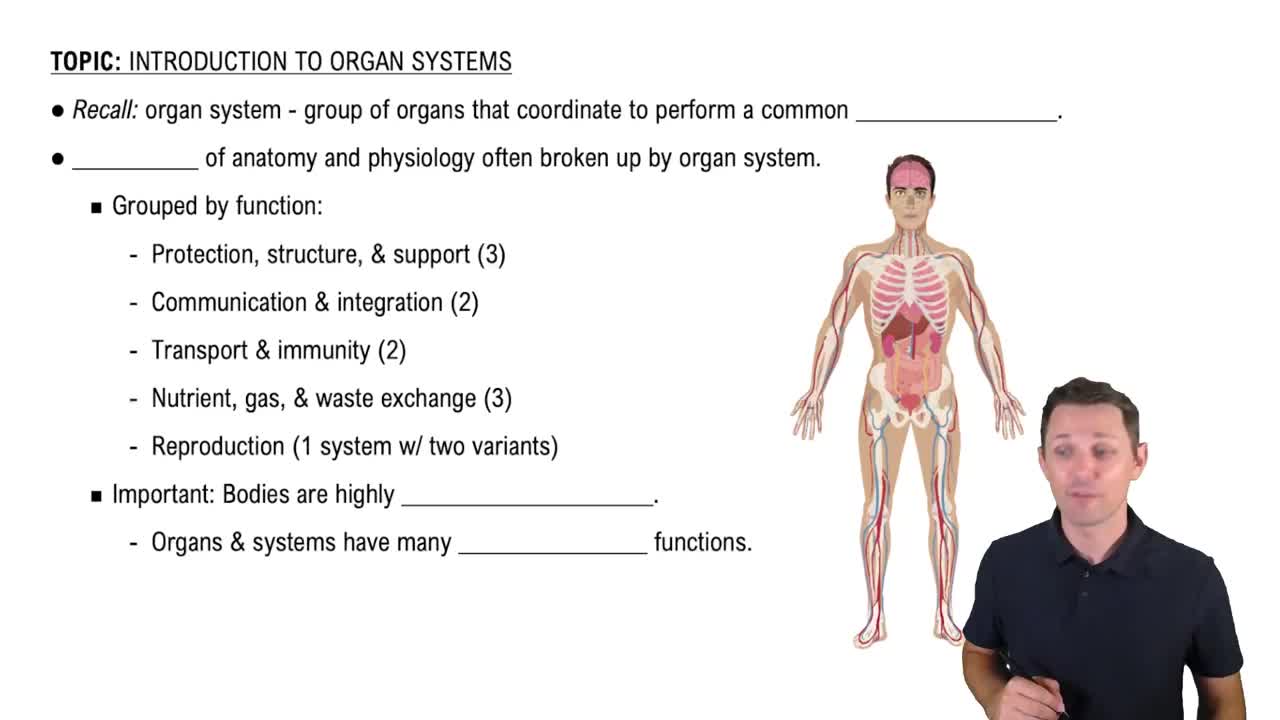
Atom → Molecule → Organelle → Cell → Tissue → Organ → Organ System → Organism
Standing erect, facing forward, feet flat and slightly apart, upper limbs at sides, palms facing forward (supinated).
Cut parallel to the long axis, separating the body into left and right portions.
Phospholipids form the lipid bilayer; Cholesterol stabilizes membrane fluidity across temperatures.
Hydrophilic heads face extracellular and cytoplasmic fluids; Hydrophobic tails form the membrane interior, repelling water.
Small, non-polar gases like \(O_2\) and \(CO_2\), and lipids pass directly through the lipid bilayer.
Interlocking membrane proteins fuse cells to prevent water and solute leakage between cells; found in stomach and urinary bladder linings.
Biconcave disc shape, lacks nucleus and organelles, increasing surface area for gas diffusion and flexibility through capillaries.
Interphase: cell growth and DNA replication; Mitosis: nuclear division and cytokinesis.
Cancer results from mutations that bypass cell cycle checkpoints, preventing apoptosis and causing uncontrolled cell division.
Connective, Epithelial, Muscular, and Nervous tissues.
Protection, permeability control, sensation, and specialized secretions.
Produce keratin, a fibrous protein that strengthens and waterproofs the skin.
Located in the Stratum Basale; produce melanin to protect DNA from UV damage by shading nuclei.
Protection, thermoregulation, excretion, sensation, Vitamin D3 synthesis, and blood reservoir.
Central (Haversian) canal surrounded by concentric lamellae of mineralized matrix with osteocytes in lacunae connected by canaliculi.
~2/3 inorganic minerals provide hardness; ~1/3 collagen fibers provide flexibility and tensile strength.
Hyaline cartilage template is replaced by bone; chondrocytes hypertrophy and die, osteoblasts deposit bone matrix forming primary ossification center.
Outer fibrous layer (dense irregular CT), inner synovial membrane (loose areolar CT), articular cartilage (hyaline), and synovial fluid.
Bone surface fit, number and arrangement of ligaments, and muscle tone (most vital).
Flexion decreases the angle between bones; extension increases the angle; both occur in the sagittal plane.
Supination rotates radius parallel to ulna (palm up); pronation rotates radius across ulna (palm down).