Skip to main content
Anatomy & Physiology
My Course
Learn
Exam Prep
AI Tutor
Study Guides
Textbook Solutions
Flashcards
Explore
Try the app
My Course
Learn
Exam Prep
AI Tutor
Study Guides
Textbook Solutions
Flashcards
Explore
Try the app
Back
Anatomy & Physiology: Urinary, Digestive, Respiratory, and Metabolic Systems
You can tap to flip the card.
Portion of the kidney that delivers urine to the ureter
You can tap to flip the card.
👆
Portion of the kidney that delivers urine to the ureter
Renal pelvis
Track progress
Control buttons has been changed to "navigation" mode.
1/42
Recommended videos
0:54
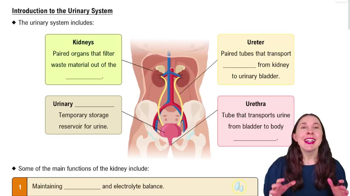
Introduction to the Urinary System Example 1
5780
views
157
rank
2:57
The Urinary System
7699
views
227
rank
2
comments
Terms in this set (42)
Hide definitions
Portion of the kidney that delivers urine to the ureter
Renal pelvis
Epithelium type composing the urinary bladder
Transitional epithelium
Outer layer of the kidney located just deep to the fibrous capsule
Renal cortex
Order of blood flow through the kidney vessels
Renal artery, segmental artery, interlobar artery, arcuate artery, interlobular artery, afferent arteriole, glomerulus, efferent arteriole
Functional and structural unit of the kidney
Nephron
Components of the renal corpuscle
Glomerulus and Bowman's capsule
Location of renal pyramids in the kidney
Medulla
End point of the nephron
Collecting duct
Muscular organ that temporarily stores urine
Urinary bladder
Normal pH range of urine
4.6 to 8.0
Single duct that drains urine from the bladder out of the body
Urethra
Cause of elevated specific gravity in urine
Dehydration
Direction of urine flow from formation to exiting the kidney
Cortex → medulla → renal pelvis → ureter
Urine color in a healthy individual
Light yellow to amber
Strong transparent covering that encases the kidney
Fibrous capsule
Test result indicating diuretic use
Low specific gravity of urine
Cells producing hydrochloric acid in the stomach
Parietal cells
Hormone that stimulates increased acid secretion in the stomach
Gastrin
Enzyme that digests proteins in the stomach
Pepsin
Phase of gastric activity when chyme enters the duodenum
Intestinal phase
Small intestine segment receiving chyme from the stomach
Duodenum
Modification of the small intestine that creates a brush border
Microvilli
Valve preventing backflow from large intestine to small intestine
Ileocecal valve
Hormone released by the duodenum in response to acids and lipids
Secretin
Hormone released by the duodenum in response to lipids and proteins
Cholecystokinin (CCK)
Cells composing liver lobules
Hepatocytes
Liver secretion responsible for emulsification of lipids
Bile
Enzyme catalyzing carbohydrate digestion in the mouth
Salivary amylase
Final electron acceptor in the electron transport chain
Oxygen
Sum of all biochemical reactions in the body
Metabolism
Process that splits glucose into two molecules in the cytosol
Glycolysis
Net ATP produced from glycolysis
2 ATP
Waste product from amino acid catabolism
Urea
Hormone that influences hydrogen ion concentration in kidney filtrate
Aldosterone
Primary role of the phosphate buffer system
Buffer intracellular fluid (ICF)
Volume remaining in lungs after forced expiration
Residual volume
Most abundant extracellular cation
Sodium ion
Effect of hypotonic solution on cells
Cells gain water and swell
Cause of respiratory acidosis
Hypoventilation
Law stating each gas in a mixture exerts its own pressure
Dalton's law
Relationship between lung volume and intrapulmonary pressure during inspiration
Lung volume increases and intrapulmonary pressure decreases
Type of alveolar cell that produces surfactant
Type II alveolar cells
 BackBack
 0:54
0:54