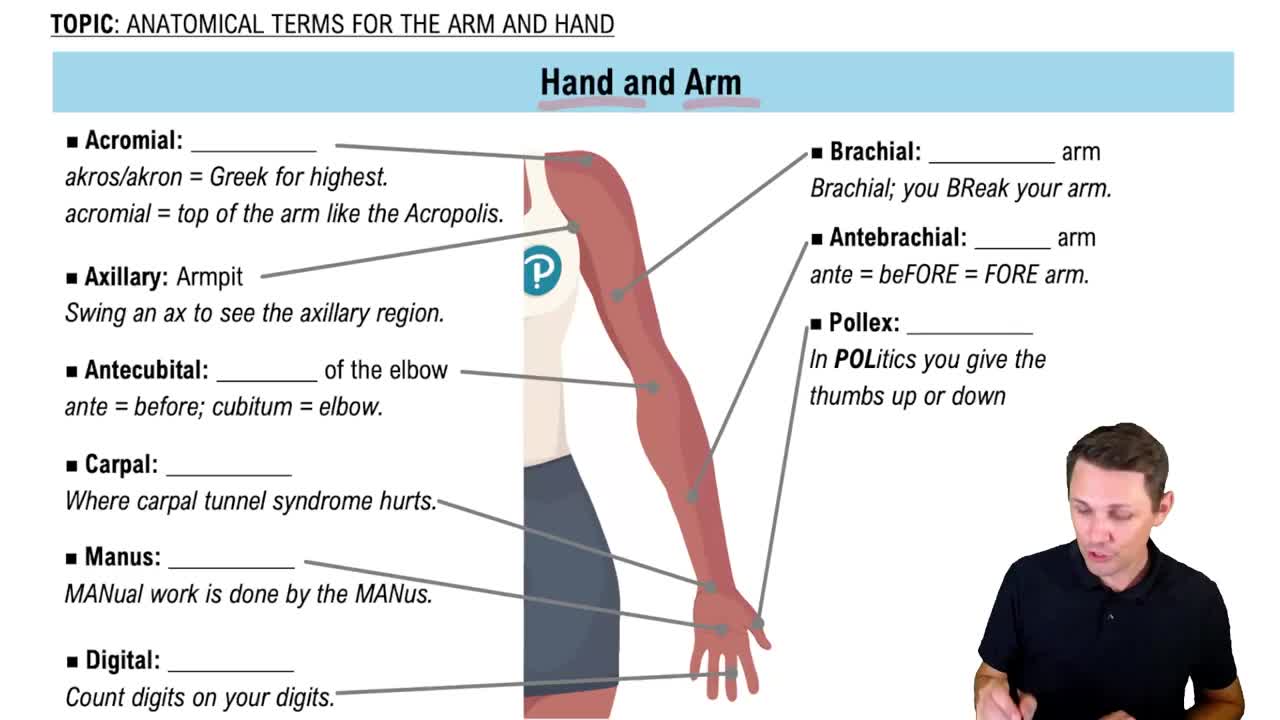
The pectoral girdle consists of the clavicle (collarbone) and the scapula (shoulder blade).
What is the function of the clavicle's medial and lateral attachments?
The medial attachment connects the clavicle to the manubrium of the sternum; the lateral attachment connects the clavicle to the scapula, forming the pectoral girdle.
How can you distinguish the anterior and posterior views of the scapula?
The posterior view shows the scapular spine, a prominent ridge; the anterior view is smooth and flat without the spine.
Name the three borders of the scapula.
The scapula has a superior border (top), medial border (closest to the spine), and lateral border (closest to the arm).
What are the three angles of the scapula?
The scapula has a superior angle (top), inferior angle (bottom), and a lateral angle near the glenoid cavity.
What is the function of the scapula's coracoid process and acromion process?
Both are muscle attachment sites; the acromion also connects to the clavicle to form the pectoral girdle.
What muscles sit in the scapular fossae?
The rotator cuff muscles occupy the subscapular, supraspinous, and infraspinous fossae, aiding shoulder and arm movement.
How many bones are in the upper extremity on one side?
There are 30 bones in the upper extremity: 1 humerus, 2 forearm bones (radius and ulna), 8 carpals, 5 metacarpals, and 14 phalanges.
What are the two epiphyses of a long bone like the humerus?
The proximal epiphysis (near the shoulder) and the distal epiphysis (near the elbow).
What is the function of the head of the humerus?
The smooth, round head articulates with the scapula's glenoid cavity to form the shoulder joint.
What are the greater and lesser tubercles on the humerus?
They are rough projections for muscle attachment; the greater tubercle is larger and visible posteriorly, the lesser is smaller.
Why is the metaphysis of the humerus called the surgical neck?
It is the common site of fractures where the diaphysis meets the epiphysis.
What are the condyles and epicondyles of the humerus?
Condyles are smooth projections forming joints (capitulum and trochlea); epicondyles are rough projections for muscle attachment.
How do you identify the medial and lateral epicondyles of the humerus?
The medial epicondyle is on the same side as the humerus head; the lateral epicondyle is on the opposite side.
What bones make up the forearm?
The forearm consists of the radius (lateral, thumb side) and the ulna (medial, pinky side).
What is the unique movement of the radius and ulna?
They can cross over each other during pronation, forming an X shape when palms face down.
How can you distinguish the radius from the ulna by their proximal ends?
The radius has a flat, round radial head; the ulna has a claw-shaped trochlear notch.
What is the function of the olecranon process of the ulna?
It is the bony projection felt at the back of the elbow and a site for muscle attachment.
What is the radial notch of the ulna?
An indentation where the radial head fits, allowing articulation between radius and ulna.
What are the names and functions of the fossae on the distal humerus?
The radial fossa accepts the radial head; the coronoid fossa accepts the ulna's coronoid process; the olecranon fossa accepts the ulna's olecranon during elbow extension.
What bones form the pelvic girdle?
The pelvic girdle is formed by the coxal bones (ilium, ischium, pubis) and the sacrum (axial bone).
What is the pubic symphysis?
A fibrocartilage disc where the two pubis bones meet anteriorly, allowing slight movement.
What type of bone is the coxal bone and its components?
The coxal bone as a whole is irregular, but its three fused parts (ilium, ischium, pubis) are flat bones.
What is the greater sciatic notch and its significance?
A large indentation on the posterior coxal bone where the sciatic nerve passes; it helps distinguish anterior from posterior.
What is the ischial tuberosity?
The thick, weight-bearing part of the ischium that you sit on; also a muscle attachment site.
What is the acetabulum?
A deep fossa where the ilium, ischium, and pubis fuse; it articulates with the femur head to form the hip joint.
What is the obturator foramen?
The largest foramen in the body, a passageway for blood vessels and nerves to the lower limb.
How many bones are in the lower extremity on one side?
There are 29 bones: femur, tibia, fibula, 7 tarsals, 5 metatarsals, and 14 phalanges.
What is the largest and strongest bone in the body?
The femur, which forms the thigh bone.
What are the trochanters of the femur?
Rough projections for muscle attachment: the greater trochanter (larger) and lesser trochanter (smaller).
What is the patellar surface of the femur?
Anterior indentation where the patella (kneecap) sits.
How do you identify medial and lateral condyles and epicondyles of the femur?
The side of the femur head is medial; condyles and epicondyles on that side are medial, opposite side is lateral.
What is the difference between the tibia and fibula in terms of weight bearing?
The tibia is weight-bearing and larger; the fibula is smaller and mainly for muscle attachment.
What are the malleoli of the tibia and fibula?
The medial malleolus is on the tibia; the lateral malleolus is on the fibula; both form ankle projections.
Which tarsal bones are weight bearing?
The talus, calcaneus, navicular, and medial and intermediate cuneiforms bear weight.
Which tarsal bones are non-weight bearing?
The cuboid and lateral cuneiform are generally non-weight bearing.
How are the bones of the fingers and toes named?
By location (distal, intermediate, proximal), bone type (phalange), and digit number (1-5). The thumb and big toe lack intermediate phalanges.
 Back
Back
 02:05
02:05