Skip to main content
Anatomy & Physiology
My Course
Learn
Exam Prep
AI Tutor
Study Guides
Textbook Solutions
Flashcards
Explore
Try the app
My Course
Learn
Exam Prep
AI Tutor
Study Guides
Textbook Solutions
Flashcards
Explore
Try the app
Back
Axial Skeleton Anatomy & Physiology
You can tap to flip the card.
Axial skeleton
You can tap to flip the card.
👆
Axial skeleton
The part of the skeleton forming the long axis of the body, including the skull, vertebral column, and rib cage.
Track progress
Control buttons has been changed to "navigation" mode.
1/23
Recommended videos
Guided course
4:50
Skeletal System
13525
views
450
rank
Terms in this set (23)
Hide definitions
Axial skeleton
The part of the skeleton forming the long axis of the body, including the skull, vertebral column, and rib cage.
Appendicular skeleton
The part of the skeleton consisting of the limbs and girdles that attach them to the axial skeleton.
Bones of the axial skeleton
Includes the skull bones, vertebrae of the vertebral column, ribs, and sternum.
Cranial bones
Bones that form the protective case around the brain.
Facial bones
Bones that form the framework of the face.
Major sutures of the skull
Includes the coronal, sagittal, lambdoid, and squamous sutures.
Paranasal sinuses
Air-filled cavities in certain skull bones that lighten the skull and enhance voice resonance.
Vertebral column functions
Supports the head and trunk, protects the spinal cord, and provides attachment points for ribs and muscles.
Spinal curvatures
Curves in the vertebral column that increase strength, flexibility, and shock absorption.
Intervertebral discs
Pads of fibrocartilage between vertebrae that act as shock absorbers and allow movement.
Typical vertebra anatomy
Consists of a vertebral body, vertebral arch, and several processes for muscle attachment and articulation.
Cervical vertebrae characteristics
Small body, large vertebral foramen, transverse foramina, and bifid spinous processes.
Thoracic vertebrae characteristics
Medium-sized body, long spinous process, and facets for rib articulation.
Lumbar vertebrae characteristics
Large body, short and thick spinous process, designed to bear more weight.
Intervertebral foramina
Openings between vertebrae through which spinal nerves exit.
Vertebral canal
The central passage formed by vertebral foramina that houses the spinal cord.
Bony thorax components
Includes the sternum, ribs, and thoracic vertebrae.
Rib anatomy
Consists of a head, neck, tubercle, and shaft.
True ribs
Ribs 1-7 that attach directly to the sternum via costal cartilage.
False ribs
Ribs 8-12 that do not attach directly to the sternum; ribs 8-10 attach via cartilage of rib 7.
Floating ribs
Ribs 11-12 that have no anterior attachment to the sternum.
Fetal skull fontanels
Soft spots on a baby's skull where bones have not yet fused, allowing brain growth and easier birth.
Advantages of fontanels
Permit skull flexibility during birth and allow rapid brain growth during infancy.
 BackBack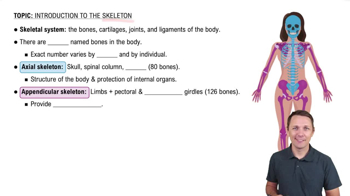
 4:50
4:50